

Traditional old sayings and phrases are falling out of use

Pip pip – you’re ready for the Knackers Yard! Traditional old sayings and phrases are falling out of use as Britons confess they no longer use or even UNDERSTAND them

Terms at risk include ‘pearls before swine’ and ‘nailing your colours to the mast’Research came from a survey of 2,000 adults, aged between 18 and 50Perspectus Global, who commissioned poll, said it shows how language evolves


<!–

<!–

<!–<!–

<!–

(function (src, d, tag){
var s = d.createElement(tag), prev = d.getElementsByTagName(tag)[0];
s.src = src;
prev.parentNode.insertBefore(s, prev);
}(“https://www.dailymail.co.uk/static/gunther/1.17.0/async_bundle–.js”, document, “script”));
<!–

DM.loadCSS(“https://www.dailymail.co.uk/static/gunther/gunther-2159/video_bundle–.css”);


<!–

Some of the English language’s most traditional old sayings and phrases are falling out of use, with many Britons now no longer using or even understanding then, according to a survey.

The national research, carried out among 2,000 adults found the top 50 expressions most at risk of never being uttered again. 

Top of the list came the term casting ‘pearls before swine’ – meaning you are wasting your time by offering something that is helpful or valuable to someone who does not appreciate it –  with 78 per cent of people saying they never use it in conversation.

It originates from the sixth verse of the seventh chapter of the Gospel of Matthew in the New Testament of the bible, as translated by William Tyndale in 1526. 

That verse reads: ‘Geve not that which is holy to dogges nether cast ye youre pearles before swyne lest they treade them vnder their fete and ye other tourne agayne and all to rent you.’ 

The phrase went on to be repeated by some of the most renowned British writers including Shakespeare and Dickens.

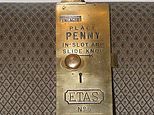
‘Spend a penny’, meaning to need to use the lavatory, refers to the use of coin operated locks on public toilets in the 19th century

‘Mad as a hatter’ is also on the list, and though popularised through the Mad Hatter character in Lewis Carroll’s Alice in Wonderland, the origin of the phrase pre-dates it

The study found the majority (71 per cent) of modern Brits have never used the saying, ‘nailing your colours to the mast’ to mean, declaring their beliefs openly, a phrase which dates back to the 17th century, when nautical battle colours – or flags – were lowered as a mark of submission. 

It was also the custom in naval warfare to direct one’s cannon fire at the opponent’s ship’s mast, thus disabling it. 

If all of a ship’s masts were broken the captain usually had no alternative but to surrender. 

If the captain decided to fight on this was marked by hoisting the colours on the remnants of the ship’s rigging, that is, by ‘nailing his colours to the mast’. 

Meanwhile, the research also found that saying goodbye with a cheery ‘pip pip’ might gain you bemused stares from 70 per cent of Brits under the age of fifty.

Its first known use was in 1907 and is thought to have originated by imitating the sound of a horn. 

And you may ‘know your onions’ – meaning you are experienced or knowledgeable on a subject – however 68 per cent of Brits have never heard of the phrase, or use it in conversation.

In terms of its origin, some suggest it comes from British lexicographer and grammarian C T Onions, who worked on the Oxford English Dictionary in the 1960s.

However, it is also claimed that its birth came four decades earlier, being published for the first time in Harper’s Bazaar magazine in the United States in 1922. 

It was one of a set of such phrases, all with the sense of knowing one’s stuff, or being highly knowledgeable in a particular field, that circulated in the 1920s. 

Others were to know one’s oats, to know one’s oil, to know one’s apples, to know one’s eggs, and even to know one’s sweet potatoes. 

‘A nod is as good as a wink’, meaning that you don’t need to be blatant with a signal if someone is willing to carry out a task, is no longer relevant for 66 per cent of Brits.

This saying dates back to the 16th century, with the longer version of phrase being: ‘A nod is as good as a wink to a blind horse.’

Even the classic proverb ‘a stitch in time saves nine’ is gobbledygook to 60 per cent of those who took part in the study.

Other classics include ‘spend a penny’, meaning to need to use the lavatory, which refers to the use of coin operated locks on public toilets which were first introduced outside the Royal Exchange in London in the 1850s.

However, its first recorded citation wasn’t until 1945, when it appeared in H. Lewis’s Strange Story. 

‘Mad as a hatter’ is also on the list, and though popularised through the Mad Hatter character in Lewis Carroll’s Alice in Wonderland, the origin of the phrase pre-dates it. 

Mercury was historically used in the making of hats and was known to have affected the nervous systems of hatters, causing them to tremble and appear insane. 

The use of mercury compounds in 19th century hat making and the resulting effects are well-established, with mercury poisoning still known today as ‘Mad Hatter’s disease’. 

A ‘curtain twitcher’ is a nosy person who watches his or her neighbours, typically from a curtained window

‘Knackers yard’ is also on the list – which dates back to the 19th century and refers to places where old and injured animals, usually horses – were killed

‘Knackers yard’ is also on the list – which dates back to the 19th century and refers to places where old and injured animals, usually horses, were killed.

‘Knackers’ was also once used to mean castanets, which then saw it become a slang term for testicles. This was used by James Joyce in his 1922 classic Ulysses, in which he wrote: Eh, Harry, give him a kick in the knackers.’

That meaning in turn led to verb to ‘knacker’, which originated in late 19th century as a synonym for castrate and not until about 1970 did it take on its current familiar meaning of exhaustion. 

‘Curtain twitcher’, which is a nosy person who watches his or her neighbours, typically from a curtained window, is included as well.

The survey was based on a nationally representative sample of 2,000 adults, aged between 18 and 50.

But there is hope for some of these fascinating expressions, as 73 per cent of respondents believe it is a shame when phrases die out.

Ellie Glason from Perspectus Global who commissioned the poll said, ‘It’s interesting to see from our research, how language evolves and changes over the years.

‘It would seem that, many of the phrases which were once commonplace in Britain, are seldom used nowadays.’

Despite the fact many sayings and phrases might be dying out, four out of five Brits believe we have the richest and descriptive language in the world.

Do you know your onions? A brief history of some of the English language’s most famous old fashioned phrases and sayings 

1. Pearls before swine –  78% (percentage of people who have never used the phrase)

Meaning: You are wasting your time by offering something that is helpful or valuable to someone who does not appreciate it. The term comes from the New Testament (Matthew 7:6), as translated by William Tyndale in 1526. The phrase went on to be repeated by some of the most renowned British writers including Shakespeare and Dickens.

2. Nail your colours to the mast –  71%

Meaning: Declaring your beliefs firmly and openly. This phrase dates back to the 17th century, when nautical battle colours – or flags – were lowered as a mark of submission. It was also the custom in naval warfare to direct one’s cannon fire at the opponent’s ship’s mast, thus disabling it. If all of a ship’s masts were broken the captain usually had no alternative but to surrender. If the captain decided to fight on this was marked by hoisting the colours on the remnants of the ship’s rigging, that is, by ‘nailing his colours to the mast’.

3. Colder than a witch’s tit –  71%

Meaning: Cold weather, thought to originate from street slang. The suggestion is that witches were evil and cold-blooded, and therefore would not retain body heat.

4. Pip pip – 70%

Meaning: Used to say goodbye in a cheery fashion. Its first known use was in 1907 and is thought to have originated by imitating the sound of a horn. The line ‘Pip Pip! Cheerio!’ also appears in the lyrics of ‘Be Back Soon’, a song written and composed by Lionel Bart for the musical Oliver!

5. Know your onions – 68% 

Meaning: To be experienced in or knowledgeable about a subject. Some suggest it originates from British lexicographer and grammarian C T Onions, who worked on the Oxford English Dictionary in the 1960s. But it is also claimed that its birth came four decades earlier, being published for the first time in Harper’s Bazaar magazine in the United States in 1922. It was one of a set of such phrases, all with the sense of knowing one’s stuff, or being highly knowledgeable in a particular field, that circulated in the 1920s.

6. A nod is as good as a wink – 66%

Meaning: You don’t need to be blatant with a signal if someone is willing to carry out a task. This phrase dates back to the 16th century. The longer version of the phrase is ‘a nod is as good as a wink to a blind horse’.

7. A stitch in time saves nine –  64%

Meaning: If you sort out a problem immediately it may save a lot of extra work later. The ‘stitch in time’ notion has been present in English for centuries, and is first recorded in Thomas Fuller’s Gnomologia: A Collection of the Proverbs, Maxims and Adages That Inspired Benjamin Franklin and Poor Richard’s Almanack in 1732.

8. Ready for the knacker’s yard –  62%

Meaning: In a state of ruin or failure due to having become useless or obsolete. A knacker’s yard refers to a slaughterhouse for old or injured horses. ‘Knackers’ was also once used to mean castanets, which then saw it become a slang term for testicles. This was used by James Joyce in his 1922 classic Ulysses, in which he wrote: ‘Eh, Harry, give him a kick in the knackers.’ That meaning in turn led to verb to ‘knacker’, which originated in late 19th century as a synonym for castrate and not until about 1970 did it take on its current familiar meaning of exhaustion.

9. I’ve dropped a clanger –  60%

Meaning: To make a very bad or embarrassing mistake. The image is of something dropping with a clang, i.e. with a loud resonant ringing sound, which underlines the conspicuous nature of the mistake. 

10. A fly in the ointment –  59%

Meaning: A minor irritation that spoils the success or enjoyment of something. The idiom likely has its roots in the Old Testament of the bible, in the book of Ecclesiastes. In the King James version, translated in the early 1600s, the passage reads: ‘Dead flies cause the ointment of the apothecary to send forth a stinking savour: so doth a little folly him that is in reputation for wisdom and honour.’

11. Keen as mustard  – 58%

Meaning: Extremely eager or enthusiastic. Long queues would form in the 18th century for people to get their hands on roast beef. Richard Leveridge described this enthusiasm in his song ‘Roast beef of Old England’ in the year 1735. Mustard being an accompaniment was soon associated with this enthusiasm.

12. A flash in the pan –  57%

Meaning: A thing or person whose sudden but brief success is not repeated or repeatable. The phrase originated sometime during the late 17th century, when flintlock muskets were used. An attempt to fire a musket that resulted in gunpowder flaring up but no ball firing was referred to as a flash in the pan.

13. Tickety boo –  57%

Meaning: Everything is fine or in good order. It is thought to have been taken from a similar-sounding Hindi phrase in the 1930s, meaning ‘all right’.

14. A load of codswallop – 56%

Meaning: Words or ideas that are foolish or untrue. It is suggested that it originates from Hiram Codd, a British soft drink maker of the 1870s, known for the eponymous Codd-neck bottle. Codswallop was then reportedly used as a derisive term for soft drinks by beer drinkers. 

15. A curtain twitcher –  56%

Meaning: A nosy person who watches his or her neighbours, typically from a curtained window.

16. Knickers in a twist –  56%

Meaning: To become upset about something that is not very important. The earliest use appears to be in comic strip Andy Capp by British cartoonist Reginald Smyth in 1971. 

17. Dead as a doornail –  55%

Meaning: Emphatically dead. It is thought the phrase comes from the manner of securing doornails that were hammered into a door by clenching them. It is also suggested it is linked to coffins being hammered shut.

18. A dog’s dinner  – 55%

Meaning: A mess or a poor piece of work. It has been derived from ‘a dog’s breakfast’ which occurs in Scarlet and Hyssop, by E. F. Benson. It was published in 1902. It goes thus, ‘Scraps only, scraps from other places. It always reminds me of a dog’s dinner,’ said Lady Alston.

19. It’s chock a block –  55%

Meaning: Crammed full of people or things. It dates back to the mid 19th century, when, originally in nautical use, it referenced having two blocks running close together. 

20. Storm in a teacup –  55%

Meaning: Great outrage or excitement about a trivial matter. The basic sentiment of a tempest in a teapot and a storm in a teacup seems to have originated in 52BC in the writings of Cicero, in a phrase that translates as stirring up billows in a ladle.

21. Could not organise a p*ss up in a brewery –  54%

Meaning: Completely unable to organise a simple task. Its first known use was in the Observer newspaper, as recently as 1980. In an article about the Ford car plant crisis on Merseyside, one worker was quotes as saying: ‘They couldn’t run a piss-up in a brewery. They can’t manage the machines, let alone the men. If Henry Ford could see them at it, he’d have a fit, poor lad.’ 

22. Not enough room to swing a cat –  54%

Meaning: A very small place or space. This expression, first recorded in 1771, is thought to allude to the cat-o’-nine-tails, or ‘cat,’ a whip with nine lashes widely used to punish offenders in the British military.

23. Flogging a dead horse  – 54%

Meaning: To keep talking about a subject that has already been discussed or decided. It comes from the mid-19th century, when the practice of beating horses to make them go faster was often viewed as acceptable. To beat a dead horse would be pointless, as it wouldn’t be able to go anywhere.

24. Toe the line –  54%

Meaning: To accept the authority, policies, or principles of a particular group, often unwillingly. The most likely origin of the term goes back to the wooden decked ships of the Royal Navy during the late 17th or early 18th century. Barefooted seamen had to stand at attention for inspection and had to line up on deck along the seams of the wooden planks, hence to ‘toe the line’.

25. Popped her clogs –  54%

Meaning: Died. Its origin is not clear, though the phrase may be explained as pawning one’s clogs before death, when there is no further need for them. It has also been conjectured that the phrase is an elaboration of to pop off, meaning to die.

26. Drop them a line – 53%

Meaning: To send someone a note or letter in a casual manner. The ‘drop’ part of the idiom ‘drop a line’ is a usage dating back to at least 1769 meaning ‘To let (a letter or note) fall into the letter-box; hence, to send (a note, etc.) in a casual or informal way.’

27. Steal my thunder – 53%

Meaning: To prevent someone from having success or getting attention by doing or saying whatever that person was planning to do or say. The idiom comes from the dramatist John Dennis early in the 18th century, after he had conceived a novel idea for a thunder machine for his unsuccessful 1709 play Appius and Virginia – and later found it used at a performance of Macbeth.

28. A few sandwiches short of a picnic – 53%

Meaning: Unintelligent.

29. A legend in one’s own lifetime – 52%

Meaning: To be very famous while still alive.

30. Be there or be square – 52%

Meaning: If one does not attend a certain event, one is not ‘cool.’ 

31. Fell off the back of a lorry – 52%

Meaning: Acquired illegally. 

32. A bodge job – 52%

Meaning: A job that was completed quickly and carelessly.

33. Eat humble pie – 52%

Meaning: To make a humble apology and accept humiliation. 

34. Having a chinwag – 52%

Meaning: To have a friendly conversation. 

35. Put a sock in it – 52%

Meaning: Shut up. 

36. Mad as a Hatter – 51%

Meaning: Mental, originating from the mercury poisoning suffered by hat-makers. Though popularised through the Mad Hatter character in Lewis Carroll’s Alice in Wonderland, the origin of the phrase pre-dates it. Mercury was historically used in the making of hats and was known to have affected the nervous systems of hatters, causing them to tremble and appear insane. The use of mercury compounds in 19th century hat making and the resulting effects are well-established, with mercury poisoning is still known today as ‘Mad Hatter’s disease’.

37. Spend a penny – 51%

Meaning: Needing to use the toilet. It refers to the use of coin operated locks on public toilets which were first introduced outside the Royal Exchange in London in the 1850s. However, its first recorded citation wasn’t until 1945, when it appeared in Hilda Lewis’s novel, Strange Story.

38. Cool as a cucumber – 51%

Meaning: Calm and relaxed. 

39. It’s gone pear shaped – 51%

Meaning: To go wrong or fail miserably. 

40. It cost a bomb – 51%

Meaning: To be extremely expensive. 

41. Raining cats and dogs – 51%

Meaning: Heavy rain 

42. See a man about a dog – 51%

Meaning: Needing to use the toilet. 

43. It takes the biscuit – 50%

Meaning: To be the most outrageous or silly in a series of things. 

44. He’s a good egg – 50%

Meaning: A good guy or kind person. 

45. Snug as a bug in a rug – 49%

Meaning: To be in an extremely comfortable position or situation. 

46. Chuffed to bits – 49%

Meaning: To feel happy or pleased about something. 

47. Have a gander – 49%

Meaning: To look or glance at. 

48. Selling like hot cakes – 49%

Meaning: To be a great commercial success. 

49. Pardon my French –  48%

Meaning: To apologise for swearing. 

50. A Turn up for the books –  45%

Meaning: An unexpected result. 

Advertisement

Advertisement

Loading

Leave a Reply

Your email address will not be published. Required fields are marked *

Follow by Email
Pinterest
LinkedIn
Share