

Putin plans ‘man made catastrophe’ at Chernobyl to ‘blackmail world’, Ukrainian intelligence claims
Putin is ‘planning a man-made catastrophe’ at Chernobyl: Ukrainian intelligence claims Russia will fake a terror attack at nuclear plant and try to blackmail the world – while the West warns it will try to use chemical weapons if invasion does not succeed
Ukrainian intelligence says Putin has ordered his troops to prepare a ‘man-made catastrophe’ at ChernobylSpies say the attack would then be blamed on saboteurs sent by Kyiv, and accuse Russia of collecting the dead bodies of Ukrainian soldiers in refrigerated lorries to pose as the terrorists Purpose of the attack would be to ‘blackmail the world’ for supporting Ukraine, and justify further violence Comes as White House and Downing Street warn that Russia also appears to be preparing a chemical attackUkraine also accused Russia of staging a ‘false flag’ jet bombing on Belarus to drag Lukashenko into the war
<!–
<!–
<!–<!–
<!–
(function (src, d, tag){
var s = d.createElement(tag), prev = d.getElementsByTagName(tag)[0];
s.src = src;
prev.parentNode.insertBefore(s, prev);
}(“https://www.dailymail.co.uk/static/gunther/1.17.0/async_bundle- -.js”, document, “script”));
<!–
DM.loadCSS(“https://www.dailymail.co.uk/static/gunther/gunther-2159/video_bundle- -.css”);
<!–
Vladimir Putin has ordered his troops to create a ‘man-made catastrophe’ at Chernobyl which he plans to blame on Ukrainian ‘saboteurs’ in order to justify further escalating his war against the ex-Soviet country, Kyiv’s intelligence service has claimed today.
Ukrainian spies say the ‘terrorist attack’ will be carried out by Russian operatives who moved in yesterday amongst a group of ‘specialists’ sent by Belarus to take over safety operations at the partially-destroyed nuclear power plant, which was seized by Russian forces in the opening days of the invasion.
Belarus sent the team in after Putin’s men disconnected Chernobyl from monitoring systems which report the status of its nuclear safety systems to UN watchdog, the International Atomic Energy Agency, and cut power to the plant – meaning water used to keep its fuel rods cooled will no longer automatically top itself up.
The Ukrainian warning comes against the backdrop of western governments saying Russia appears to be laying the groundwork to use chemical or biological weapons in Ukraine – an attack that would also be blamed on Kyiv with the aim of justifying a further increase in violence.
Ukraine has also today accused fighter jets of staging a ‘false flag’ attack on Belarus as a pre-text to getting Alexander Lukashenko’s troops involved in the fighting.
Kyiv said two Su-25 bombers crossed the border from Belarus this afternoon, carried out attacks on Ukrainian soil, and then bombed Belarus itself. Defence minister Olexiy Reznikov said the attack was planned by Russia.
‘The purpose of this provocation is to force the current leadership of Belarus into war against Ukraine. Moscow is trying to bind you with blood,’ he said.
Lukashenko has so-far refused to get his men involved in the war, after commanders reportedly quit rather than join the fighting. The ‘false flag’ operation came immediately after the dictator met Putin in Moscow to discuss trade links.
Nuclear safety experts say Chernobyl has diesel generators which should have automatically kicked in after the power was disconnected to keep pumps running, after which water which cools nuclear fuel rods at the plant will start to evaporate – exposing the rods which could then start to burn and create a cloud of radioactive ash. All that should be needed to prevent that is for Russians to top up the water manually, which could be done with a water truck.
But Kyiv’s Main Intelligence Directorate believes Moscow’s actions show it is laying the ground for a manufactured nuclear catastrophe. They say Russian forces have been collecting the bodies of Ukrainian soldiers who died fighting at Hostomel airport – the site of clashes close to Kyiv – in refrigerated lorries so they can be taken to Chernobyl and posed up as saboteurs.
Putin’s motivation is to ‘blackmail the global community’ for sanctioning Russia and providing weapons to Ukraine, which have battled the Russian leader’s forces to a near-standstill with heavy losses. At the same time, the disaster – which would almost certainly cause radioactive fallout to land on Russia – would also be used to justify the use of further force against Ukraine.
Though Kyiv’s account cannot be independently verified, it comes against the backdrop of Russian attacks on other nuclear reactors in the country – at Zaporizhzhia in central Ukraine and Kharkiv in the east – which Ukraine has said are ‘nuclear terrorism’.
Zaporizhzhia power plant was attacked last week, sparking a fire near one of the reactors which Russian forces initially prevented fire crews from extinguishing. Kharkiv’s Institute of Physics, which houses a reactor, was also shelled this morning – though no damage was cause to the nuclear facility.
Jen Psaki, spokesman for the White House, said Russia is engaged in an ‘obvious ploy’ to justify its own use of chemical weapons by pumping up disinformation that America is secretly developing such weapons in Ukraine in laboratories close to the Russian border.
‘Now that Russia has made these false claims, and China has seemingly endorsed this propaganda, we should all be on the lookout for Russia to possibly use chemical or biological weapons in Ukraine, or to create a false flag operation using them,’ she said earlier this week.
UK Prime Minister Boris Johnson made a similar statement yesterday, saying: ‘The stuff that you’re hearing about chemical weapons is straight out of their playbook.
‘They start saying that there are chemical weapons that have been stored by their opponents or by the Americans. And so when they themselves deploy chemical weapons, as I fear they may, they have a… fake story ready to go.
‘You’ve seen it in Syria. You saw it even in the UK. That’s what they’re doing. It is a cynical, barbaric government.’
It came a day after Russia’s deputy energy minister, Yevgeny Grabchak, said power had been restored to the decommissioned plant, after Ukraine said earlier this week that Putin’s forces had cut the electricity.
However, the intelligence update disputed this, and repeated an earlier warning that if the electricity is cut, the plant’s emergency diesel generators that provide back-up power to safety systems can only last 48-hours.
Chernobyl nuclear power plant, pictured on Thursday March 10 in a satellite image released today. The plant is currently under the control of Russian forces, who have disconnected it from international safety systems
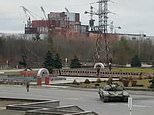
Russian forces took control of the power plant, which is located to the north of Kyiv, in the early days of fighting (pictured, Russian tanks at the site) and have since shut off the power which runs the cooling system, and disconnected
Ukraine has warned that radioactive substances could be released from Chernobyl if power is not restored to the plant. Pictured: A still image taken from a handout video made available by the Russian Defence Ministry press service shows a general view of the Chernobyl Nuclear Power Plant in Pripyat, Ukraine, March 7
Earlier this week, Ukraine pleaded with Russia to observe a ceasefire so engineers could go into Chernobyl and restore the power. This was refused, Ukraine said.
‘The occupiers refused to grant access to the station to Ukrainian repairmen,’ the update continued.
‘Instead, ‘Belarusian specialists’ went there on the instructions of Alexander Lukashenko. Among them, under the guise of nuclear power plants, Russian saboteurs also come to organize a terrorist attack.’
On Wednesday, IAEA also said it had lost contact with the captured Zaporizhzhia power plant, just hours after warning of a potential unfolding disaster at Chernobyl.
The agency said warning systems at Zaporizhzhia – Europe’s largest nuclear power plant – had stopped broadcasting updates in the days since Russian forces shelled the site, resulting in international condemnation.
IAEA chief Rafael Grossi said Wednesday he was ‘concerned about the sudden interruption’ of the data flows to the watchdog’s Vienna headquarters.
He added that the reason for the disruption in updates from the power plants was not clear but the IAEA was still receiving data from other nuclear facilities in Ukraine, including three other operational nuclear power plants.
Also on Wednesday, Ukraine warned Chernobyl could be 48 hours away from leaking radiation, and the country’s nuclear company Energoatom warned that radioactive substances could be released if an electricity outage at the site continues any longer, as it makes it impossible to cool spent nuclear fuel.
Energoatom has said that work to repair the connection and restore power to the plant – the site of the world’s biggest nuclear disaster in 1996 – has not been possible because fighting is under way in the region.
Pictured: A graphic showing the series of events that led to the explosion in the reactor in Reactor 4 on the night of April 26, 1986
The company said there were about 20,000 spent fuel assemblies at Chernobyl that could not be kept cool amid a power outage.
Their warming could lead to ‘the release of radioactive substances into the environment. The radioactive cloud could be carried by wind to other regions of Ukraine, Belarus, Russia, and Europe,’ it said in a statement.
Without power, ventilation systems at the plant would also not be working, exposing staff to dangerous doses of radiation, it added.
Russia took control of the defunct atomic plant on the first day of the invasion and has since captured a second nuclear site – Zaporizhzhia – the biggest in Europe.
Energy operator Ukrenergo also said their power has been entirely cut to the plant and its security systems.
The plant ‘was fully disconnected from the power grid,’ Ukrenergo said in a statement on its Facebook page, adding that military operations meant ‘there is no possibility to restore the lines’.
The recent developments have now added increasing concern about safety and security around the region.
Last week staff at the Zaporizhzhia nuclear power plant were captured on video pleading with Russian soldiers directing fire on the building before they overtook it.
The nuclear power plant, which creates around 20 percent of Ukraine’s electricity, was captured after a fierce gun battle between Russian President Vladimir Putin’s men and Ukrainian defenders that sparked a fire in a six-story training building.
Eventually, emergency crews were allowed to go in and douse the flames at the Zaporizhzhia plant before Russian troops moved in and occupied the site.
The United Nation’s nuclear monitoring agency said that, fortunately, none of the site’s six reactors had been directly damaged and radiation levels remained normal.
The IAEA said later on Wednesday it saw ‘no critical impact on safety’ from the power cut at the decommissioned Chernobyl nuclear plant in Ukraine.
The Vienna-based U.N. nuclear watchdog said Wednesday that Ukraine had informed it of the loss of electricity and that the development violates a ‘key safety pillar on ensuring uninterrupted power supply.’
But it tweeted that ‘in this case IAEA sees no critical impact on safety.’
The IAEA said that there could be ‘effective heat removal without need for electrical supply’ from spent nuclear fuel at the site.
Speaking to MailOnline Claire Corkhill – Professor of Nuclear Material Degradation at Sheffield University – said that while power being cut at Chernobyl was concerning, the spent nuclear fuel would not lead to a nuclear ‘meltdown’.
‘With the electricity supply to the Chernobyl site unavailable, there are several areas of concern with regards to the safety of the nuclear material stored there,’ she said.
The first issue, she explained, is that spent fuel from reactors one and three is kept cool in metal casings in a pond (that looks like a large swimming pool).
‘This material produces heat through radioactive decay and requires constant cooling, which is achieved by pumping fresh cool water into the ponds,’ she said.
‘With no power supply, this water could slowly evaporate, potentially resulting in contamination of the building by low levels of radioactive isotopes.’
The second issue, she said, concerns the monitoring of radioactivity levels in reactor four – the reactor that exploded in 1996.
‘It is essential that radiation monitoring systems are able to constantly monitor the situation inside reactor 4 so that we can be aware of any potential reasons for concern about the exposed nuclear fuel that resides there,’ Prof. Corkhill said.
‘Another serious concern is the maintenance of the ventilation system in the New Safe Confinement structure,’ she continued. The Chernobyl New Safe Confinement is the huge cover – or sarcophagus – that was placed over reactor four in 2016.
‘This prevents further degradation of Reactor number 4 and the hazardous exposed nuclear fuel within, and is essential to the future decommissioning of the site.
‘If there is no power to this structure, we could see the complete failure of the 1.5Bn euro decommissioning programme to make the site safe once and for all.’
While Prof. Corkhill said there the loss of power would unlikely lead to a wide scale released of radioactivity, she said it was more likely there would be ‘severe contamination within one of the spent fuel storage facilities.’
Prof Corkhill’s research focuses on understanding the long-term evolution of radioactive waste material in disposal environments and she provides independent advice to the UK government’s radioactive waste management and disposal policies.
She is leading a British team that is making a key contribution to the huge clear-up operation at the stricken Fukushima nuclear power station in Japan after developing material that simulates the most dangerous radioactive debris remaining in the reactors.
On February 24, Russia invaded Ukraine and seized the defunct plant, site of a 1986 disaster that killed hundreds and spread radioactive contamination west across Europe.
The Chernobyl site has been under the control of Russian troops since last week.
The cause of the damage to the power line serving it was not immediately clear.
On Tuesday the UN atomic watchdog IAEA said that the site was no longer transmitting data and voiced concern for staff working under Russian guard.
The situation for the staff ‘was worsening’, the IAEA said, citing the Ukrainian nuclear regulator.
The defunct plant sits inside an exclusion zone that houses decommissioned reactors as well as radioactive waste facilities.
In 2016, the Chernobyl New Safe Confinement was put in place to cover the reactor. It was designed to prevent further release of radioactive contaminants for 100 years.
More than 2,000 staff still work at the plant as it requires constant management to prevent another nuclear disaster.
IAEA Director General Rafael Grossi on Tuesday called on ‘on the forces in effective control of the site to urgently facilitate the safe rotation of personnel there.’
He also repeated his offer to travel to Chernobyl or elsewhere to secure ‘the commitment to the safety and security’ of Ukraine’s power plants from all parties.
‘The Director General indicated that remote data transmission from safeguards monitoring systems installed at the Chernobyl NPP had been lost,’ the IAEA said in a statement yesterday.
Safeguards keep track of nuclear material and waste products generated by nuclear power plants.
The IAEA urged Russian authorities to allow the 210 staff members who are being held captive at Chernobyl to leave, arguing that although radiation levels in the area are relatively low, it is necessary to ensure a ‘safe rotation’ of staff.
It comes after the Vienna-based UN body said Ukrainian authorities reported an attack on a nuclear facility in Kharkiv on Sunday – though no increase in radiation levels had been reported at the site.