

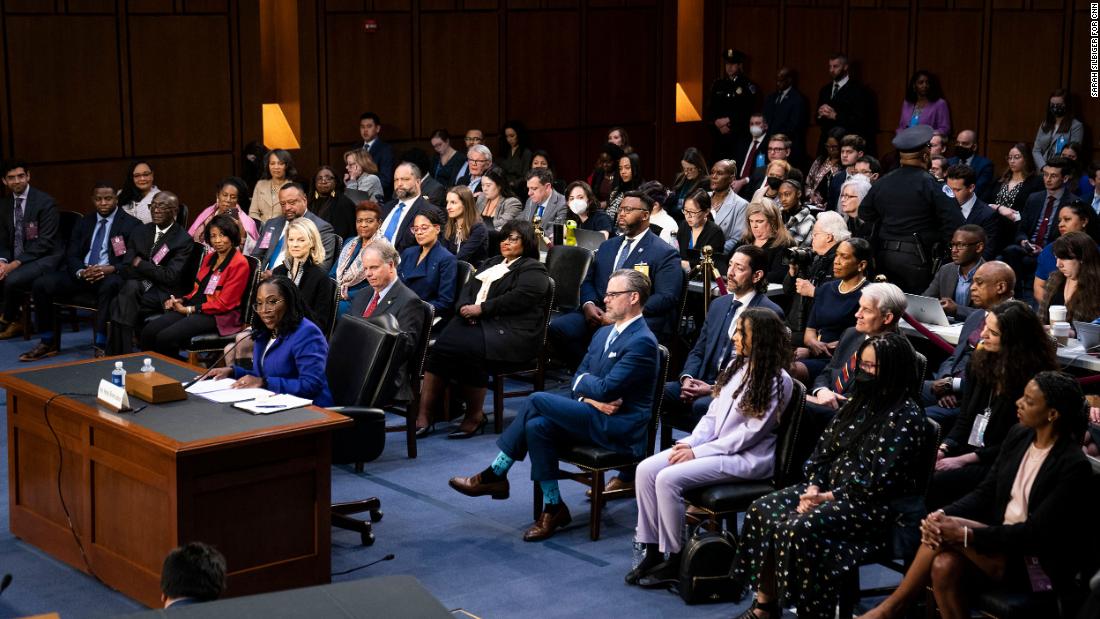
Jackson discusses advocacy for Gitmo detainees while she worked at private firm
Republicans attempted to portray the nominee as weak on crime by zeroing in on some of her past defense work of Guantanamo Bay detainees and sentencing in child pornography cases, and they raised questions about her judicial philosophy.
Jackson addressed and disputed those criticisms by stressing her concern for public safety and the rule of law, as a judge, a mom and an American. She argued that she approaches her work in an impartial way and personal opinions do not play a role.
“Over the course of my almost decade on the bench, I have developed a methodology that I use in order to ensure that I am ruling impartially and that I am adhering to the limits on my judicial authority,” said Jackson. “I am acutely aware that as a judge, in our system, I have limited power, and I am trying in every case to stay in my lane.”
Asked by South Carolina Republican Sen. Lindsey Graham if she would say that she is an activist judge, Jackson replied, “I would not say that.”
Democrats have used the hearings to praise Jackson — who would be the first Black woman to serve as a Supreme Court justice — as an exceptionally qualified, trail-blazing nominee whose depth and breadth of experience, including as a federal public defender, would add a valuable and unique perspective to the bench.
Jackson disputes claims she is weak on crime: ‘I care deeply about public safety’
“Crime, and the effects on the community, and the need for law enforcement — those are not abstract concepts or political slogans to me,” she said.
The insistence by the nominee that she cares about public safety comes as Republicans have widely attempted to portray her record as weak on crime. Arkansas Sen. Tom Cotton pressed her on whether rapists and murderers should spend more time in jail. Missouri Sen. Josh Hawley criticized her sentencing in some cases regarding child pornography. And Graham and Texas Sen. John Cornyn expressed concerns over her advocacy for Guantanamo Bay detainees while in private practice.
“As a judge, I care deeply about the rule of law and I know that in order for us to have a functioning society we have to have people being held accountable for committing crimes,” she said. “We have to do so fairly, under our Constitution.”
Jackson discusses advocacy for Guantanamo Bay detainees
Jackson called the September 11, 2001, terrorist attacks “a tragic attack on this country” and paid tribute to military service members.
“After 9/11, there were also lawyers who recognized that our nation’s values were under attack. That we couldn’t let the terrorists win by changing who we were fundamentally.”
“What that meant was that the people who were being accused by our government of having engaged in actions related to this, under our constitutional scheme, were entitled to representation, were entitled to be treated fairly. That’s what makes our system the best in the world,” she said.
Cornyn claimed that Jackson had called former President George W. Bush and former Defense Secretary Donald Rumsfeld war criminals in legal filings. Jackson argued that the detainees had been tortured and subjected to other inhumane treatment but did not explicitly use the phrase “war criminal.”
“I did not intend to disparage the President or the secretary of defense,” said Jackson.
Graham, the only Republican member of the Judiciary Committee who voted for Jackson for the DC Circuit Court last year, also grilled her, in an intense line of questioning that indicated he may not support her for the Supreme Court.
“If you had your way, the executive branch could not do periodic reviews about the danger the detainee presents to the United States, they would have to make a decision of trying them or releasing them, is that not accurate?” he asked.
“Respectfully, senator, it was not my argument,” Jackson said in response. She said she was “filing an amicus brief on behalf of clients,” citing various organizations.
Graham told CNN it’s “fair to say” he sees red flags with her nomination, saying her answers on defending Guantanamo Bay detainees “just doesn’t make sense to me.” Graham will get a chance to ask questions again at the hearing on Wednesday.
Jackson rebuts scrutiny of her approach to child porn offenses
One of the most striking moments of the hearing happened when Hawley has charged that Jackson had been too lenient in sentencing child pornography cases, particularly one involving an eighteen-year-old in possession of sexual images and videos of children whom Jackson had sentenced to three months, rather than two years as the prosecution recommended and a sentencing guideline of up to ten years.
“I am questioning your discretion and your judgment,” said Hawley on Tuesday. “That’s exactly what I’m doing. I’m not questioning you as a person.”
Jackson forcefully rebutted the accusations and referred to the issue as a “sickening and egregious crime.”
“As a mother, and a judge who has had to deal with these cases, I was thinking that nothing could be further from the truth,” the nominee said when asked by Senate Judiciary Chairman Dick Durbin, an Illinois Democrat, to react to the accusations.
Hawley, who tweeted about the issue last week, returned to the highly charged subject during Tuesday’s hearing and had the opportunity to question Jackson directly about it.
In response, Jackson said, “I appreciate, senator, that you have looked at these from the standpoint of statistics, that you are questioning whether or not I take them seriously or I have some reason to handle them in either a different way than my peers or a different way than other cases, and I assure you that I do not.”
The White House and Senate Democrats have also refuted the criticisms in defense of Jackson.
“In the vast majority of cases involving child sex crimes, the sentences Judge Jackson imposed were consistent with or above what the government or US probation recommended,” White House press secretary Jen Psaki said last week.
Court packing and other key issues
Republican senators have also criticized support for the nomination from left wing groups and attempted to pin Jackson down on the hot-button issue of expanding the number of Supreme Court justices who sit on the bench, also known as court packing, an idea that has gained currency among progressive elements of the Democratic Party.
On Tuesday, Jackson argued that it was not in her purview to weigh in on a politically sensitive topic.
“In my view, judges should not be speaking to political issues, and certainly not a nominee for a position on the Supreme Court,” she said in response to a question on the issue.
Later on in the hearing, Democratic Sen. Dianne Feinstein of California asked Jackson if she believes Roe v. Wade, the landmark 1973 Supreme Court decision that legalized abortion nationwide, is settled as precedent.
What’s next after confirmation hearings conclude
Democrats can confirm Jackson to the high court on the strength of their narrow Senate majority, with 50 votes and Vice President Kamala Harris breaking a tie. The party does not need any Republican support for successful confirmation, but if any Republicans do vote to confirm, it would give the White House a chance to tout a bipartisan confirmation.
It’s not yet clear, however, whether Jackson will receive any votes from Republicans.
This story and headline have been updated with additional developments Tuesday.
CNN’s Tierney Sneed, Daniel Dale and Joan Biskupic contributed to this report.