

Russia admits to Moskva losses: Kremlin says one serviceman has died and 27 others are missing
Russia admits to Moskva losses: Kremlin says one serviceman has died and at least 27 others are missing after days of denials over the warship’s sinking
After the sinking, the ministry said the entire crew of the ship had been rescuedThe loss of the guided missile cruiser was a humiliating setback for MoscowImages emerged on Monday appearing to give a first glimpse of the sinking
<!–
<!–
<!–<!–
<!–
(function (src, d, tag){
var s = d.createElement(tag), prev = d.getElementsByTagName(tag)[0];
s.src = src;
prev.parentNode.insertBefore(s, prev);
}(“https://www.dailymail.co.uk/static/gunther/1.17.0/async_bundle–.js”, document, “script”));
<!–
DM.loadCSS(“https://www.dailymail.co.uk/static/gunther/gunther-2159/video_bundle–.css”);
<!–
Russia has admitted that one serviceman was killed and at least 27 others were left missing after days of denial over the warship’s sinking.
The flagship was blown-up by Ukrainian missiles last week before it sunk to the bottom of the Black Sea.
The Russian Defence Ministry said on Friday that 396 others were rescued and offered no explanation for the contradicting reports.
Shortly after the episode, the ministry said the entire crew of the ship, which was presumed by the media to be about 500 people, had been rescued.
Russia has admitted that one serviceman was killed and at least 27 others were left missing after days of denial over the warship’s sinking
The loss of the guided missile cruiser – the flagship of Russia’s Black Fleet – was a humiliating setback for Moscow. Russia on Friday did not acknowledge an attack on the ship.
It continued to say a fire broke out after ammunition detonated, without offering any details about what caused the detonation.
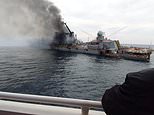
But images emerged on Monday appearing to give a first glimpse of the sinking warship.
The pictures, which seem to have been taken from a rescue vessel alongside the stricken Russian warship, show damage its left side along with flames burning below deck and a thick pall of black smoke rising into the sky.
The pictures seem to contradict Russian accounts of the sinking, after Moscow claimed the warship sank in choppy seas while being towed to the port of Sevastopol following an explosion on board
A short video clip also appears to show the listing battleship, with a voice heard saying – in Russian – ‘what the f*** are you doing?’ before the seconds-long clip cuts out
Moskva is shown sitting low in the water, leaning to the port side, and appears to have deployed its lifeboats with no crew visible on board. Its rear helicopter door is also open, suggesting the aircraft has taken off. There also seems to be a firefighting ship behind the vessel which is spraying jets of water into the air.
Multiple black marks scar the port-side of the ship, including several near deck-level where smoke appears to have streamed out of portholes and left marks on the paint. But there are also dark marks close to the waterline that don’t match the position of portholes and suggest the ship has sustained external damage.
The images are largely consistent with Ukrainian descriptions of the sinking – that the Moskva was hit by two missiles on its port side which sparked a fire and caused it to roll – and contradict Russia’s account which was that the ship suffered a fire and internal explosion in rough seas.
Video has also since emerged which appears to show two rescue vessels approaching the burning ship – one to the left side and one to the right – in which a Russian voice can be heard speaking. One man says ‘what the f*** are you doing?’ before the short clip ends.
The images show what appears to be damage to the left-hand side of the vessel close to the water line, smoke and fire damage along its left-hand side, missing lifeboats and open helicopter bay doors – suggesting the aircraft has taken off. A rescue ship also appears to be behind the stricken ship, spraying water jets
Moskva (pictured last leaving port on April 10) got into trouble on April 14 while sailing around 60 miles off the coast of Odesa – Ukraine’s largest port – before Moscow confirmed she had sunk on April 15
Putin’s inner circle’s shrinking – and the stakes are rising, writes Russian President’s biographer Professor Mark Galeotti
Few in the Kremlin’s inner circle get a face-to-face audience with president Vladimir Putin these days.
The Russian dictator is paranoid about contracting Covid and conducts most meetings over videolink.
That has the added bonus of making it easier to end conversations that displease him.
Last month the governor of the country’s central bank, Elvira Nabiullina, attempted to resign over Zoom in protest at the invasion of Ukraine.
She didn’t mince her words. The disastrous military invasion was ‘flushing the economy into the sewers’, she told him.
Putin refused to accept her resignation. She was needed to steady the markets, he said. Then he disconnected the call.
He will not tolerate dissent or any opinion that contradicts his own. But around him in Moscow’s halls of power, there is increasing disquiet.
It has been reported that senior Kremlin insiders fear Putin’s invasion of Ukraine was a ‘catastrophic’ mistake which could ‘doom’ Russia to years of isolation.
Chillingly, they warn he might well resort to the use of tactical nuclear weapons. Such criticism is coming from both flanks, from the nationalists and the more socially liberal technocrats – from the hawks and doves, uniforms and suits.
The nationalists back Putin’s belief that Ukraine should be forced back into Russia’s sphere of influence, severing it from the West. But they are horrified at how badly the war has gone.
The liberals were always sceptical about the overthrow of a foreign government and are in despair at the damage being done to Russia – both its economy and its international standing.
Putin has blocked his ears to almost all of them. One of the few people he still listens to is the Secretary of the Security Council, Nikolai Patrushev. A former head of the FSB or secret police, Patrushev wears a suit these days but his soul, if he has one, wears a uniform. He makes Putin look like a pacifist.
Most of the president’s other advisers and ministers are not Putinists. Indeed, there’s no such thing – for all of them, their first priority is their own skin.
And if enough of them become so alienated and scared that they are prepared to mount a mutiny, a coup at the Kremlin is no longer unthinkable.
But it would take an alliance of top-ranking figures in the army, government and security services.
That’s what happened 60 years ago when premier Nikolai Kruschev was overthrown following the Cuban missile crisis. Knowing they could not win a nuclear war against the US, ministers and generals united to depose their leader.
According to the Russian constitution, if a president is unable to continue in office, the prime minister would then head an interim government. Russian PM Mikhail Mishustin is a moderate who is known to oppose the war – without ever stating it directly. He would be a safe pair of hands.
But what about Russians outside the Kremlin? So far, Western pressure, including severe economic sanctions, has not been enough to bring crowds of protesters on to the streets.
But if Putin did resort to tactical nuclear strikes in Ukraine – he was boasting on Wednesday night that Russia’s deadliest-ever nuclear missile, Satan II, had been successfully tested – that could well be the catalyst for a putsch.
Talk of ‘tactical nukes’ is a euphemism. The devastation would be the equivalent of a Hiroshima or Nagasaki. But that doesn’t seem to matter to Putin, who is rumoured to have both Parkinson’s disease and cancer. He cannot afford to wait years for victory in Ukraine.
He is desperate for a triumph of some sort and he could decide to gamble everything on a roll of the nuclear dice. But he cannot simply press a red button. The weapons have been partly decommissioned and would have to be removed from storage, transported to the launchers and made active.
Tests and checks would be required – and his officials, along with Western intelligence, would know about it.
The Kremlin pragmatists know a tactical nuclear strike would be a catastrophe even greater than the initial invasion.
Nato would be forced to respond, as would China, to end Putin’s regime, whatever the cost.
That growing band of dissidents in Moscow might well be prepared to act first against their leader – both for their own survival and perhaps for the survival of Russia itself.
Mark Galeotti is Honorary Professor at the University College London School of Slavonic and East European Studies.