

Ukraine war: Finland and Sweden submit NATO applications
Putin’s worst nightmare: Finland and Sweden present their NATO applications – adding nearly a MILLION troops to the alliance’s forces – in defiance of Russian threats
<!–
<!–
<!–<!–
<!–
(function (src, d, tag){
var s = d.createElement(tag), prev = d.getElementsByTagName(tag)[0];
s.src = src;
prev.parentNode.insertBefore(s, prev);
}(“https://www.dailymail.co.uk/static/gunther/1.17.0/async_bundle–.js”, document, “script”));
<!–
DM.loadCSS(“https://www.dailymail.co.uk/static/gunther/gunther-2159/video_bundle–.css”);
<!–
Finland and Sweden have today submitted formal letters of application to NATO, firing the starting pistol on their race to become part of the military alliance.
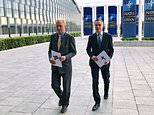
Axel Wernhoff and Klaus Korhonen, the Swedish and Finnish ambassadors to NATO, were pictured walking into Brussels headquarters on Tuesday morning clutching their letters of application to present to alliance head Jens Stoltenburg.
The proposals must now be judged and approved by all 30 members of the alliance before the Scandinavian nations can be accepted. The process typically takes up to a year, but will be fast-tracked and could take as little as two months.
If approved as expected, the two will become part of the world’s largest military alliance – gaining protection from its mutual defence pledge while adding almost a million troops to its ranks along with state of the art artillery, planes and submarines.
But Turkey’s President Recep Tayyip Erdogan has threatened to derail the process, saying he is not in favour of Finland and Sweden joining because the countries have granted asylum to opponents of his regime.
All NATO decisions must be taken unanimously, so Erdogan’s protest-vote could scupper the alliance’s plans.
Finnish and Swedish diplomats met with their Turkish counterpart at an informal summit in Berlin on Saturday in an attempt to iron out any creases, and there is a general feeling that – with the right incentives – Erdogan can be pacified.
Expanding the alliance to Finland and Sweden represents a huge shift in what is known as Europe’s ‘security architecture’, as both nations have been historically bound to pacts of neutrality.
Finland’s neutrality dates back to the Second World War and the last time it was invaded by the Soviets.
The Winter War – which saw the Soviet army suffer heavy casualties at Finnish hands – ended with a deal in which Finland ceded 10 per cent of its territory and agreed it would never allow its territory to be used to attack Russia.
In return, Stalin pledged that he would never attack Finland.
Sweden’s neutrality dates back even further – to the Napoleonic Wars – and is based on a similar premise, that Stockholm will never be dragged into a war on Russia provided Russia does not invade.
But both nations have been forced into a radical re-think of their security arrangements after Putin launched his war on Ukraine.
Kyiv had also struck a security deal with Russia in 1993, when it agreed to hand over stocks of Soviet nuclear weapons on its territory in return for assurances that it would never be attacked.
Putin tore up those assurances when he ordered troops across the border on February 24, prompting questions in both Helsinki and Stockholm about the value of Russia’s promises to them.
Both Finland and Sweden had been drawing close to NATO for some time – joining intelligence briefings and taking part in joint military drills as ‘partner nations’ – but public opinion had remained firmly against full membership.
However, as the public watched the Russian army wreak death and destruction on Ukraine’s cities opinion shifted, with majorities in both nations quickly coming out in favour of joining NATO.
Prime Ministers Sanna Marin, of Finland, and Magdalena Andersson, of Sweden, were quick to signal their intention to join the alliance – though were concerned Russia could launch some kind of attack in retaliation.
But after receiving security guarantees from the US, UK, Norway, Denmark and others, they felt safe enough to submit membership bids.
Russia has threatened to take ‘military-technical’ measures in response, which could include stationing more nuclear weapons and missiles in Kaliningrad – the Kremlin’s European enclave that sits to the south of Finland and Sweden across the Baltic Sea.
But Putin – whose army has been shown up in Ukraine and suffered heavy casualties – has sought to play down the threat posed, saying earlier this week that he has ‘no problem’ with either country joining NATO.
Russia would only respond, he insisted, if NATO ‘infrastructure’ was moved into either country – thought to be a reference to missiles or missile bases.