

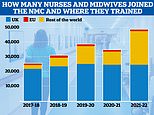
Half of new nurses trained overseas, latest figures show
Record 23,000 NHS nurses and midwives employed last year – nearly HALF of new workforce – came from abroad, with the majority recruited in India and the Philippines
Some 48 per cent of new nurses and midwives came from abroad in the last yearOverwhelming majority of these, 66 per cent, came from India and PhilippinesMeanwhile workforce is shedding nurses, with many citing ‘too much pressure’
<!–
<!–
<!–<!–
<!–
(function (src, d, tag){
var s = d.createElement(tag), prev = d.getElementsByTagName(tag)[0];
s.src = src;
prev.parentNode.insertBefore(s, prev);
}(“https://www.dailymail.co.uk/static/gunther/1.17.0/async_bundle–.js”, document, “script”));
<!–
DM.loadCSS(“https://www.dailymail.co.uk/static/gunther/gunther-2159/video_bundle–.css”);
<!–
Almost half of Britain’s newly hired nurses and midwives were recruited from abroad in the last year, new figures show, raising concerns of an overreliance on overseas health workers.
Some 48 per cent of the 48,436 people who joined the nursing and midwifery workforce came from different countries, with the vast majority of these overseas trained joiners (66 per cent) hailing from India and the Philippines.
Leading nurses questioned how sustainable it is to ‘recruit half of all new nurses from around the world’.
Meanwhile, nurses are leaving their jobs at an alarming rate, with more than 27,000 shed in the last year alone, with many claiming the job put them under ‘too much pressure’.
In another warning sign, one fifth of the workforce are currently at retirement age, risking a further exodus next year.
The data, from the the Nursing and Midwifery Council (NMC), suggest an overall increase in the number of staff – with some 758,300 now registered to work in Britain.
However, concerns have been raised about the rising number of people leaving the register.
A total of 27,133 nurses and midwives left the NMC register in 2021/22 – 13 per cent more than the year before.
Nursing leaders have voiced concern over a rising reliance on overseas trained nurses and midwives in the UK with them now accounting for nearly half of newly registered professionals, a huge increase compared to previous years
A total of 27,133 nurses and midwives left the NMC register in 2021/22 – 13 per cent more than the year before and bucking a recent decline
The vast majority of these were nurses, some 25,000, and almost 1,500 midwives.
Among 6,500 nurses and midwives who responded to a ‘leavers’ survey’, the top reasons for quitting the register were retirement (42.9 per cent), personal circumstances (21.7 per cent) or ‘too much pressure’ (18.3 per cent).
The report states that stress and poor mental health are factors in ‘many people’s decision to stop practising’.
Midwives were the most likely to cite this reason, closely followed by mental health nurses.
One nurse who left due to workplace pressures told the NMC: ‘Pressure at work and the change of working practice did not allow me to provide the care I wanted to give.’
‘Covid restrictions compounded this. I was becoming stressed, tired and not sleeping well.’
Additionally, 36.5 per cent of leavers reported their experience of working during the pandemic had influenced their decision to quit the register.
One midwife told the NMC it was not the virus itself but the associated workplace pressures that led to them leaving.
A total of 22,745 nurses and midwives who trained outside the EU and UK joined the UK’s professional register in 2021/22, with the majority coming from India and the Philippines
This graph shows the country of training of all newly registered nurses and midwives in the UK over the past five years. Unsurprisingly, British trained nurses make the majority with about 120,000 joiners. India (about 21,000), Philippines (nearly 18,000) and Nigeria (nearly 5,000) are the biggest providers of overseas trained nurses and midwives registered to work in the UK
‘Regularly caring for two, three, four women who should have been one-two-one was terrifying and exhausting,’ they said.
‘Wearing the same mask all day because there were no others, begging for sterile gowns for crash sections, holding pee in all day because you are so short staffed, the list goes on.’
The figures also suggest one in five nurses and midwives (21 per cent) working in the UK are ‘of potential retirement age’.
Andrea Sutcliffe, NMC chief executive, said the total number of registrants was the highest level ever, however there were some concerning signs.
‘The total number of people leaving the register has risen, after a steady and welcome fall over the previous four years,’ she said.
‘Another note of caution is that growth of the workforce has become more reliant on internationally trained professionals joining our register.
‘These professionals make a welcome and vital contribution to our nation’s health and wellbeing. But we can’t take them for granted.’
She said the pandemic had demonstrated the vulnerability of relying on overseas trained professionals.
‘Two years ago, we felt the pandemic’s impact on global travel; the number of international joiners to our register fell sharply,’ she said.
‘A future pandemic or other global disruption could see history repeat itself, but with an even bigger impact on the overall growth of the register.’
The figures also show the number of nurses coming from the EU has fallen for the fifth year in a row.
Commenting on the figures, Pat Cullen, general secretary and chief executive of the Royal College of Nursing, said: ‘The loss of 25,000 registered nurses last year is being felt profoundly by both patients and nurses alike.
‘When we have tens of thousands of vacant nurse jobs, a sharp rise in leavers should not be overlooked while we welcome new recruits.
‘Ministers should avoid overclaiming today – nursing staff tell us these shortages are biting more than ever.’
She also questioned the sustainability of recruiting ‘half of all new nurses from around the world.’
‘The UK’s health and care workforce is proudly diverse, but it must be done ethically and come at the same time as increased investment in education and domestic workers,’ she said.
Commenting on the figures, Pat Cullen, general secretary and chief executive of the Royal College of Nursing, said: ‘The loss of 25,000 registered nurses last year is being felt profoundly by both patients and nurses alike’ (Stock image)
Gill Walton, chief executive of the Royal College of Midwives, added: ‘We are already 2,000 midwives short in England, yet the number in the NHS continues to fall while demands on maternity services grow.
‘Other UK countries are also facing pressures.
‘This is not sustainable and is without doubt having an impact on the safety and quality of care for women, babies and their families.
‘It is also putting massive and unreasonable pressures on NHS midwives and maternity support workers – already battered by the pandemic – and many are starting to vote with their feet and leave the NHS.’
Saffron Cordery, deputy chief executive of NHS Providers, added: ‘It is concerning to see a rise in the number of nurses, midwives and nursing associates leaving the register, reversing the trend of recent years.
‘Workforce shortages across the NHS, with more than 110,000 vacancies, are a huge risk to patient safety by impacting the quality of care that overstretched staff can provide – ‘too much pressure’ is the third most common reason cited by leavers.’