

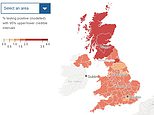
How rife is Covid in YOUR area? Interactive map reveals current hotspots are all in Scotland
How rife is Covid in YOUR area? Interactive map reveals current hotspots are all in Scotland as UK’s outbreak continues to fizzle out
ONS figures show 874,400 people in England had Covid in the week to May 21, equating to 1.6% of populationThe figure based on thousands of tests is lowest logged since October — before the Omicron variant emergedCases also continued to fall in Wales and Northern Ireland last week but the trend in Scotland was uncertain
<!–
<!–
<!–<!–
<!–
(function (src, d, tag){
var s = d.createElement(tag), prev = d.getElementsByTagName(tag)[0];
s.src = src;
prev.parentNode.insertBefore(s, prev);
}(“https://www.dailymail.co.uk/static/gunther/1.17.0/async_bundle–.js”, document, “script”));
<!–
DM.loadCSS(“https://www.dailymail.co.uk/static/gunther/gunther-2159/video_bundle–.css”);
<!–
England’s Covid wave continues to collapse as infection rate falls to lowest level seen in in more than seven months.
Statisticians at the Office for National Statistics (ONS) estimate that 874,400 people in England were infected with Covid in the week to May 21, equating to 1.6 per cent of people or one in 60.
The figure, calculated based on swabs taken from thousands of Britons, is the lowest logged since October — before the Omicron variant emerged.
Cases also continued to fall in Wales and Northern Ireland last week but the trend in Scotland was uncertain.
Sarah Crofts, head of analytical outputs for the infection survey, said cases are trending in the ‘right direction across much of the UK’.
She said: ‘While Scotland and some regions of England saw an uncertain trend in the most recent week, it is too early to say if these uncertain trends mark the end of recent declines.’
Statisticians at the Office for National Statistics (ONS) estimate that 874,400 people in England were infected with Covid in the week to May 21, equating to 1.6 per cent of people or one in 60
The ONS figures show infections fell in most UK nations last week. In Wales, 52,900 people were thought to be infected — around 1.7 per cent of the population or one in 55 people. Another 23,300 individuals were carrying the virus in Norther Ireland, translating to 1.3 per cent or one in 80. However, the trend was uncertain in Scotland, where twice as many people (2.6 per cent) were infected — equating to 135,400 people or one in 40 people
The ONS figures show infections fell in most UK nations last week.
In Wales, 52,900 people were thought to be infected — around 1.7 per cent of the population or one in 55 people.
Another 23,300 individuals were carrying the virus in Norther Ireland, translating to 1.3 per cent or one in 80.
However, the trend was uncertain in Scotland, where twice as many people (2.6 per cent) were infected — equating to 135,400 people or one in 40 people.
The ONS data is considered as the gold-standard way of measuring the outbreak now that the Covid dashboard is reporting figures less regularly.
Experts had warned that the daily infection numbers had become extremely unreliable following the end of free Covid tests for the majority of Britons.
The latest ONS update also shows that Covid cases fell across most of England. Cases fell in the North West, where 1.4 per cent are infected — the lowest rate in England.
They also dropped in the East Midlands (1.4 per cent), East of England (1.5 per cent), London (1.5 per cent) and the South West (1.7 per cent).
But the ONS said it was unclear whether cases were rising or falling in the West Midlands (1.7 per cent), the North East (2.1 per cent), Yorkshire and The Humber (1.7 per cent) and the South East (1.8 per cent).
Covid rates also fell in almost all age groups, with infection levels lowest among 11 to 15-year-olds (0.8 per cent), followed by two to 10-year-olds (1 per cent) and 16 to 24-year-olds (1.3 per cent).
The trend in cases was uncertain among 25 to 34-year-olds (2.1 per cent) where Covid prevalence appeared to be highest. Virus rates were slightly lower among the over-70s (1.8 per cent), 50 to 69-year-olds (1.9 per cent) and 35 to 49-year-olds (1.6 per cent).