

The state has recorded 315 outbreaks linked to student sports teams or recreational clubs in the first two months of 2021, drawing a sharper focus on testing
“We have seen cases and hospital admissions move from historic declines to stagnations, to increases,” CDC Director Dr. Rochelle Walensky said during a White House Covid-19 briefing on Friday. “And we know from prior surges that if we don’t control things now, there is a real potential for the epidemic curve to soar again.”
At the time, Walensky said, the seven-day average of new cases was about 57,000 cases a day — a 7% increase from the seven days prior.
“I know people are tired,” Walensky said during the briefing. “We’re just asking people to hang on a little while longer in terms of the masks and the mitigation strategies so that we can get the majority of people vaccinated.”

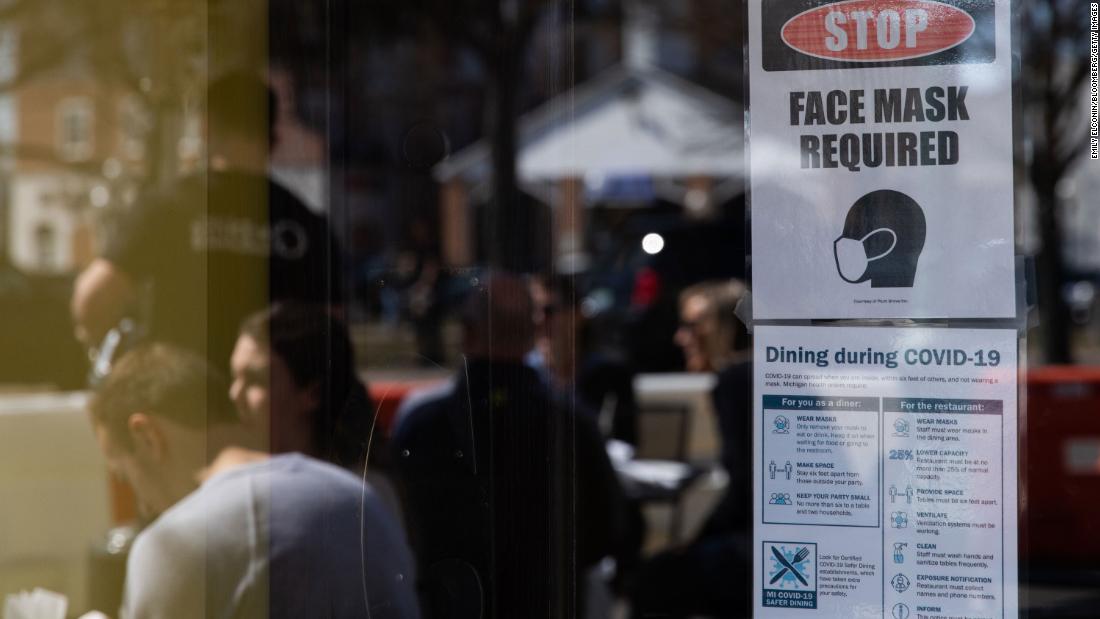
A sign requiring face masks and Covid-19 protocols at a restaurant in Plymouth, Michigan, on Sunday, March 21, 2021
Michigan sees third surge
Some state leaders have already expressed concern over recent Covid-19 trends.
“I think we are in the third surge in Michigan,” Dr. Joneigh Khaldun, chief medical executive of the Michigan Department of Health and Human Services, told CNN on Sunday, with cases increasing the most in people between the ages of 10 and 19.

Khaldun attributed the rise in cases to a number of factors, including increased gatherings, reopenings and outbreaks in some prisons and schools.
Outbreaks related to sports and student gatherings are a particular concern, with 315 outbreaks linked to student sports teams or recreational clubs in the first two months of 2021. Michigan is now testing more in schools and it will be mandatory for those playing sports.
“Anyone age 13 to 19 whose playing organized sports, they have to get tested at least weekly,” Khaldun said.
She added: “If they have symptoms, they can’t play at all.”
On Friday, Vermont officials reported more than 250 new Covid-19 cases — the highest one-day total for the state since the pandemic’s start.
The increase is likely fueled by more people moving around now that warmer weather is here and by variants that are circulating, Dr. Mark Levine, the state’s health commissioner, said.
“Our efforts to vaccinate Vermonters is a race against what the virus does best: move easily from person to person,” Levine said. “Throughout the country, including up and down the Eastern Seaboard, case numbers are up.”
Half of the cases in the last two weeks have been in people under 30 years old, while the most prominent age group with new cases is people between 20 and 29 years old, Levine added.


Ohio Gov. Mike DeWine said Friday that while the state’s Covid-19 numbers were going down for several months, they have now plateaued and officials are concerned they will start climbing again.
“This really is a critical time. We have a race going on,” DeWine said. “The race really is between how fast we can vaccinate people and the variant which you’re seeing in state after state.”
That rise in cases will likely continue for a couple of weeks as part of what Gov. Chris Sununu called the “spring surge.”
‘Conceivable’ kids could go to summer camp without vaccines
But after a year, many are itching for some return to normal, especially as spring and summer approach.
Dr. Anthony Fauci has said elementary school-aged children likely won’t be vaccinated until the first quarter of 2022, but on Sunday he told CBS News it was “conceivable” children could go to summer camp or playgrounds — even if they aren’t vaccinated.


He pointed to the current pace of vaccinations, suggesting that if it continued it could help drive cases down within communities.
“If we get into the summer and you have a considerable percentage of the population vaccinated, and the level in the community gets below that plateau that’s worrying me and my colleagues in public health,” he said, “it is conceivable that you would have a good degree of flexibility during the summer, even with the children with things like camps.”
At Six Flags Magic Mountain theme park in Valencia, California, the roar of roller coasters could be heard this weekend as workers prepared to welcome guests back on Thursday for the first time since March 2020.
Public Safety Manager Justin Miyahira told CNN the park, which boasts 19 roller coasters, would only open at 15% capacity, and reservations are limited to California residents.
“While you’re here, there are some things like social distancing, physical distancing, we have signage on the floors to remind individuals to stay separate,” he said. “There’s also a rule about wearing your mask at all times, including while you’re participating in our rides.”
Cases of a dangerous variant are climbing
The CDC is continuing to scale up its surveillance of variants, Walensky said Friday, and is watching this specific variant “very closely.”
“If you look from week to week, 1.1.7 becomes more of a percentage (of US cases) and as the percentage goes up, that’s a reflection that it has the capability to become dominant (in the country),” Dr. Anthony Fauci added during Friday’s briefing.
The CDC has previously said the B.1.1.7 variant will likely become dominant in the US by the end of March or early April.
Still, while variants are playing a role in the rise in cases, they’re not the only reason, Dr. Fauci told CBS’ “Face the Nation” on Sunday.
“What we’re likely seeing is because of things like spring break and pulling back on the mitigation methods that you’ve seen now,” he said, calling those steps “premature.”
The three vaccines that have gotten the green light in the US appear to protect well against that variant.
CNN’s Linh Tran, Miguel Marquez, Paul Vercammen, Heather Law, Jamiel Lynch and Jacqueline Howard contributed to this report.