

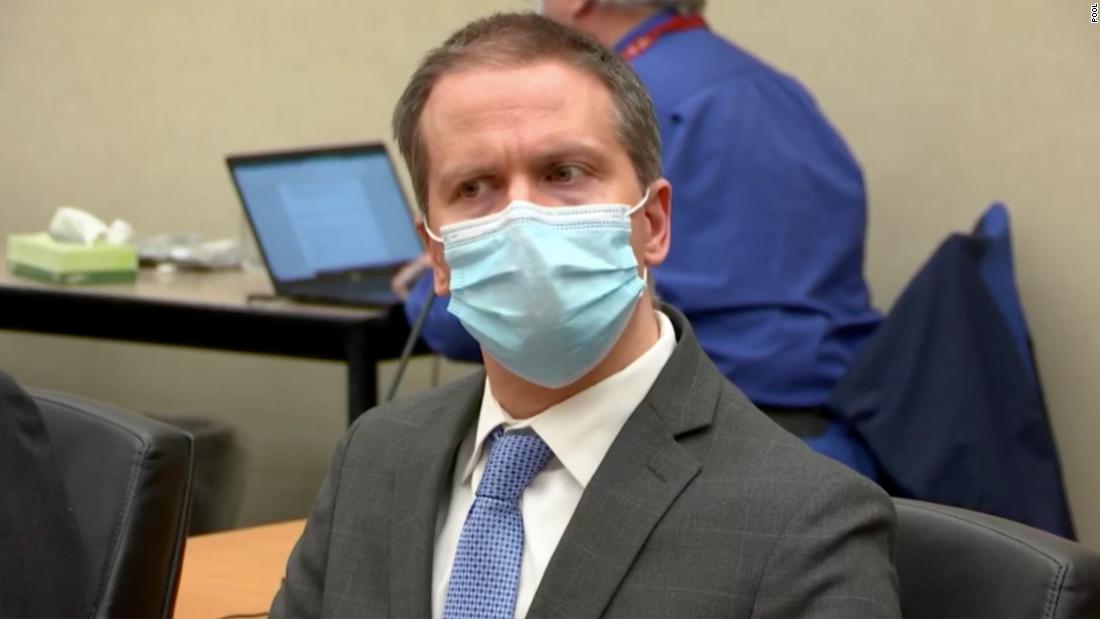
When officers kill a person, they’re rarely charged and even more rarely convicted. Here’s what made this case different.
From the beginning, the killing of George Floyd on May 25, 2020, has stood on its own as a uniquely disturbing police killing in a sea of disturbing police killings.
It was captured in clear and intimate video by bystanders and the officers’ body cameras. It lasted over 9 minutes rather than a few seconds. Police officials across the country came together to denounce his actions as excessive. And making it all the more upsetting was Chauvin’s impassive facial expressions and body language throughout.
The bystander video
The prosecution called 38 witnesses in their case against Chauvin, but the focal point of it all was the video.
It was played for the jury in its entirety during opening statements, and then it was played again and again and again. The prosecution played composite videos that combined Frazier’s footage with that from police body cameras, and they played clips of the video for witnesses, police experts and medical experts who walked jurors through it moment by moment.

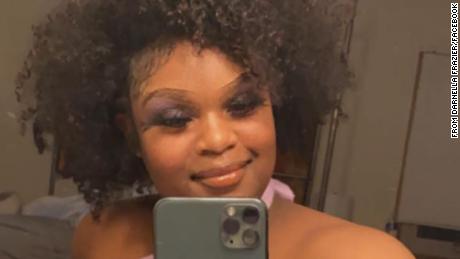
“I feel helpless,” he said through sobs. “I don’t have a mama either. I understand him.”
Throughout the trial, the prosecution’s message was concise and video-focused: “Believe your eyes.”
The 9 minutes and 29 seconds
Most police killings are shootings — split-second decisions with fatal consequences. Juries have long been wary of second-guessing a police officer’s rapid decision made under difficult circumstances.
He broke down the timing of Chauvin’s kneeling into three sections: 4 minutes and 45 seconds as Floyd cried out that he couldn’t breathe; 53 seconds as Floyd had anoxic seizures due to low oxygen; and 3 minutes and 51 seconds as Floyd was non-responsive.
“This case is not about split-second decision-making,” Blackwell said in opening statements.
“It’s not the proper analysis because the 9 minutes and 29 seconds ignores the previous 16 minutes and 59 seconds. It completely disregards it,” Nelson said.
Chauvin’s face and body language

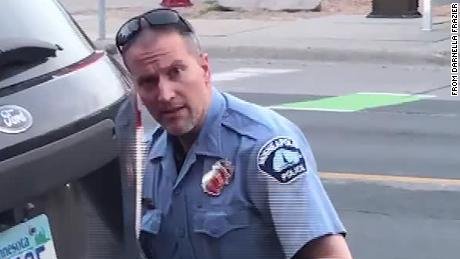
This image, deemed “Exhibit 17,” was shown in court dozens of times.
Prosecutors leaned into Chauvin’s particularly disturbing facial expressions and body language while kneeling on Floyd.
Dozens of times in court, prosecutors showed witnesses and jurors “Exhibit 17” — a still image of Chauvin on Floyd’s neck taken from Frazier’s bystander video. In the image, Chauvin has a disinterested look on his face, his sunglasses sit on top of his head, and his hand rests in his pocket. He appears altogether unconcerned with the desperation and agony just below him.
“You saw the photo, you saw the body language,” Schleicher said in closing arguments. “You can learn a lot about someone by looking at their body language.”
Chauvin’s defense tried to counter this point in cross-examination of Minneapolis Police Sgt. Ker Yang, the crisis intervention training coordinator. Yang said that officers are trained to appear confident, stay calm and avoid staring or eye contact.
Yet the prosecution returned to the image again and again. In closing arguments, they showed jurors a close-up of Chauvin’s face, only to then zoom out to show Floyd’s pained face pinned below him. The contrast was clear.
“This wasn’t the face of fear or concern or worry,” Blackwell said of Chauvin.
Police testimony against him

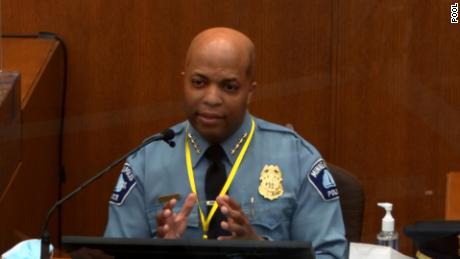
“Once there was no longer any resistance and clearly, when Mr. Floyd was no longer responsive and even motionless, to continue to apply that level of force to a person proned out, handcuffed behind their back — that in no way shape or form is anything that is by policy,” the police chief told the jury. “It is not part of our training, and it is certainly not part of our ethics or our values.”
“This is not an anti-police prosecution. It is a pro-police prosecution,” Schleicher said in closing arguments. “There is nothing worse for good police than bad police.”
In the end, even the nation’s largest police union praised the trial as fair.