

Analysis: Trump transformed the Supreme Court that mostly helped advance his agenda
With forceful leadership from Senate Majority Leader Mitch McConnell, Senate Republicans enabled Trump to make lifetime appointments to nearly 30% of the 870-seat federal bench. A majority of the powerful US appellate courts are now dominated by Republican appointees.
The justices also have delayed for months action on the latest chapter of a Manhattan district attorney’s long-pending subpoena for Trump tax returns.
The Supreme Court and lower US court judges, however, failed to give Trump what he desired most at the end. They swatted away his attempts to discard valid 2020 presidential election results. For that, Trump called the Supreme Court “totally incompetent and weak.”
Still, Roberts often afforded the administration some measure of victory even in its losing cases, such as a broader reading of executive discretion under the Administrative Procedure Act, or a chance to return with stronger arguments.
Trump responded to the Roberts’ opinion in the dispute over the program known as Deferred Action for Childhood Arrivals by saying, “Do you get the impression that the Supreme Court doesn’t like me.”
Conservative plan to save vacancies for Trump works out
Trump and conservative advocates effectively triumphed on a goal dating to the 2016 election campaign when Trump took the unorthodox step of issuing a list of possible candidates for the high court, and McConnell ensured that the vacancy caused by that February’s death of Justice Antonin Scalia was waiting for the new president.
Just days after taking office in January 2017, Trump nominated US appeals court Judge Neil Gorsuch to fill the Scalia vacancy.

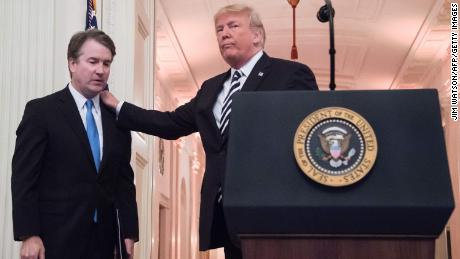
Trump pats Associate Justice of the US Supreme Court Brett Kavanaugh on the back during a ceremonial swear-in at the White House in Washington, DC, on October 8, 2018.
The next year, Trump appointed Brett Kavanaugh to succeed Justice Anthony Kennedy, who retired after 30 years on the bench. Four months ago, a new vacancy suddenly appeared with the September 18 death of prominent liberal Ruth Bader Ginsburg, for whom Trump chose Amy Coney Barrett.
McConnell had also stalled on Obama lower court nominations in 2016, ensuring that about 100 lower court vacancies also awaited Trump in 2017. After four years, the President has filled 177 of the 682 district court judgeships (26%) and 54 of the 179 appeals court judgeships (30%), according data compiled by the Brookings Institution’s Russell Wheeler.
When Trump first came to office, four of the 13 US appeals courts had Republican majorities, Wheeler said, and today, seven of the 13 are now dominated by GOP appointees. These regional appeals courts usually have the last word on legal disputes because the Supreme Court accepts fewer than 1% of the petitions that arrive at its door.
SCOTUS backs Trump’s legal agenda
In a case that drew far less attention but reinforced the Trump agenda limiting eligibility for asylum in the US, the justices in June curtailed court review for asylum seekers in an expedited removal process who claim they cannot return home because they have a credible fear of torture or death.

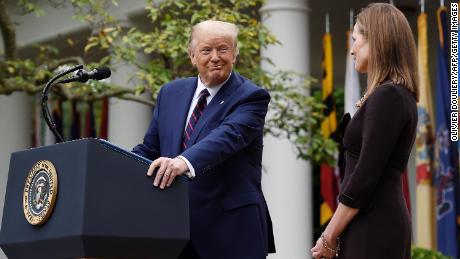
Judge Amy Coney Barrett speaks after being nominated to the US Supreme Court by President Donald Trump in the Rose Garden of the White House in Washington, DC on September 26, 2020.
The administration won several major cases favoring employers over labor. In one of the most contentious, the five-justice bloc on the right in 2018 reversed a 1977 ruling that had allowed states to require employees who declined to join a union to pay “fair share” fees to finance bargaining for pay and benefits but not political activities.
“Big loss for the coffers of the Democrats!” Trump wrote on Twitter after the ruling.
Equally consequential were some decisions that arose through Trump requests on the so-called “shadow docket,” which were never fully briefed and heard in oral arguments.
Department of Justice lawyers repeatedly persuaded the conservative majority to block adverse lower court orders that would have prevented the administration from enforcing its initiatives while legal challenges were pending.


The justices by 5-to-4 votes, conservatives over liberals, let Trump divert funds to build the wall at the US southern border; to institute a new rule disadvantaging green-card applicants who seek food stamps and other public assistance; and, most recently, to reinstate a Food and Drug Administration requirement that women prescribed mifepristone, to end a pregnancy in its early weeks, pick up the pill in person at a hospital or clinic despite the Covid-19 pandemic.
Trump’s taxes and financial documents
One of Trump’s most conspicuous losses appeared, at the time, to be July 2020 rulings rejecting his attempt to block subpoenas from US House committees and the Manhattan district attorney for his personal business records.
But the compromise 7-2 court decisions offered Trump additional ways to fight the subpoenas, and by the end of 2020 Trump had relinquished none of the disputed financial documents.
The decision in Trump v. Vance regarding a Manhattan grand jury’s subpoena had appeared most lethal to Trump’s desire to keep records secret. Reaching back 200 years in court history, Roberts wrote, “No citizen, not even the president, is categorically above the common duty to produce evidence when called upon in a criminal proceeding.”
After that July 9 decision on the subpoena directed to Trump’s accounting firm, Mazars USA, lower court judges reviewed new Trump defenses that the subpoena was overly broad and issued in bad faith.
The Trump claims were again spurned, and in October the 2nd US Circuit Court of Appeals wrote that “there is nothing to suggest that these are anything but run-of-the-mill documents typically relevant to a grand jury investigation into possible financial or corporate misconduct.”
Manhattan District Attorney Cyrus Vance has been seeking the financial records as he investigates any Trump or Trump Organization involvement in “hush money” payments to women who alleged sexual affairs with him during the 2016 presidential campaign. Trump has denied the affairs.


Trump’s lawyers in October asked the Supreme Court to postpone the effect of the Second Circuit decision and hear the merits of their defense. Vance’s lawyers countered, “This litigation has already substantially hampered the grand jury’s investigation.”
For the past three months, the justices have not acted — with no public explanation.
Despite his many victories and what will be a transformative legacy, Trump, of course, always wanted more and suggested he was being denied the respect he deserved.
Last July, when the Supreme Court spurned Trump’s immunity claim and sent the Vance case back to lower courts, Trump wrote on Twitter, “I have to keep fighting in a politically corrupt New York. Not fair to this Presidency or Administration! …. Courts in the past have given ‘broad deference.’ BUT NOT ME!”