

Asian markets skid on jitters over future Fed action
Asian markets have skidded after a sell-off Friday on Wall Street gave the S&P 500 its worst weekly loss since February
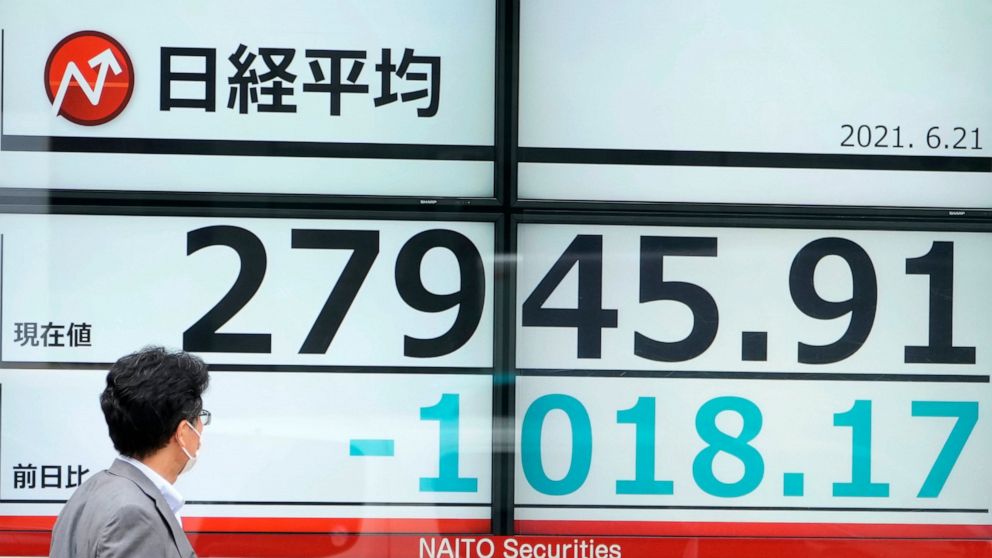
BANGKOK — Asian markets skidded on Monday, with Japan’s Nikkei 225 index losing 3.3%, after a sell-off Friday on Wall Street gave the S&P 500 its worst weekly loss since February. U.S. futures were marginally lower.
Investors are still recalibrating their moves after the Federal Reserve’s signal last week that it may raise current ultra-low rates sooner than had been expected. That gave the Dow Jones Industrial Average its worst weekly loss since last October.
Part of the Fed’s mission is to keep prices under control. The fear is that burgeoning inflation may prompt central banks to dial back the lavish support that has lifted markets to new highs after they plunged at the onset of the coronavirus pandemic last year.
Until its latest policy meeting, last week, the Fed had indicated it viewed recent price hikes as transient and would let the recovering economy run hot. Now it’s forecasting raising interest rates twice in 2023.
“The shift to an earlier timeline for a rate hike, accompanied with an upward revision in core inflation forecast to 3%, seems to suggest that the Fed may still be concerned about inflationary pressures to some extent as opposed to its previous stance of letting inflation run wild,” Yeap Jun Rong of IG said in a commentary.
The Nikkei gave up 953 points to 28,010.93 and the Kospi in Seoul lost 0.8% to 3,240.79. Hong Kong’s Hang Seng index lost 1.3%, to 28,438.31. Australia’s S&P/ASX 200 declined 1.8% to 7,235.30.
The Shanghai Composite index edged 0.1% higher, to 3,529.18.
India’s Sensex lost 0.3% and Thailand’s benchmark fell 1%.
On Friday, the S&P 500 fell 1.3% to 4,166.45 in a broad retreat, while the Dow Jones Industrial Average lost 1.6%, to 33,290.08. The Nasdaq composite fell 0.9% to 14,030.38.
Markets were spooked after St. Louis Federal Reserve President James Bullard said Friday on CNBC that his personal prediction was that the first rate increase may come as soon as next year.
It’s an acknowledgment that a rebounding economy with near-record prices for homes and stocks may not need super low rates much longer. A recent burst of inflation may also be upping the pressure. But any pullback in Fed support would be a big change for markets, which have been feasting on ultra-low rates for more than a year.
The Fed also has begun talks about slowing its $120 billion of monthly bond purchases, which are helping to keep mortgages and other longer-term borrowing cheap. But the Fed’s chair has said such a tapering is still likely a ways away.
The Dow industrials lost 3.5% last week. The Nasdaq composite, which has more high-growth tech stocks, dipped a much more modest 0.3%.
Still, the major U.S. stock indexes remain relatively close to their record highs, as the economy continues to leap out of the recession caused by the pandemic. The S&P 500 is only about 2% below its all-time high set on Monday, and the Dow is within 5% of its record set last month.
A measure of nervousness in the stock market, known as the VIX, rose Friday but is only back to where it was about a month ago.
The 10-year Treasury yield eased to 1.40% on Monday from 1.43% late Friday.
In other trading, U.S. benchmark crude oil rose 45 cents to $72.09 per barrel in electronic trading on the New York Mercantile Exchange. It gained 60 cents to $71.64 on Friday. Brent crude, the international standard, picked up 35 cents to $73.86 per barrel.
The U.S. dollar was at 109.92 Japanese yen, down from 110.27 on Friday. The euro rose to $1.1867 from $1.1861.