

Britain and US will build Australia’s first fleet of NUCLEAR submarines as part of new security pact
Global war of words over China: Furious France says it has been ‘stabbed in the back’ by UK-US defence pact to take on Beijing by building Australia’s nuclear-powered submarines – which will be BANNED from New Zealand
Unprecedented security partnership was announced by Boris Johnson, Joe Biden and Scott MorrisonThe agreement will see UK, US and Australia share nuclear technology secrets in tech battle with the ChineseThe pact means Australian navy will be equipped with nuclear-powered vessels made in the UK and the USFrance was due to make Australia’s new subs – but claimed last night it had been ‘stabbed in the back’ New Zealand also isolated with Jacinda Ardern declaring the submarines will be banned from their waters
<!–
<!–
<!–<!–
<!–
(function (src, d, tag){
var s = d.createElement(tag), prev = d.getElementsByTagName(tag)[0];
s.src = src;
prev.parentNode.insertBefore(s, prev);
}(“https://www.dailymail.co.uk/static/gunther/1.17.0/async_bundle–.js”, document, “script”));
<!–
DM.loadCSS(“https://www.dailymail.co.uk/static/gunther/gunther-2159/video_bundle–.css”);
<!–
A war of words has broken out over a new nuclear submarine pact between the UK, US and Australia aimed at combatting China – with Beijing denouncing their ‘Cold War mentality’, France fuming after its $90bn sub contract with Canberra was torn up, and New Zealand and Canada side-lined from the deal.
The new alliance – called AUKUS – will see the US and UK cooperate to build Australia’s first ever nuclear submarine fleet which will comprise at least eight vessels. The trio will also share other military technologies such as artificial intelligence, cyber defence, quantum computing and long-range strike capabilities.
Boris Johnson, Joe Biden and Scott Morrison were careful not to mention Beijing as they announced the new deal last night, but there can be little doubt that the alliance’s purpose is to counter China’s growing aggression – particularly in the South China Sea, which is criss-crossed by valuable trading routes, and towards Taiwan.
China wasted little time responding to the deal, with foreign ministry spokesman Zhao Lijian denouncing the ‘exclusionary bloc’ which he said ‘seriously undermines regional peace and stability and intensifies the arms race.’
But Beijing is far from the only upset party. Paris was also quick to react, with foreign minister Yves Le-Drian complaining it is a ‘stab in the back’ after a $90bn deal for France supply Australia with 12 conventionally-powered submarines was torn up. The French subs were not due for completion until mid-2030, while the new pact aims for a much faster delivery time.
The deal also side-lines New Zealand and Canada – who together with the UK, US and Australia make up the Cold War-era Five Eyes intelligence alliance. While AUKUS is not a straight replacement for Five Eyes, it is almost certain to reduce its importance and isolates Wellington and Ottawa from the group.
It seems the duo have been punished for failing to take a stronger stance against Beijing, just four months after New Zealand refused to sign a joint Five Eyes statement which criticised China’s aggression in the South China Sea, its crackdown in Hong Kong, threats to Taiwan and its treatment of Uyghur Muslims.
Jacinda Ardern, New Zealand’s left-wing PM, has since admitted that she was not even consulted on the new pact – adding that Australia’s new subs will be banned from entering New Zealand waters under the country’s long-standing ‘nuclear free’ policy.
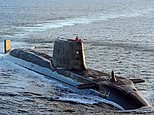
Britain and America are to help Australia build a fleet of nuclear-powered submarines as part of an unprecedented alliance known as the AUKUS pact to combat China’s naval dominance and will likely be the similar design as this Astute class submarine HMS Ambush (pictured)
China has inflamed tensions in the South China Sea in recent years by expanding its claimed territory, to the objection of its neighbors in the Asia-Pacific
The pact does not make the design of Australia’s new submarines clear, but they will be based on previous US and UK designs. Pictured above is a cross-section of Britain’s Astute-class nuclear attack subs, which is likely to mirror the new vessels
Meanwhile Canada is thought to have angered Washington after refusing to ban Chinese firm Huawei from incorporating its technology into the country’s 5G network – something America believes will leave it vulnerable to Beijing’s spies.
Liberal Prime Minister Justin Trudeau did not immediately react to the deal, suggesting he may also have been left out of the loop – though his Defence Department insisted it had been informed before the announcement was made while stressing the continued importance of Five Eyes.
China’s President Xi Jinping currently controls the world’s largest Navy, when measured purely by the number of vessels – comprising some 770 vehicles, including large numbers of patrol ships and subs.
He is using the fleet to lay claim to the entire South China Sea – something the West and its allies hotly dispute – while also menacing Taiwan.
Western nations have been pushing back, sailing so-called ‘freedom of navigation’ missions through the region to test Xi’s resolve – with a recent and high-profile mission sailed by Britain’s £3bn HMS Queen Elizabeth aircraft carrier and her ‘strike group’, comprised of British and American destroyers alongside support vessels.
The US possesses what is widely regarded as the world’s most-powerful navy which includes a huge fleet of nuclear-powered aircraft carriers.
Giving Australia nuclear submarines is a significant development because the vessels need to refuel far less-often than traditional subs, allowing them to stay submerged longer and roam further – sailing undetected into waters which Beijing is trying to claim.
Chinese state media has threatened to carry out ‘freedom of navigation’ operations of its own, with regime mouthpiece Global Times publishing an editorial on Wednesday threatening that warships will ‘soon’ turn up off the coasts of Hawaii and Guam – where the US has large military bases.
‘Hopefully when Chinese warships pass through the Caribbean Sea or show up near Hawaii and Guam one day, the US will uphold the same standard of freedom of navigation,’ the article said. ‘That day will come soon.’
Under the terms of the new pact, the UK, US and Australia will spend the next 18 months working to construct a framework that will allow Australia to safely take command of a nuclear-powered fleet and other sensitive technologies.
The submarines will then be constructed in South Australia, making use of facilities already in place that were supposed to be used for the now-cancelled French submarines.
The UK’s Rolls-Royce plant near Derby and BAE Systems in Barrow-in-Furness are also expected to be involved in the design and build of the submarines, creating hundreds of highly-skilled scientific and engineering roles in Britain.
Prime Minister Boris Johnson has hailed the announcement, saying it will increase security in the Indo-Pacific region, strengthen ties with two of Britain’s oldest allies, and cement Britain as a technological and scientific superpower while helping to reduce the costs of its own future military projects.
The deal does not make it clear exactly what type of submarines Australia will eventually receive, or what technology will be incorporated in them.
Nevertheless, it marks the first time in 50 years that the US has shared its submarine technology, and Australia will be only the second country to receive it – after the UK.
Australia will join an elite group of nations operating nuclear-powered subs that includes France, China, India and Russia. The deal will not give Australia nuclear weapons, as the country has a long-standing commitment not to develop them.
Australia already has diesel-electric submarines but the new stealthier fleet will be faster, able to carry more, and can stay underwater for longer – covering greater distances without expelling traceable exhaust gases.
The new submarines, built using UK and US components, will ‘protect and defend our shared interests in the Indo- Pacific’, Downing Street said.
Britain will also share its cyber capabilities, artificial intelligence, quantum technologies and undersea systems with allies as part of the deal, ushering in a new era of collaboration on security and defence-related science, technology, industrial bases and supply chains.
China already has a substantial number of nuclear-powered submarines. The Pentagon assessed in its 2020 China Military Power report that China has the largest navy in the world, with an overall battle force of approximately 350 ships and submarines, including more than 130 major surface vessels.
China was not mentioned in the cross-continental briefing but there was frequent reference to the changing situation in the region.
Tom Tugendhat, Conservative chairman of the Commons Foreign Committee, said: ‘The reason for all this is clear – China.’
He tweeted: ‘After years of bullying and trade hostility, and watching regional neighbours like the Philippines see encroachment into their waters, Australia didn’t have a choice.’
China’s U.S. embassy reacted by saying that countries ‘should not build exclusionary blocs targeting or harming the interests of third parties.’
‘In particular, they should shake off their Cold-War mentality and ideological prejudice,’ it said.
Australia’s plea for help to replace its ageing Collins-class subs prompted the new deal agreed by Mr Johnson, US President Joe Biden and Australian Prime Minister Scott Morrison.
The last time Britain and the US formally agreed collaborate on nuclear technology to build submarines was in 1958. Although Britain has operated nuclear-powered subs for over 60 years, Canberra has never built its own.
Britain’s Prime Minister Boris Johnson, Australia’s Prime Minister Scott Morrison (C) and US President Joe Biden attend a joint press conference to announce the AUKUS partnership last night
China has been rapidly expanding its naval capabilities in recent years, and now has two aircraft carriers which it is using to assert its claim over the South China Sea (pictured, Chinese aircraft carrier Liaoning patrols with its support vessels)
Chinese navy sailors march in formation during a parade to celebrate the 70th Anniversary of the founding of the People’s Republic of China at Tiananmen Square, on October 1, 2019
Australia is seen as essential to counter China’s regional influence, especially in the contested South China Sea.
In recent years, the UK and Australia have increasingly worked together on defence, with joint training exercises.
Last night Mr Johnson said: ‘The UK, Australia and US are natural allies.
‘While we may be separated geographically, our interests and values are shared. The AUKUS alliance will bring us closer than ever, creating a new defence partnership and driving jobs and prosperity.’
As part of a joint statement with the other two leaders, Mr Johnson added: ‘The endeavour we launch today will help sustain peace and stability in the Indo-Pacific region.
‘For more than 70 years, Australia, the United Kingdom, and the United States, have worked together, along with other important allies and partners, to protect our shared values and promote security and prosperity.
‘Today, with the formation of AUKUS, we recommit ourselves to this vision.’
‘We all recognize the imperative of ensuring peace and stability in the Indo-Pacific over the long term,’ Biden said Wednesday from the East Room of the White House.
‘We need to be able to address both the current strategic environment in the region and how it may evolve because the future of each of our nations, and indeed the world, depends on a free and open Indo-Pacific, enduring and flourishing in the decades ahead.’
The three countries already share extensive intelligence through the Five Eyes alliance, which also involves Canada and New Zealand.
It is not known when the vessels will be ready, but officials said the initial scoping phase is expected to take 18 months when it will be determined where they will be built and by whom.
Mr Johnson said Scotland and parts of the north of England and the Midlands would feel the benefit of the work on the nuclear-powered submarines, with the Government keen to exploit the Royal Navy’s decades-worth of knowledge of using such machines.
At a later press conference in Canberra, Mr Morrison said it was undecided if Australia would purchase British-built BAE Systems Astute class submarines or the Virginia class vessels constructed in the US.
French foreign minister Jean-Yves Le Drian and armed forces minister Florence Parly said in a statement issued by the country’s embassy in Canberra that it had taken note of Australia’s decision to halt the Future Submarine programme with France.
‘This decision is contrary to the letter and spirit of the cooperation that prevailed between France and Australia, based on a relationship of political trust and on the development of a very high-level defence industrial & technological base in Australia,’ the statement added.
A man waves a Union flag as the British Royal Navy aircraft carrier HMS Queen Elizabeth sails out of Tokyo bay on September 8, on the final leg of a journey that has inflamed tensions with China
‘The world is a jungle,’ ex-ambassador to the US Gerard Araud tweeted on Thursday morning
Earlier this year, in the integrated review of security and foreign policy, the UK Government outlined plans for a ’tilt’ in focus to the Indo-Pacific.
Aircraft carrier HMS Queen Elizabeth was earlier this year deployed on a voyage East in a decision said to be about sending a message to Beijing and Russia about Britain’s military might.
The Indo-Pacific area is of particular concern due to increasing geopolitical tensions such as unresolved territorial disputes and the risk of nuclear proliferation.
France has been ‘stabbed in the back’ by the Australian nuclear submarine deal, a former top diplomatic official has said.
‘The world is a jungle,’ ex-ambassador to the US Gerard Araud tweeted on Thursday.
‘France has just been reminded this bitter truth by the way the US and the UK have stabbed her in the back in Australia. C’est la vie.’
Australia has for years been planning to build a fleet of 12 diesel-powered submarines in Adelaide via French company Naval Group, with a deal made in 2016 valued at $90billion.
The French government later on Thursday said Australia’s decision to ditch the agreement was ‘contrary to the spirit of cooperation which prevailed’ between the two countries.
Foreign Minister Jean-Yves Le Drian and Armed Forces Minister Florence Parly said the change in plan ‘marks an absence of coherence that France can only observe and regret’.
Prime Minister Scott Morrison reportedly held concerns Naval Group would be unable to deliver submarines until 2030 with deadline and price disputes.
Defence officials have openly discussed abandoning the deal since June and told a Senate estimates hearing in June there were ‘challenges’ with the agreement.
Australia will instead embrace nuclear power after decades of debate – marking the first time the US and UK have shared their nuclear submarine technology with another nation. orrison