

Inside the creation of the US-Australia submarine deal
Officials familiar with the matter said the discussions were kept exceedingly quiet, even within their own governments, given the sensitive nature of the technology, the prospect for angering China and the belief that any word leaking out could potentially scuttle the entire thing.
The process “was undertaken with a high degree of discretion,” a senior administration official said.
Talks proceeded at the staff-level over the course of the spring before the issue was raised in a meeting between Biden, Australian Prime Minister Scott Morrison and British Prime Minister Boris Johnson on the sidelines of the G7, held in June on the Cornish coast. There was no public disclosure of the submarine deal at the time, though a White House description of the talks said the leaders “agreed that the strategic context in the Indo-Pacific was changing and that there was a strong rationale for deepening strategic cooperation between the three governments.”
Biden met French President Emmanuel Macron on the same day, and the two men appeared to get on well: cameras caught them wrapping their arms over each others’ shoulders as they walked from the beach to the summit venue. Officials said one-on-one talks between the men, which occurred on a sunny deck overlooking Carbis Bay, seemed cordial.
Nor did it arise in subsequent meetings between top US and French officials, even as the France-Australia deal was being touted in Paris as a sign of France’s focus on Pacific security.
It wasn’t until this week that the US formally told France of the agreement, which was finalized over the past month.
“It was a surprise,” he said. “It was not a surprise that there was a discussion. We were ready to have further discussions. What was also a surprise was that all the allies, very close allies, were so much involved.”
US officials said they informed France before the announcement was formalized during a Wednesday afternoon event at the White House. Secretary of State Antony Blinken said there were conversations with the French in the 24-48 hours before it was made public.
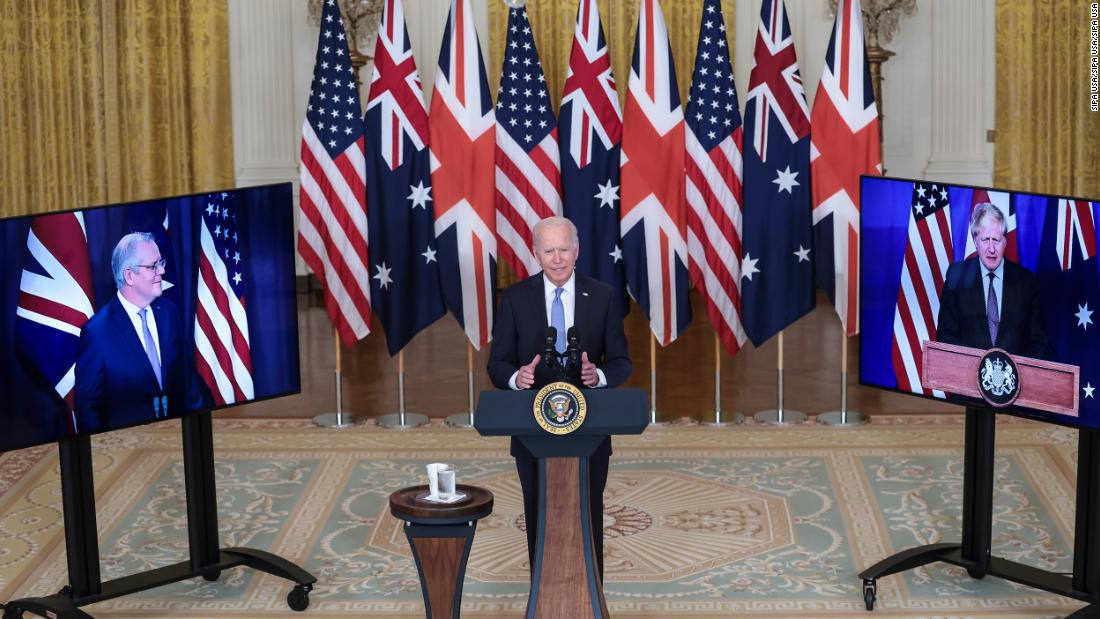
A person familiar with the matter said the White House called Étienne on Wednesday in the hours before Biden made the announcement from the East Room alongside Morrison and Johnson, who beamed in virtually.
The official said that, for now, there is a general belief that the dust-up will not permanently damage relations with France, but acknowledged the spat remains in its early days. The official acknowledged that relations between Biden and Macron — who is preparing to run for reelection — will likely take time to repair.