

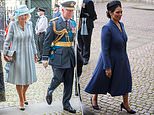
Prince Charles and the Duchess of Cornwall join Boris Johnson and Priti Patel at Battle of Britain

Prince Charles and the Duchess of Cornwall join Home Secretary Priti Patel – wearing Royal Air Force blue – at Westminster Abbey for the 81st Battle of Britain Anniversary Service

Prince wore full military outfit to attend Westminster Abbey service to remember those lost in Battle of BritainA smiling Duchess of Cornwall, 74, looked chic in a striped blue dress-jacket and a wide-brimmed hat The royals were joined by key figures from the Government including Prime Minster Boris Johnson and Home Secretary Priti Patel, who donned a mid-length navy dress jacket and a charcoal pillbox hat

Advertisement


<!–

<!–

<!–<!–

<!–

(function (src, d, tag){
var s = d.createElement(tag), prev = d.getElementsByTagName(tag)[0];
s.src = src;
prev.parentNode.insertBefore(s, prev);
}(“https://www.dailymail.co.uk/static/gunther/1.17.0/async_bundle–.js”, document, “script”));
<!–

DM.loadCSS(“https://www.dailymail.co.uk/static/gunther/gunther-2159/video_bundle–.css”);


<!–

The heir-to-the throne and the Duchess of Cornwall attended a service to mark the 81st Battle of Britain Anniversary Service at Westminster Abbey on Sunday morning. 

After a pared down service due to the pandemic in 2020, this year’s annual remembrance saw social distancing measures remain in place but many more well-wishers gathered outside the historic London building to see the royals and members of the British Government arrive. 

The service marks the victory, and loss of life, by the Royal Air Force during the Battle of Britain in 1940.  

Scroll down for video 

The royal couple arrive at Westminster Abbey service on Sunday to remember those lost in the Battle of Britain. Prince Charles, 72, wore a full military uniform while the Duchess of Cornwall looked chic in a striped blue dress-jacket and a wide-brimmed hat

Caution: While clergy wore face masks as they escorted Charles and Camilla through the Abbey’s entrance, the royals opted not to

The 11am service remembers the 1,497 pilots and aircrew killed or mortally wounded in the battle was borne through the church

The Duchess of Cornwall offers a smile to well-wishers as she arrived at Westminster Abbey this morning

Home Secretary Priti Patel, who donned a mid-length navy dress jacket – in Royal Air Force blue – and a charcoal pillbox hat

Military chic: The Home Secretary, 49, wore a three-tiered string of pearls and matching pearl drop earrings, with her hair neatly pinned back under a pillbox hat 

The royals were joined by key figures from the Government including Prime Minster Boris Johnson, who wore a sober grey suit and opted to wear a face mask

Mr Johnson’s face mask offered a nod to the patriotism of the event, with a Union Jack stitched onto it 

Prince Charles, 72, donned a full military outfit to attend the service, arriving just before 11am in a royal car. 

The heir-to-the throne was appointed to the rank of Marshal of the RAF in 2012, the highest rank in the British Royal Air Force. 

Camilla, 74, looked chic in a striped dress with multiple shades of blue and a pastel blue wide-brimmed hat. 

The Duchess of Cornwall accessorised her look with cream heels with a navy blue toe and a three-tier string of pearls with a central diamond brooch and a sapphire blue cross bracelet. 

Neither of the royals arrived wearing masks. The couple were joined by Prime Minister Boris Johnson and Home Secretary Priti Patel. Mr Johnson did opt to wear a black face mask, and the covering offered a nod to the patriotism of the event, with a Union Jack stitched onto it.

While Mr Johnson opted for a sober grey suit and black tie Ms Patel wore a mid-length navy dress jacket – in Royal Air Force blue – with matching heels and a charcoal pillbox hat. 

Earlier, the couple had arrived outside Westminster Abbey in their royal vehicle, with tourists gathering to catch a glimpse of the royals

Camilla looked in good spirits as she arrived at the London church this morning ahead of the 11am service

The Duchess of Cornwall accessorised her look with cream heels with a blue toe and a three-tier string of pearls with a central diamond brooch 

Prince Charles graduated from Cranwell in Lincolnshire and was awarded his RAF pilot’s wings in 1971. The royal was appointed to the rank of Marshal of the RAF in 2012, the highest rank in the British Royal Air Force

When the service was finished around midday, the royal couple chatted to clergy as they left Westminster Abbey

The Home Secretary, 49, also wore a three-tiered string of pearls and matching pearl drop earrings, with her hair neatly pinned back under the military-style hat. 

Westminster Abbey has held a service of thanksgiving and rededication on Battle of Britain Sunday every year since 1944.  

While clergy wore facemasks as they escorted Charles and Camilla through the Abbey’s entrance, the royals opted not to.

The 11am service included an act of remembrance, during which the Battle of Britain Roll of Honour bearing the names of 1,497 pilots and aircrew killed or mortally wounded in the battle was borne through the church.

The Battle of Britain was a major air campaign fought in the skies over the UK in 1940, and although the battle took place between July and October, September 15 saw the British Royal Air Force (RAF) gain a decisive victory over the Luftwaffe in what was Nazi Germany’s largest daylight attack.  

Prince Charles graduated from Cranwell in Lincolnshire and was awarded his RAF pilot’s wings in 1971. 

The Battle of Britain: Hitler’s failed attempt to crush the RAF

In the summer of 1940, as the Nazi war machine marched its way across Europe and set its sights on Britain, the RAF braced for the worst. 

Young men, in their late teens or early twenties, were trained to fly Spitfires and Hurricanes for the coming Battle for Britain, with others flying Blenheims, Beaufighters and Defiants, becoming the ‘aces’ who would secure the country’s freedom from Hitler’s grasp. 

But Britain’s defiance came at a cost. From an estimated crew of 3,000 pilots, roughly half survived the four-month battle, with 544 Fighter Command pilots and crew among the dead, more than 700 from Bomber Command and almost 300 from Coastal Command falling to secure Britain’s skies. 

The losses were heavy, but the Germans, who thought they could eradicate the RAF in a matter of weeks, lost more. 

2,500 Luftwaffe aircrew were killed in the battle, forcing German Air Command to reconsider how easily Britain would fall to an invading Nazi occupation force. 

The pilots who gave everything in the aerial fight for British freedom were named ‘The Few’, after a speech from Sir Winston Churchill, who said: ‘The gratitude of every home in our island, in our Empire, and indeed throughout the world, goes out to the British airmen who, undaunted by odds, unwearied in their constant challenge and mortal danger, are turning the tide of the world war by their prowess and by their devotion.

‘Never in the field of human conflict was so much owed by so many to so few.’ 

‘Never in the field of human conflict was so much owed by so many to so few’ (pictured: An aerial photograph of Spitfires) 

After the fall of France to the Axis in May 1940, German High Command considered how best to push the fight across the English Channel to take Britain out of the fight.

Up until mid-July the German campaign consisted of relatively small-scale day and night air raids, targeting towns, aerodromes, ports and the aircraft industry.

But the Luftwaffe was at full readiness, ready to ramp up attacks on ships and ports and eliminate the RAF in the air and on the ground.

After the Allies were defeated in western mainland Europe, the German Air Force set up bases near the Channel to more readily take on Britain, hurriedly establishing the infrastructure needed to co-ordinate an aerial conflict with the UK.

As the Battle of Britain begun, the Royal Air Force consistently downed more Axis aircraft than they lost, but British fighters were often overwhelmed by the greater number of enemy aircraft.

Pictured: One of the most iconic images of the summer of 1940 and the fight above Dunkirk, with Squadron 610’s F/Lt Ellis pictured at the head of his section in DW-O, Sgt Arnfield in DW-K and F/O Warner in DW-Q

Fighting in France and Norway had left British squadrons weakened as the time now came to defend the homeland from Nazi occupation, but as the year went on, the RAF’s fighting force increased in strength, with more pilots, aircraft and operational squadrons being made available.

The Luftwaffe started a mounting campaign of daylight bombing raids, targeting strategic targets such as shipping convoys, ports, and airfields – and probing inland to force RAF squadrons to engage in an attempt to exhaust them.

German air units also stepped up night raids across the West, Midlands and East Coast, targeting the aircraft industry with the objective of weakening Britain’s Home Defence system, especially that of Fighter Command, in order to prepare for a full-scale aerial assault in August.

Heavy losses were sustained on both sides.

The main Luftwaffe assault against the RAF, named ‘Adler Tag’ (Eagle Day), was postponed from August 10 to three days later due to poor weather.

Hawker Hurricane planes from No 111 Squadron RAF based at Northolt in flight formation, circa 1940

Pictured: Squadron 610’s fighter pilots, a unit which witnessed some of the most intensive aerial combat in the Second World War (taken at RAF Acklington, in Northumberland, between 17-19 September 1940)

The Germans’ plan was to make RAF Fighter Command abandon south east  England within four days and defeat British aerial forces completely in four weeks.

The Luftwaffe battled ruthlessly in an attempt to exhaust Fighter Command through ceaseless attacks on ground installations, which were moved further inland, with airfields in southern England facing intensive daylight raids while night attacks targeted ports, shipping targets and the aircraft industry.

But despite sustaining heavy damage across the south, Fighter Command continued to push back against the Germans in a series of air battles, which inflicted critical losses upon the enemy, who thought the RAF would have been exhausted by this point.

Both sides feared becoming exhausted through the constant engagements.

Pictured: German plans to invade Britain, if naval and air superiority was achieved

Focus of the German attacks then shifted to London, where the RAF would lose 248 and the Luftwaffe would lose 322 between August 26 and September 6.

By September London had become the primary target of Luftwaffe aggression, with large-scale round-the-clock attacks carried out by large bomber formations with fighter escorts.

German Air Command had still not exhausted the RAF as it had hoped to, and British forces continued to face off against their German counterparts, with Fighter Command pushing back Hitler’s forces, forcing German invasion plans to be postponed.

By October, it had become apparent to the Germans that the RAF was still very much intact, and the Luftwaffe struck against Britain with single-engined modified fighter-bombers, which were hard to catch upon entry and still dangerous on their way out.

By the middle of the month German strategy had pivoted from exhausting the RAF to a ruthless bombing campaign targeting the Government, civilian population and the war economy – with London still the primary target.

But as of November, London became less of a target, with the Battle of Britain morphing into a new conflict – the Blitz.

Advertisement

Advertisement

Loading

Leave a Reply

Your email address will not be published. Required fields are marked *

Follow by Email
Pinterest
LinkedIn
Share