

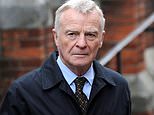
Oxford University is accused of ‘moral failure’ after accepting donations from Mosley family
Oxford University is accused of ‘moral failure’ after accepting more than £12million in donations from a charitable trust set up by Max Mosley to house fortune he inherited from his fascist leader father Sir Oswald
Oxford University accepted millions in donations from a trust set up by Max Mosley to house family fortune The £12million gifts were from trust which used some of the fortune he inherited from Sir Oswald MosleySir Oswald Mosley was the wartime leader of the British Union of Fascists and a Hitler sympathiserHe married wife Diana Mitford in 1936 in Berlin at the home of Joseph Goebbels, Nazi minister for propaganda Senior academics accused Oxford of ‘moral failure’ for accepting money from family linked to anti-Semitism
<!–
<!–
<!–<!–
<!–
(function (src, d, tag){
var s = d.createElement(tag), prev = d.getElementsByTagName(tag)[0];
s.src = src;
prev.parentNode.insertBefore(s, prev);
}(“https://www.dailymail.co.uk/static/gunther/1.17.0/async_bundle–.js”, document, “script”));
<!–
DM.loadCSS(“https://www.dailymail.co.uk/static/gunther/gunther-2159/video_bundle–.css”);
<!–
Oxford University has been accused of a ‘moral failure’ after accepting millions in donations from a trust set up by Max Mosley, pictured in 2011, to house the fortune he inherited from his Fascist leader father
Oxford University has been accused of a ‘moral failure’ after accepting millions in donations from a trust set up by Max Mosley to house the fortune he inherited from his Fascist leader father.
The university and two of its colleges – St Peter’s and Lady Margaret Hall – received the £12million gifts from a trust set up by Mosley, the former Formula 1 chief, which used some of the fortune he inherited from Sir Oswald Mosley, leader of the British Union of Fascists.
Senior academics have accused Oxford of a ‘vast hypocrisy’ for accepting donations from a family renowned for its links to Fascism and anti-Semitism while ‘going off the scale in wokery’ – a reference to moves to ‘decolonise’ the curriculum and having a plaque installed next to the Cecil Rhodes statue which critics claim depict the 19th Century imperialist as the ‘devil incarnate’.
Professor Lawrence Goldman, a former vice-master of St Peter’s who lost relatives in the Holocaust and spent five months trying to persuade the college to refuse its donation, told The Telegraph: ‘There has been a total moral failure.’
Lord Mann, the Government’s anti-Semitism advisor, said: ‘If Oxford is trying to rehabilitate the Mosley family name in any way, they can expect a very hostile response. I don’t imagine people would be very happy to have a Mussolini building, or a Hitler scholarship. People in this country will feel the same way in relation to the Mosley name.’
A spokesman for Campaign Against Antisemitism said: ‘The Mosley family has an infamous record in relation to anti-Semitism. Oxford University should think hard about accepting a donation from the family’s trust, ensuring that a portion of the money funds education about anti-Semitism or supports Jewish life at the university.’
And Robert Halfon, Conservative chairman of the Education Select Committee, told the newspaper: ‘I find it distressing that Oxford University is so keen to go on about diversity and inclusion, but is prepared to take the shilling from such sources.’
The university took in a £6million donation from the fund, while two Oxford colleges accepted £6.3million between them. Mosley, who died with cancer this year aged 81, set up The Alexander Mosley Trust in the name of his son who died from an drug overdose in 2009.
An Oxford spokesman confirmed that the £6million donation to the university will be used to set up the Alexander Mosley Professor of Biophysics Fund, while the sum given to St Peter’s is being put towards the construction of a new block of student accommodation in the city.
The university and the colleges said the funds were cleared by an independent committee, taking ‘legal, ethical and reputational issues into consideration’.
In a statement to MailOnline, it added: ‘We can confirm that donations to the Department of Physics from the Alexander Mosley Charitable Trust, including endowment of a chair in Biophysics named after Alexander Mosley, a graduate of the University, were all considered and approved by the University’s committee to review donations and research funding.’
Much of the money funnelled into the charitable foundation came from the estate of Sir Oswald, who married wife Diana Mitford in 1936 in Berlin at the home of Joseph Goebbels, the Nazi minister for propaganda, with Adolf Hitler as their guest of honour.
The university and two of its colleges – St Peter’s and Lady Margaret Hall – received the £12million gifts from a trust set up by Mosley, the former Formula 1 chief, which used some of the fortune he inherited from Sir Oswald Mosley, leader of the British Union of Fascists
The establishment’s acceptance of the charitable donations from a family renowned for its links to fascism has drawn ire from former professors
Max Mosley with his mother Lady Mosley and father Sir Oswald Mosley – leader of the British Union of Fascists – pictured in London in August 1962.
Dr Lawrence Goldman (pictured in 2015), the former director of the Institute of Historical Research and senior dean of St Peter’s college, accused the university of ‘vast hypocrisy’ and ‘moral failure’ for accepting the donations.
Mosley served as a Tory and Labour MP before he founded the British Union of Fascists. His movement had about 50,000 followers at its height and George Orwell once wrote that he doubted Mosley and his ilk ‘would ever be more than a joke to the majority of English’.
Lady Diana was one of six famous society sisters and an admirer of Hitler. Shortly after he was born, both his parents were arrested under wartime regulations as Nazi sympathisers.
During the 1936 abdication crisis, Mosley rallied his followers to support King Edward VIII, who later visited Nazi Germany with Wallis Simpson.
British fascists converged on Buckingham Palace, 10 Downing Street and the Houses of Parliament, calling loudly for the Stanley Baldwin’s resignation. Fears spread that Edward might even dismiss the Prime Minister and invite Mosley to form a government.
Max Mosley’s support for the British Union of Fascists and its successor, the Union Movement, is well documented, and his family’s links to Oxford go as far back as the 1960s.
He was sent to school in Germany for two years where he learned to speak fluent German. On his return to England, he spent a year at Millfield, a prestigious international boarding school, and then later went on to Oxford, graduating with a degree in physics in 1961.
In 1961, the former boss of world motorsport worked for a Fascist candidate in a local by-election whose campaign included the slogan ‘coloured immigration threatens your children’s health’, and was also arrested for assaulting anti-Fascist protesters during a march.
Mr Mosley, who had been involved in his father’s post-war party, the far-Right Union Movement, in his teens and early 20s, abandoned attempts to launch a political career with the Conservative party in the 1980s, claiming his name would have been a handicap. He joined the Labour party during Tony Blair’s leadership and later became a donor.
Oxford University has recently been embroiled in a number of rows ‘wokeness’. Last month, academics slammed Oriel College for pandering to Left-wing statue topplers by erecting a plaque which depicts Rhodes as the ‘devil incarnate’ and ‘distorts’ history.
Cambridge professor David Abulafia said the plaque ‘lacks balance’, claiming it is ‘only concerned with linking him to racist and imperialist policies’ and is ‘clearly a reaction to the Rhodes Must Fall campaign’.
Students began campaigning for the Rhodes statue outside Oriel to be removed in 2015, but the ‘Rhodes Must Fall’ protests were reignited after the toppling of a statue of slave trader Edward Colston in Bristol at the height of last summer’s Black Lives Matter protests.
The new plaque describes Rhodes as a ‘committed British colonialist’ who ‘obtained his fortune through exploitation of minerals, land and peoples of southern Africa. Some of his activities led to great loss of life and attracted criticism in his day and ever since.’
It adds: ‘In recent years, the statue has become a focus for public debate on racism and the legacy of colonialism. In June 2020, Oriel College declared its wish to remove the statue but is not doing so following legal and regulatory advice.’
The wording has now sparked a backlash among a group of academics who intend to write to Oriel’s Provost, Lord Mendoza, to express their concerns.
Prof Abulafia told the Telegraph: ‘I am not trying to defend Rhodes’s career right across the board. This is a man who was a great benefactor of Oxford University and who – it may seem strange to us – actually thought he was bringing benefits to the people who fell under his control.
‘The notice is only concerned with linking him to racist and imperialist policies. This is clearly a reaction to the Rhodes Must Fall campaign and it’s simply not how you do it.’
Rhodes, an Oxford student in the 1870s who left money to Oriel on his death in 1902, was an imperialist, businessman and politician who played a dominant role in southern Africa in the late 19th Century.
The university however seemed happy to turn a blind eye to the Mosley family’s chequered past. The £6 million donation to Oxford University will be used to set up the Alexander Mosley Professor of Biophysics Fund, while the £5 million given to St Peter’s is being put towards the construction of a new block of student accommodation in the city (pictured: Oxford University/St Mary’s church)
He founded Rhodesia and served as prime minister of the Cape Colony in the 1890s. Rhodes was not a slave trader but supported apartheid-style measures in southern Africa.
Last year, Oriel’s governing body said it was their ‘wish’ to remove the statue and it established an independent commission to examine the key issues surrounding it. The commission eventually concluded its inquiry saying it backed the college’s original wish to remove the statue.
More than 100 Oxford academics are refusing requests from Oriel to give tutorials to its undergraduates. They have also pledged not to assist the college with its outreach work and admissions interviews, and they will refuse to attend or speak at talks, seminars, and conferences sponsored by the college.
Oxford students recently removing a portrait of the Queen from Magdalen’s Middle Common Room due to the monarchy’s links to colonialism, while Theresa May’s portrait was taken down from the geography department so as not to antagonise EU students.
In March, Oxford was considering changes to the music curriculum, including alternative titles for courses, after certain staff raised concerns about the ‘complicity in white supremacy’ in the teaching of the subject.
Professors were set to reform their music courses to move beyond the classic repertoire, which includes the likes of Beethoven and Mozart, in the wake of the BLM movement.
University staff argued that the current curriculum focuses on ‘white European music from the slave period’, according to The Telegraph.
Documents seen by the publication indicate proposed reforms to target undergraduate courses. It claimed that teaching musical notation had ‘not shaken off its connection to its colonial past’ and would be ‘a slap in the face’ to some students.
And it added that musical skills should no longer be compulsory because the current repertoire’s focus on ‘white European music’ causes ‘students of colour great distress’.
It is thought that music writing will also be reformed to be more inclusive.
But the proposals caused upset among some faculty members who argued that it was unfair to accuse those teaching music from before 1900 of being concerned with just ‘white’.
All Souls College in January removed the name of an 18th century slave trader from its main library but defied calls to take down his statue.
The college reviewed its link to Christopher Codrington, a Barbados-born colonial governor, in the wake of last year’s Black Lives Matter movement.
The former fellow, who died in 1710, bequeathed £10,000 to the library which has since been unofficially known as the Codrington Library.
A marble statue by Edward Cheere of the benefactor has been standing in the library for centuries and the college says it has no plans to take it down despite the clamour from students.
The All Souls governing body said: ‘Rather than seek to remove it the College will investigate further forms of memorialisation and contextualisation within the library, which will draw attention to the presence of enslaved people on the Codrington plantations, and will express the College’s abhorrence of slavery.’
Their review found that Codrington’s wealth ‘derived largely from his family’s activities in the West Indies, where they owned plantations worked by enslaved people of African descent’.
The college claims it has undertaken a number of measures to address the colonial legacy, including erecting a memorial plaque in memory of those who worked on the Caribbean plantations.
It comes just days after Oxford University’s Linacre College, named after humanist and physician Thomas Linacre (1460-1524), announced its name would be changed to ‘Thao college’ in honour of Vietnamese billionaire Nguyen Thi Phuong Thao who donated a whopping £155 million.
Thao founded the budget airline VietJet Air and has been fined several times for perking up her flights with semi-naked stewardesses.