

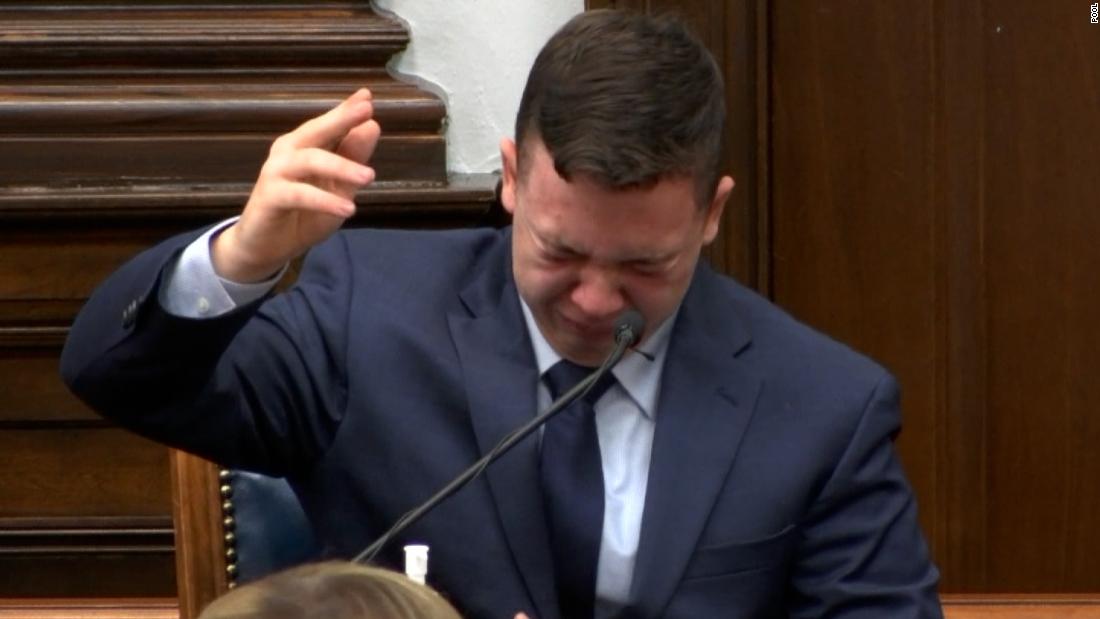
Kyle Rittenhouse’s defense plans to call several more witnesses after his crucial testimony
The first witness called by defense lawyers on the eighth day of testimony was use-of-force expert John Black, who analyzed video of the shootings.
“I didn’t do anything wrong. I defended myself,” he testified.
He testified he subsequently shot at three other people because one tried to kick him, one hit him with a skateboard and one pointed a gun at him.
“If I would have let Mr. Rosenbaum take my firearm from me, he would have used it and killed me with it and probably killed more people if I would have let him get my gun,” he testified.
Rittenhouse’s testimony was crucial to both the prosecution’s and the defense’s arguments about his actions on the night of August 25, 2020, when Rittenhouse shot at four people, killing two of them and wounding one. The prosecution has sought to show Rittenhouse’s actions were reckless and criminal, while the defense has said he acted in self-defense.
Rittenhouse broke down in tears at one point in his testimony, leading to a short break.
“Don’t get brazen with me,” Schroeder warned. “You know very well that an attorney can’t go into these types of areas when the judge has already ruled without asking outside the presence of the jury to do so, so don’t give me that.”
The defense asked for a mistrial with prejudice due to the prosecution’s questioning, and the judge said he would take it under advisement.
Rittenhouse has pleaded not guilty to six charges, including first-degree intentional homicide, first-degree reckless homicide and first-degree attempted intentional homicide. Judge Schroeder dismissed a curfew violation charge Tuesday, saying prosecutors had failed to present evidence to support it.
Rittenhouse lays out the night of the shootings
Rittenhouse, now studying nursing at Arizona State University, testified that he lived in Antioch, Illinois, with his mother and that his father lived in Kenosha. He said he went into Kenosha on August 25, 2020, with a rifle and small medic kit and joined up with a group of armed people in order to protect a car dealership and to provide first aid.
A man he identified as Rosenbaum, 36, twice threatened to kill Rittenhouse during the night, he testified. Later, Rittenhouse became separated from the other armed people, and Rosenbaum ran at him and threw a plastic bag at him. Rittenhouse testified he believed at the time the thrown object was a chain.
Seconds after that gunshot, Rittenhouse turned and saw Rosenbaum coming at him with his arms out front. He then shot Rosenbaum four times, killing him.
In cross-examination, he said he pointed the gun at Rosenbaum during the chase even though he knew that was a dangerous thing to do.
“He was chasing me, I was alone, he threatened to kill me earlier that night. I didn’t want to have to shoot him,” Rittenhouse testified. “I pointed it at him because he kept running at me and I didn’t want him to chase me.”
Rittenhouse then tried to run down the street to where police were situated to turn himself in, he testified, but a “mob was chasing me.” While running, he became lightheaded and fell to the ground, he said.
An unknown person jumped at him trying to kick him, and Rittenhouse fired at the person twice. Anthony Huber, 26, then came at him, struck him with a skateboard, and grabbed his gun, he testified. Rittenhouse shot him once in the chest, killing him.
Much of the cross-examination centered on why Rittenhouse brought an AR-15-style rifle into an already volatile situation in Kenosha. Rittenhouse explained he did so to protect himself, even as he said he didn’t necessarily think he would be in danger.
“I brought the gun for my protection, but I didn’t think I would have to use the gun and end up defending myself,” he testified. He also said he did not think carrying a rifle would “cause a negative reaction” among the crowd.