

Government ramps up programme to keep winter wave at bay
Covid booster jabs for all over-40s: No10 expands programme and says good uptake could save Xmas — as ministers confirm all healthy 16-17 year olds will get SECOND vaccine
Older Britons are currently able to get a top up jab from six months after they received their second doseBut now ministers are poised to expand the drive to younger age groups amid concern over a winter waveMinister Oliver Dowden has called on Britons to get their jabs to ensure the country has a ‘decent’ Christmas
<!–
<!–
<!–<!–
<!–
(function (src, d, tag){
var s = d.createElement(tag), prev = d.getElementsByTagName(tag)[0];
s.src = src;
prev.parentNode.insertBefore(s, prev);
}(“https://www.dailymail.co.uk/static/gunther/1.17.0/async_bundle–.js”, document, “script”));
<!–
DM.loadCSS(“https://www.dailymail.co.uk/static/gunther/gunther-2159/video_bundle–.css”);
<!–
Britain’s Covid booster vaccine programme is being expanded to under-50s to safeguard against a winter wave, it was confirmed today.
The Joint Committee on Vaccination and Immunisation has recommended third doses are given to an extra 8million Britons in their forties.
Eligible people can pre-book their vaccine five months after their second dose, but they will only get their booster after six months have passed.
The UK’s medical regulator said Britons can come forward for their booster ‘with the confidence that they are safe and effective’. A total of 12m top-up doses have already been administered.
Over-40s will be offered either a dose of Pfizer or Moderna as a booster, regardless of which jab they were initially vaccinated with.
Data published today by the UK Health Security Agency revealed that people who get a third shot are 80 per cent less likely to get symptomatic Covid than those who had their second dose in spring.
There has not been enough time to measure the effect on hospitalisations and deaths, officials said, but protection is expected to be ‘even higher’.
‘Every jab builds our wall of defence across the country ahead of Christmas,’ said Sajid Javid, the Health Secretary, ahead of the announcement. Conservative chairman Oliver Dowden warned Christmas was ‘in our hands’.
It was also announced today that 16 and 17-year-olds will be offered a second dose of their Covid vaccine. They will be given the second Pfizer dose 12 weeks following their first jab because evidence suggests the longer gap reduces the risk of side effects.
Officials had delayed a decision on second doses while it investigated reports of heart inflammation in young people.
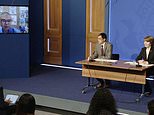
The booster programme was expanded to over-40s today, and 16 and 17-year-olds were told they could get thier second dose of the vaccine. Pictured from left to right are England’s deputy chief medical officer Jonathan Van-Tam, the chair of the JCVI Professor Wei Shen Lim and chief executive of Britain’s medical regulator the MHRA Dr June Raine
Conservative party chairman Oliver Dowden said today that Christmas was ‘in our hands’ ahead of the expected roll out of the jab to younger age groups. Older Britons have been able to get their third jabs since September
Over-50s were invited to get their third doses in September, after data showed antibody levels had started to drop off in the age group. The youngest in this group will be able to get their third dose from mid-December.
Over-40s will be invited for their third dose from January, after Christmas, about six months after when second doses were dished out in the age group.
Professor Wei Shen Lin — who chairs the JCVI — told a Downing Street press conference that under-40s may also be invited for a top up shot at ‘some point’.
He said: ‘We don’t know whether that is definitely the case yet. We are looking very closely at the data all the time and should there be sufficient signal to warrant a third dose, so a booster dose for this age group, then certainly we will announce that and advise that accordingly.’
England’s deputy chief medical officer Professor Jonathan Van-Tam urged Britons to get their third shots to ensure the country could have an ‘as safe and disruption-free winter as possible’.
He told the briefing: ‘People keep asking me about Christmas. I think for Christmas and the winter period, we can expect respiratory viruses to be around and we are particularly concerned that flu will come back and add to our problems, and it could be quite a bumpy few months ahead.
‘But everyone has a key role to play in achieving as safe and disruption-free a winter as possible.
‘Wear face coverings in crowded places if it is practical to do so, increase indoor ventilation whenever you can, make sure you are vaccinated and, like any medicine, make sure you finish the course.
‘And when you are called for your booster please come forwards at pace so that we as a whole UK can get on and finish this job.’
Health Secretary Sajid Javid said he had accepted the JCVI’s advice to expand the booster programme to younger age groups, and to offer 16 to 17-year-olds a second dose.
He said the NHS has already been asked to prepare to offer the vaccine to these age groups.
‘We know immunity to Covid begins to wane after six months and new data published today shows a third dose boosts protection against symptomatic infection to more than 90 per cent — this highlights just how important it is that everyone eligible gets their top-up jabs as soon as possible.
‘The JCVI will keep under review whether the booster programme should be extended to all people under the age of 40 and I look forward to receiving their advice in due course.
‘This is a national mission – the vaccines are the best way to protect yourself and your loved ones and I urge everybody to get your jabs as soon as you can.’
Dr June Raine, chief executive of the MHRA, said: ‘This further strengthens our ability to ensure people are protected against Covid and saves lives.
‘Our safety monitoring to date shows that Covid vaccines continue to have a positive safety profile for the majority of people. The vast majority of reactions which are reported relate to expected side-effects such as injection site reactions and flu-like symptoms, as was seen in our initial assessment.’
The booster programme was accused of being too sluggish last month, with hundreds of elderly people saying they could not find out where to book their appointment.
Ministers tweaked the booking system to allow people to book their booster from five months after their second dose, to help them get it in the diary. Data showed that after the update record numbers started signing up.
But many elderly people are still being left without adequate protection after NHS staff noted down the date of their second dose incorrectly.
Retired taxi driver Michael Kelly, 70, from Gateshead, told the Telegraph he had his second jab almost seven months ago on April 23.
But NHS staff noted this down as June 18 — two months later than actually happened — leaving him spending hours on the phone to 119 trying to book his follow-up appointment.
He is just one of many affected by this error, and it comes after it was revealed that up to 700,000 vaccine passports were affected by similar blunders this summer stopping thousands from holidaying abroad.
Some 360,000 booster shots are being dished out every day on average, up about a third from 270,000 a fortnight ago. Three quarters of over-75s have already got their boosters.
Calling on Britons to get their top up doses today, Mr Dowden warned that Christmas was ‘in our hands’.
He told Sky News: ‘If you get the booster when the call comes that is the biggest wall of defence that we have against Covid.
‘I am confident that if we stick the course, people take the boosters when they are asked to do so, that vaccine wall will hold up and we will be able to have a decent Christmas this year.
‘There are no plans to stop Christmas happening. The huge difference this time is the vaccine.’
He cautioned however that controls could be needed if the situation changed dramatically, such as the emergence of a new Covid variant.
‘We haven’t ruled it out. If the situation change dramatically we would have to review that again.’
‘Professor Lockdown’ Neil Ferguson — who advises SAGE — told BBC Radio 4’s Today programme at the weekend: ‘I see no reason why we shouldn’t be rolling them out to younger age groups once we’ve got through the priority groups: over-50s and the clinically vulnerable.
‘Our modelling suggests that, yes, it could make quite a big difference to driving transmission down to low levels.’
It comes after official data published today showed Covid booster jabs gave more than 90 per cent protection against symptomatic infection among over-50s.
The UK Health Security Agency — which took over the reigns from the now defunct Public Health England — found that two weeks after getting the top up protection was 93.1 per cent for AstraZeneca recipients, and 94 per cent for those who got the Pfizer shot.
After two doses of either vaccine, effectiveness against symptomatic disease appears to wane over time.
While experts say vaccine effectiveness against severe outcomes, such as hospital admission, remains high for several months after completing the primary course, researchers have seen greater waning in older adults and those with underlying medical conditions compared with young, healthy adults.
Dr Mary Ramsay, head of immunisation at the UKHSA, said: ‘Our findings demonstrate the protection provided by the booster dose against symptomatic infection in those at highest risk from developing severe Covid.
‘We know that in older age groups, protection from the first two vaccines is beginning to wear off, leaving millions that need extra protection as we head into winter.
‘That is why it is critical that you come forward for your booster as soon as you become eligible so we can drive down hospitalisations and deaths over the winter.’
Officials are also drawing up plans to slash the costs of the NHS’s contact-tracing system, which attempts to find those who might have been exposed to coronavirus
A SAGE adviser says that repeated Covid vaccinations may be needed to offer protection against the virus and any further restrictions for ‘years to come’.
He told Sky News: ‘In the longer term, Covid is likely to become endemic and we probably are going to have to manage it with repeated vaccination campaigns for years to come.’
Asked whether he felt confident about a ‘normal Christmas’, Professor Tildesley added: ‘I’m cautiously optimistic.
‘If we look at (the trends) we can see that although there has been quite a lot of variation over the past few weeks, and we’re still reporting very high numbers of cases, the total number of daily hospital admissions and the total number of deaths are quite a long way below where we were in November last year, which should give us some level of confidence.’
He added: ‘The booster vaccination campaign is going far better than it was a few weeks ago, but there’s still quite a lot of eligible people who have not yet had their booster jab.
‘So it’s really important if we do want to avoid restrictions ramping up that we get as many of those people out to get their booster jabs as possible over the next few weeks.’
It comes as strict rules that force those who test positive for Covid to self-isolate are set to be scrapped.
Last September, MPs extended laws that force those who catch the virus – as well as unvaccinated people who may have been exposed to it – to self-isolate for ten days.
But Government officials now assume that mandatory self-isolation will be ditched in March when the legal powers expire.
‘Working assumption [is] that legal duties will cease after March,’ a document written last month states.
A scheme that pays out £500 to those on low incomes who are self-isolating is expected to be axed at the same time to save cash. The Test and Trace Support Payment has paid out £167.9 million to 335,000 low-income workers during the pandemic.
Officials are also drawing up plans to slash the costs of the NHS’s contact-tracing system, which attempts to find those who might have been exposed to coronavirus.
The Treasury handed the NHS a further £94 million to bankroll its tracing service until the end of this month, but officials are now poring over ‘potential cost savings, including reducing staff numbers’.
Currently, those who self-isolate are called at home by NHS Test and Trace staff, who check they are complying with the rules. Officials, however, are preparing to recommend to Ministers that these calls be axed.
‘We are undertaking a review of the future approach to tracing to improve cost efficiency,’ one of the documents obtained by The Mail on Sunday states.
Unvaccinated travellers who arrive in the UK from abroad also have to self-isolate for ten days and are called every day. Those calls may also be ditched, it is suggested.
In the longer term, the UK Health Security Agency is planning to end the entire nationwide ‘trace’ regime as part of its ‘rampdown’ strategy as the country comes to live with Covid.
Instead, the responsibility could be handed over to local authorities, the documents suggest.