

Daily Covid cases in Omicron ground zero South Africa surge 119% in week and admissions jump 141%
Daily Covid cases in Omicron ground zero South Africa surge 119% in a week and hospital admissions jump 141% but country records just 11 deaths
Public health officials recorded 13,992 new coronavirus infections in the past 24 hours across South AfricaWith a test positivity rate of 31%, suggests outbreak in South Africa is growing faster than swabs can keep upThere were 422 new hospital admissions across country in last day, a rise of 141% compared to a week ago
<!–
<!–
<!–<!–
<!–
(function (src, d, tag){
var s = d.createElement(tag), prev = d.getElementsByTagName(tag)[0];
s.src = src;
prev.parentNode.insertBefore(s, prev);
}(“https://www.dailymail.co.uk/static/gunther/1.17.0/async_bundle–.js”, document, “script”));
<!–
DM.loadCSS(“https://www.dailymail.co.uk/static/gunther/gunther-2159/video_bundle–.css”);
<!–
South Africa‘s Omicron wave continued to surge today as daily Covid cases and hospital admissions more than doubled in a week.
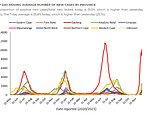
Officials recorded 13,992 new coronavirus infections in the past 24 hours, marking a 119 per cent rise on the figure last Monday and six times more than a fortnight ago.
With a test positivity rate of 31 per cent today, it suggests the outbreak in South Africa is growing faster than swabs can keep up.
The country’s National Institute for Communicable Diseases said there were 422 new hospital admissions across the country in the last day, a rise of 141 per cent compared to last week.
It also revealed there has also been a sharp rise in Covid inpatient numbers since the weekend.
A total of 6,198 people are being treated for the virus now compared to the 5,562 who were in hospital on Sunday — the biggest single-day rise since the new variant took off.
Yet, despite the increasing case and hospital numbers, there were just 11 deaths attributed to Covid in the last 24 hours, up only marginally on last week.
Doctors in South Africa’s Omicron ground zero maintain that Omicron patients are coming in with milder illness and being discharged quicker.
Official figures suggest the number of Covid hospital patients with severe illness is a third of the level at the same point in the country’s Delta wave.
Scientists believe South Africa is benefitting from high levels of T cell immunity after recording high Covid infection rates in previous waves — with up to 80 per cent of the population already having had Covid.
Professor Paul Hunter, an infectious disease expert from the University of East Anglia in England, told MailOnline that there were ‘grounds for optimism’ for the UK, which has high levels of natural and vaccine-induced immunity.
With a test positivity rate of 31 per cent today, it suggests the outbreak in South Africa is growing faster than swabs can keep up
The majority of new cases today were in Gauteng province (48 per cent) which has been at the heart of the country’s Omicron outbreak. It was followed by KwaZulu-Natal (19 per cent), while Western Cape accounted for 10% and Free State and North West each accounted for 5 per cent
The NICD said that today’s case numbers may include several backlogged infections that were delayed due to an IT glitch over the weekend.
The agency said on Twitter: ‘We are working through the data, which is now flowing into the #COVID19 laboratory data stream.
‘And we would like to indicate that the reporting backlog may result in the inclusion of retrospective case data over the next few days in the daily #COVID19 surveillance reports.’
The majority of new cases today were in Gauteng province (48 per cent) which has been at the heart of the country’s Omicron outbreak.
It was followed by KwaZulu-Natal (19 per cent), while Western Cape accounted for 10% and Free State and North West each accounted for 5 per cent.
Eastern Cape and Mpumalanga both made up 4 per cent, Limpopo accounted for 2 per cent and Northern Cape accounted for just 1 per cent.
It came as the UK’s Omicron outbreak surged by 50 per cent in a day today after more than 1,500 Britons were diagnosed with the mutant virus and the first death was confirmed.
Officials confirmed another 1,576 cases of the highly-evolved variant over the past 24 hours, bringing the total number to 4,713 — however this is believed to be a vast underestimate with the true number several times greater because not all positive tests are analysed for variants.
Sajid Javid, the Health Secretary, said the best estimate was that there are currently 200,000 overall daily infections across the country, with Omicron expected to become dominant in London by tomorrow and nationally within days.
Yet, the Department of Health’s daily update revealed that there were only 54,661 overall Covid cases in the past 24 hours, marking a rise of just 6 per cent week-on-week. No10’s scientific advisers have warned this could rise to an astronomical 1million per day by the end of the month if Omicron continues to spread at its current pace. The DOH also recorded another 926 daily hospital admissions, up 14 per cent in a week, and 38 deaths, down 7 per cent.
Meanwhile, the Prime Minister today revealed that at least one patient has died from the Omicron variant as he warned it was now leading to hospitalisations, and that the ‘best thing’ people could do was get a booster.
The PM did not reveal the age of the person who died, or if they had underlying health conditions, which made them vulnerable or whether Omicron was the leading cause of their death or a secondary factor.
Mr Johnson warned against being complacent about Omicron, despite reports in South Africa that it is milder than Delta. The death in the UK is thought to be the first confirmed Omicron fatality in the world. However, given the variant makes up almost every case in South Africa it is likely that the vast majority of fatalities there are due to the mutant strain but a lack of testing means these are not picked up.