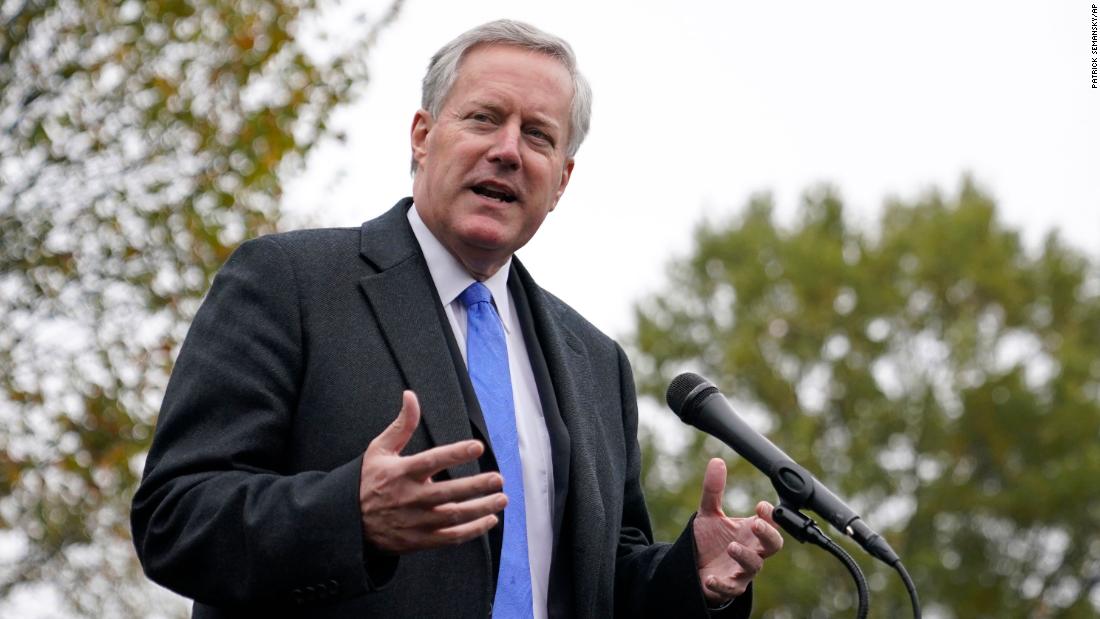
These news outlets got much of the story right: Meadows wrote that then-President Donald Trump had told him one day last year to “bust some heads and make some arrests” of protesters in Lafayette Square park near the White House.
The date matters — and not only because facts generally matter. There has been particularly intense public and
congressional interest in what prompted the use of force against
peaceful racial justice protesters in Lafayette Square shortly before Trump
held up a Bible for the cameras outside St. John’s Church, where a fire had been set in the basement the night before. If Meadows had actually written that Trump gave a “bust some heads and make some arrests” instruction prior to this use of force, that would have been an important new allegation about the timeline of events on that day.
The liberal website
Raw Story, the culture and politics publication
Rolling Stone, the media and politics news website
Mediaite, the conservative website
Independent Journal Review and the British publications
The Independent and
The Daily Mail all incorrectly reported last week that Meadows had written that Trump gave the directive on June 1, 2020. All of these outlets except for The Daily Mail published corrections after
CNN and Religion News Service reporter
Jack Jenkins pointed out the error on Twitter last Friday. The Daily Mail did not respond to CNN’s Friday request for comment and had not corrected its story as of Monday afternoon.
Meadows made clear in the book that Trump made the “bust some heads and make some arrests” comment on June 22, 2020, not on June 1, 2020. The book, in fact, included a section break between Meadows’ account of what happened on June 1 and his account of what happened on June 22.
So how did so many outlets get such a simple fact wrong?
The inaccurate reports were linked; some of them relied on material from some of the other news reports rather than independent readings of Meadows’ book. This practice, known as
aggregation, can lead to an error in one story being replicated in numerous others.
For example, the
erroneous Rolling Stone article quoted the Meadows book but said he “reportedly” wrote those words — and linked to the erroneous Raw Story article as a source. The
erroneous Independent Journal Review article, meanwhile, cited the erroneous Mediaite article. And that Mediaite article relied on the erroneous article in The Independent.
What Meadows wrote about Trump’s remark
Meadows wrote that on June 22, Trump was in his White House residence “growing anxious” as people Meadows called “rioters” appeared to attempt to take down the Andrew Jackson statue. Trump “had given an order for the park to be cleared, and it was not being followed,” Meadows wrote, so Meadows called Trump.
When he told Trump he assumed they had the authority to “deploy whatever law enforcement is necessary to fix this,” Meadows wrote, Trump responded, “Not only do you have the authority, I want you to go out there and bust some heads and make some arrests. We need to restore order.”
Meadows wrote that he had soon walked out to the park and personally ordered law enforcement officers on the scene to spring into action and “stop them from taking down that statue.”
Meadows addressed the June 1 photo op at length in the previous section of the book. He did not write that Trump had given him any directive on June 1 about how to handle the protesters outside the White House, though he did write that Trump had,
on a conference call that day, urged state governors to “dominate” cities beset by rioting following the murder of George Floyd by a Minneapolis police officer.
Meadows cited a
report released earlier this year by the Interior Department inspector general, which concluded that the US Park Police had acted to disperse protesters on June 1 not because of Trump’s photo op but because of a plan to install security fencing “i
n response to destruction of property and injury to officers.” It’s worth noting that the inspector general’s probe
did not interview some of the key players in the events leading up to the photo op, including Trump and then-Attorney General William Barr, and
left some important questions unanswered.