

Hong Kong university REMOVES Tiananmen Square memorial
Hong Kong university REMOVES Tiananmen Square memorial called the ‘Pillar of Shame’ in the dead of night after pro-Beijing ‘patriots’ dominate elections
The 26-foot tall Pillar of Shame depicts 50 bodies piled on top of each otherIt was made by a Danish sculpture to symbolise those killed in the square in 1989To this day, the true number of deaths in the bloody military crackdown on pro-democracy protesters in Beijing’s Tiananmen Square on June 4, 1989 is unknownThe dismantling of the sculpture came days after pro-Beijing candidates scored a landslide victory in the Hong Kong legislative elections
<!–
<!–
<!–<!–
<!–
(function (src, d, tag){
var s = d.createElement(tag), prev = d.getElementsByTagName(tag)[0];
s.src = src;
prev.parentNode.insertBefore(s, prev);
}(“https://www.dailymail.co.uk/static/gunther/1.17.0/async_bundle–.js”, document, “script”));
<!–
DM.loadCSS(“https://www.dailymail.co.uk/static/gunther/gunther-2159/video_bundle–.css”);
<!–
A monument at a Hong Kong university that commemorates the 1989 Tiananmen Square massacre has been removed in the dead of night – the latest sign of an Communist authoritarian crackdown in the city state.
The 26-foot tall Pillar of Shame, which depicts 50 torn and twisted bodies piled on top of each other, was made by Danish sculptor Jens Galschiot to symbolise the lives lost during the bloody military crackdown on pro-democracy protesters in Beijing’s Tiananmen Square on June 4, 1989.
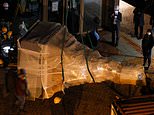
Workers barricaded the monument at the University of Hong Kong late on Wednesday night. Drilling sounds and loud clanging could be heard coming from the boarded-up site, which was patrolled by guards.
The dismantling of the sculpture came days after pro-Beijing candidates scored a landslide victory in the Hong Kong legislative elections, following amendments in election laws allowed the vetting of all candidates to ensure they are so-called ‘patriots’ loyal to Beijing.
The 26-foot tall Pillar of Shame, which depicts 50 torn and twisted bodies piled on top of each other. It was removed in the middle of the night from the University of Hong Kong
The dismantling of the sculpture came days after pro-Beijing candidates scored a landslide victory in the Hong Kong legislative elections,
The removal also happened in the same week Hong Kong leader Carrie Lam travelled to Beijing to report on developments in the semi-autonomous Chinese city, where authorities have silenced dissent following the implementation of a sweeping national security law.
The Pillar of Shame monument became an issue in October, with the university demanding that it be removed, even as activists and rights groups protested.
Mr Galschiot offered to take it back to Denmark provided he was given legal immunity that he would not be persecuted under Hong Kong’s national security law, but has not succeeded so far.
Danish sculptor Jens Galschiot created the sculpture to symbolise the lives lost during the bloody military crackdown on pro-democracy protesters in Beijing’s Tiananmen Square on June 4, 1989
‘No party has ever obtained any approval from the university to display the statue on campus, and the university has the right to take appropriate actions to handle it at any time,’ the university said in a statement on Thursday.
‘Latest legal advice given to the university cautioned that the continued display of the statue would pose legal risks to the university based on the Crimes Ordinance enacted under the Hong Kong colonial government.’
The university said that it had requested for the statue to be put in storage and would continue to seek legal advice on follow-up actions.
In October, the university informed the now-defunct candlelight vigil organiser, the Hong Kong Alliance in Support of Patriotic Democratic Movements of China, it had to remove the statue following ‘the latest risk assessment and legal advice.’
The organisation had said it was dissolving, citing a climate of oppression, and that it did not own the sculpture. The university was told to speak to its creator instead.
Pictured: The eight-metre-high ‘Pillar of Shame’ paid tribute to the victims of the Tiananmen Square crackdown in Beijing on June 4, 1989 is seen before it is set to be removed at the University of Hong Kong (HKU) in Hong Kong, China October 12, 2021
Pictured: The statue seen on June 4, 2021, to mark the anniversary of the Tiananmen Square massacre. Some estimates say the death toll was in the several thousands
When reached by The Associated Press, sculptor Mr Galschiot said he was only aware of what was happening to the sculpture on Wednesday from social media and other reports.
‘We don’t know exactly what happened, but I fear they destroy it,’ he said. ‘This is my sculpture, and it is my property.’
Mr Galschiot said that he would sue the university if necessary to protect the sculpture.
He had previously written to the university to assert his ownership of the monument, although his requests had gone largely ignored.
Over 100 pro-democracy activists have been arrested since Beijing implemented the national security law in Hong Kong. It outlaws secession, subversion, terrorism and foreign collusion to intervene in the city’s affairs. Critics say it rolled back freedoms promised to Hong Kong when it was handed over to China by Britain in 1997.
The Pillar of Shame monument has been erected for over two decades, and initially stood at Hong Kong’s Victoria Park before eventually being moved to the University of Hong Kong on a long-term basis.
– University students clean the Pillar of Shame, a statue by Danish artist Jens Galschiot to remember the victims of the 1989 Tiananmen crackdown in Beijing, at The University of Hong Kong (HKU) in Hong Kong on June 4, 2020
Each year on June 4, members of the now-defunct student union would wash the statue to commemorate the Tiananmen massacre.
The city, together with Macao, were previously the only places on Chinese soil where commemoration of the Tiananmen crackdown was allowed.
Over the past two years, the annual candlelight vigil in Hong Kong had been banned by authorities, who cited public risks from the coronavirus pandemic.
Some 24 activists were charged for their roles in the Tiananmen vigil last year, during which activists turned up and thousands followed, breaking past barricades in the park to sing songs and light candles despite the police ban on the event.