

US warns Putin might launch false flag chemical weapons attack before invading Ukraine
US warns Putin might launch false flag chemical weapons attack before invading Ukraine: Russia expels America’s deputy ambassador and demands Biden pull all troops out of Central and Eastern Europe
US has warned that Russia’s Vladimir Putin might launch a chemical weapons attack before invading UkraineRussia dramatically upped price of de-escalating the Ukraine crisis, all-but dashing faint hopes of diplomacyMoscow has demanded the US remove all weapons and troops in central and eastern Europe and the Baltics It came as Putin kicked out the US deputy ambassador, prompting Biden to warn of invasion within ‘days’Russia-backed rebels also launched mortar attacks in eastern Ukraine, attempting to blame Kiev in what Boris Johnson said was a ‘false flag’ operation aimed at providing a ‘spurious pretext’ to invade
<!–
<!–
<!–<!–
<!–
(function (src, d, tag){
var s = d.createElement(tag), prev = d.getElementsByTagName(tag)[0];
s.src = src;
prev.parentNode.insertBefore(s, prev);
}(“https://www.dailymail.co.uk/static/gunther/1.17.0/async_bundle–.js”, document, “script”));
<!–
DM.loadCSS(“https://www.dailymail.co.uk/static/gunther/gunther-2159/video_bundle–.css”);
<!–
The US on Thursday warned that Vladimir Putin might launch a false flag chemical weapons attack before invading Ukraine after Russia expelled America’s deputy ambassador and demanded Washington pull all of its troops out of Central and Eastern Europe.
Secretary of State Antony Blinken said Russia’s plans for a false flag operation could include a chemical weapons attack on its own people as it tries to manufacture a pretext for invading Ukraine.
Addressing the United Nations Security Council, he gave the fullest account of what Washington knows of Russia’s plans and he demanded that Russia immediately begin withdrawing troops from Ukraine’s borders.
Blinken, who upended his travel plans to speak at the UN, said Russia was preparing for an invasion ‘in the coming days.’
‘We don’t know exactly the formal take,’ he said, explaining that he believes Putin will start an invasion by creating an excuse to attack.
‘It could be a fabricated so-called terrorist bombing inside Russia, the invented discovery of the mass grave, a staged drone strike against civilians, or a fake – even a real – attack using chemical weapons.’
It came hours after Moscow’s foreign ministry dashed what little hope remained for diplomacy in a lengthy document handed to the US ambassador to Russia demanding that all of Washington’s weapons in central and eastern Europe and the Baltics be removed – along with all weapons already sent to Ukraine – and repeated demands that Ukraine is banned from joining NATO.
In the document, which the US is expected to reject, Moscow accused Washington of failing to respond constructively to the demands it presented in December, including for a halt to the eastern enlargement of NATO.
Russia’s ‘red lines’ were still being ignored, it said in a riposte to US and NATO counter-proposals received last month.
The Russian document listed a series of demands to de-escalate the situation around Ukraine. These included a halt to Western weapons supplies and removal of those already sent, the withdrawal of Western military advisers and instructors from Ukraine, and a halt to any joint NATO exercises with Ukraine.
‘In the absence of the readiness of the American side to agree on firm, legally binding guarantees of our security from the United States and its allies, Russia will be forced to respond, including through the implementation of military-technical measures,’ the document said.
Russia has suggested in the past that ‘military-technical measures’ could include missile and troop deployments.
At the same time, the US deputy ambassador to Moscow was expelled – prompting Joe Biden to say he now expects Russia to invade Ukraine in a ‘matter of days’ and that he will not be speaking to Putin in the meantime.
It comes after Boris Johnson accused Russia of staging a ‘false flag’ operation in eastern Ukraine by firing mortars at a kindergarten in order to give Putin a ‘spurious pretext’ to invade the country.
The UK Prime Minister, speaking during a visit to RAF Waddington, said he fears that more such attacks will take place in the coming days and that the picture on Ukraine’s border ‘continues to be very grim’.
Meanwhile satellite images revealed a new pontoon bridge has been build across the Pripyat River in Belarus, close to Chernobyl and about 80 miles north of Kiev. It is feared the bridge, which has appeared close to areas where Russian tanks are stationed, could be used for an assault on the capital.
And on Thursday evening, Yaşar Halit Çevik, chief monitor of the OSCE Special Monitoring Mission in Ukraine, said that some 500 explosions had been recorded between Wednesday evening and Thursday morning. In a sign that tensions could be easing, he said: ‘After 11.20 (am) we have recorded about 30 explosions.’
US Secretary of State Antony Blinken at the UN in New York (pictured fist bumping the UK’s Minister of State for Europe James Cleverly) on Thursday warned that Vladimir Putin might launch a chemical weapons attack before invading Ukraine after Russia demanded America pull all of its troops out of Central and Eastern Europe
Ukrainian President Volodymyr Zelensky visited soldiers stationed not far Donetsk, a city controlled by pro-Russian militants, on Thursday as the US warned that Russia’s President Putin might launch a chemical weapons attack before invading Ukraine
Boris Johnson, pictured at RAF Waddington today, accused Putin of launching a ‘false flag’ operation in Donbas with the aim of providing a ‘spurious pretext’ for an invasion of Ukraine
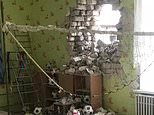
Artillery has opened fire in eastern Ukraine – striking a kindergarten located in Stanytsia Luhanska, on the Ukrainian side of the frontline with Russian-backed rebel forces
Pictured: Marine Guard of the State Border Guard Service maneuver during Ukrainian President Volodymyr Zelensky visit to get acquainted with the order of service at Azov sea in Mariupol, Ukraine, 17 February 2022
This handout video grab taken and released by the Russian Defence Ministry on February 17, 2022, shows the Grad multiple rocket launcher firing at mock enemy targets during a joint exercises of the armed forces of Russia and Belarus
Russia’s President Vladimir Putin chairs a video conference meeting on Thursday
Ukrainian President Volodymyr Zelensky (right) during a visit to the front line not far from pro-Russian militants controlled city of Donetsk, Ukraine, 17 February 2022
Artillery opened fire at multiple points along the frontline between Ukraine and Russia-backed rebels in the country’s east today, with at least two locations hit with witnesses reporting hearing artillery firing at a third
US deployments in Europe in January, before Biden ordered more troops to the region as the crisis escalated
Ukraine’s ministry of defence issued images of the damaged building early Thursday, saying it is located in Stanytsia Luhanska and was hit by shells fired by Russian rebels. Pro-Moscow accounts then picked up the same images, but claimed the building is actually on their side of the frontline and was hit by Kiev’s men
Around an hour after the kindergarten was shelled, Ukraine reported another attack which hit a school in Popasna along with two nearby houses and a water pipe
Damage to Popasna, a town on the border between Ukrainian forces and Russian-backed rebels, which Ukraine says was caused by shelling from the rebel side
A partially-destroyed building is seen in the town of Popasna, on the Ukrainian side of the frontline with Russia-backed rebels, after artillery opened fire in the early hours
An image put out by the Ukrainian security services shows a partially-destroyed water pipe in the town of Popasna
A satellite image reveals that a new pontoon bridge has been constructed across the Pripyat River in Belarus (left), around 80 miles north of Kiev amid fears it could be used to provide an attack route to the capital
Before and after images show how the bridge has been constructed in recent days, providing a route for Russian tanks to cross the river and advance south towards Kiev
British Foreign Secretary Liz Truss, center, and Ukrainian Foreign Minister Dmytro Kuleba, right, attend a wreath-laying ceremony at a the monument to the victims of the Great Famine as she visits Kiev to give her backing to the government
As Mr Johnson spoke, defence secretary Liz Truss landed in Kiev for a meeting with her Ukrainian counterpart – saying that Russia was engaged in a ‘blatant’ attempt to fabricate a justification for an attack.
Truss, wearing her new-favourite fur hat in 7C (44F) temperatures, took part in a flower-laying ceremony at a monument to the victims of Ukraine’s Great Famine before joining Defence Minister Dmytro Kuleba for talks.
The pair were speaking about mortar attacks launched by Russian-backed rebels in Ukraine’s east who fired mortar rounds and artillery at the towns of Stanytsia Luhanska and Popasna earlier in the day – hitting a kindergarten in the former and a school in the latter – before claiming it was actually they who had been attacked.
Other images revealed a huge movement of forces across Belarus, Russia and occupied Crimea. Some showed camps once full of Russian tanks have emptied, others showed new build-ups of attack helicopters and vehicles, while more showed tanks and artillery pieces formed up in convoy and getting ready to move.
It comes amid warnings from NATO and Washington that Putin is not withdrawing troops from Ukraine’s borders as he has claimed, but is instead moving forces closer and continuing to build up troop numbers, with an extra 7,000 arriving yesterday and today.
There are now thought to be around 150,000 troops backed by tanks, artillery, attack helicopters and fighter jets stationed near Ukraine – more than half of Russia’s total ground forces – which are at a high level of readiness and could invade at short notice, according to Western allies.
British Foreign Secretary Liz Truss on Thursday told Vladimir Putin to ‘think again’ and described today’s shelling of a school and a kindergarten near the Ukrainian front line a ‘false flag operation.’
She said: ‘We have spoken about the likelihood of a false flag operation and that is what we are seeing taking place. And we are very clear the aggressor in this situation is Russia.
‘We will continue to call out false flag operations, we will continue to call out their cyberattacks and their attempts to undermine Ukraine, which is a democratic sovereign country.’
She added: ‘We need Russia to step back from the brink. They must take the path of diplomacy.’
Around 20 Russian warships started drills in the Caspian Sea on Thursday, Russia’s defence ministry said, part of broader war games involving most of its army and navy.
Putin claimed earlier this week that ‘genocide’ is underway against Russians in Donbas, an unsubstantiated claim that was immediately followed by reports in state media outlets of the discovery of ‘mass graves’ dating back to 2014 when Moscow last invaded.
The White House has been warning for weeks that such claims could be used to justify a Russian attack, with State Department spokesman Ned Price saying: ‘Over the past several weeks, we’ve also seen Russian officials plant numerous stories in the press, any one of which could be elevated to serve as a pretext for an invasion.’
Those claims, which have spread on social media, include genocide, mass graves and the potential of the Ukrainian government to use chemical weapons against the people of Donbass.
‘There is no basis of truth to any of these allegations,’ Price said. ‘These are false narratives that Russia is developing for use as a pretext for military action against Ukraine.’
It comes after Russia’s rubber-stamp Duma parliament passed a resolution earlier this week calling on Putin to officially recognise the breakaway regions of Donetsk and Luhansk as independent states and take measures to help them defend themselves.
The Kremlin has, for now, resisted the calls – saying it would violate the ceasefire agreements currently in place in the region. But there are fears it opens the door for Putin to quickly change his mind and move troops in.
Video also emerged purporting to show a thick column of smoke rising from the Russian embassy in Kiev, raising fears that sensitive documents are being burned before diplomats evacuate.
Ukraine’s foreign minister Dmytro Kuleba, meanwhile, said on Thursday that fire from a tank operated by Russia-backed separatists has been recorded in the east of the country.
‘These shells came from the temporarily occupied territories of Ukraine, which are controlled by Russia,’ Kuleba said at a joint press conference in Kyiv after meeting his British counterpart Liz Truss.
Also today, the website of Russia’s foreign ministry went down on Thursday, a ministry official told Reuters, the same day that Russia submitted its response to Western security proposals.
The TASS news agency cited the ministry as saying that the website had been down for an hour due to technical issues. The official did not say why the site was down, although Russia has been accused of launching cyber attacks against key Ukrainian government websites in recent weeks.
Satellite images released overnight show Russia has moved some of its military equipment that was deployed near Ukraine, but other hardware has arrived and Moscow still has a lot of forces and equipment in the region.
In Crimea, from where Russia has shown videos of it pulling out tanks and military equipment, Maxar pointed to armoured vehicles positioned at the Yevpatoria railyard that could be preparing to depart.
Troops and equipment remained deployed, however, at other sites on the peninsula that Russia seized from Ukraine in 2014, including the Opuk training area, and sites at Lake Donuzlav and Novoozernoye, it said.
In Belarus, where Russia is holding exercises, Maxar pointed to a new military pontoon bridge over the Pripyat river less than six kilometres from the border with Ukraine, and a large new field hospital at one training site.
At an airfield in Belarus, a new unit of nearly 20 attack helicopters had been deployed, but significant troop and ground forces units recently deployed there had departed and were unaccounted for, Maxar said.
Troops and armoured equipment were still deployed at other sites and were training. Most of the equipment and troop housing area that had been present near Rechitsa in southeast Belarus has departed and was unaccounted for, it said, adding that a military convoy was seen heading west.
Speaking Thursday morning, UK Minister for the Armed Forces James Heappey said that intelligence he has seen over the last 48 hours indicates Russia is continuing to build its forces near Ukraine.
‘You saw overnight that the US administration has briefed out that a further 7,000 are moving towards the border,’ he told the BBC Radio 4 Today Programme.
‘Those aren’t necessarily numbers that we’ve been able to verify for ourselves, but certainly the trend is that more is moving towards Ukraine rather than away from it, and we’re concerned that that’s the case.’
Asked on Times Radio whether Moscow was ‘lying’ about withdrawing from the area around the border, he added: ‘I would offer that we have seen intelligence – open source intelligence – over the last few days that clearly shows the build-up of Russian troops on the Ukrainian border continues.
‘That there are more moving to the area than people moving away, and that the key combat enablers that we saw moved towards the Ukrainian border over the last few days now include bridges having been built and a number of other things, suggest the final preparations are being made for them to invade.’
Asked whether he was saying Moscow was ‘ramping up’ preparations for an incursion rather than moving back, Mr Heappey replied: ‘That’s exactly what I believe to be happening, yes.’
A senior U.S. administration official said some forces arrived only recently and that there had been a marked increase in false claims by Russians that the Kremlin might use as pretext for an invasion.
The official said those claims included reports of unmarked graves of civilians allegedly killed by Ukrainian forces, assertions that the U.S. and Ukraine are developing biological or chemical weapons, and claims that the West is funnelling in guerrillas to kill Ukrainians.
The official was not authorised to speak publicly about sensitive operations and spoke to The Associated Press on condition of anonymity. The official did not provide underlying evidence for the assertions.
Helicopters take part in joint military drills between Belarusian and Russian forces in Belarus today at the Osipovichsky training ground, around 160 miles north of the Ukraine border
Helicopters fly in formation over the Osipovichsky training ground, in central Belarus, today during joint training exercises between Russian and Belarusian forces
Alexander Lukashenko, Belarusian president, is pictured overseeing joint training exercises between Russian and Belarusian forces in central Belarus today
A Russian attack helicopter is pictured landing in Belgorod, around 20 miles north of the Ukraine border
Video purports to show smoke rising over the Russian embassy in Kiev, sparking fears that diplomats could be burning sensitive documents before evacuating
Another satellite showed the construction of a large field hospital (brown tents, centre of the image) at the Osipovichi training area in Belarus, raising fears an invasion could be imminent
Russian vehicles formed up in convoy are shown driving down a highway in Belarus (top), heading west and further into the country despite Vladimir Putin’s claims to be pulling troops back
Newly-deployed attack helicopters are seen at Zyabrovka airfield near Gomel in Belarus, a short distance from Ukraine
Russian artillery remains deployed near Brest, Belarus, despite dictator Alexander Lukashenko saying that all Russian military units would leave when training drills were over
Russian artillery units are shown loaded on to a train near Brest, Belarus, amid a huge movement of forces along the Ukraine border – with Putin claiming he is withdrawing by the West saying he is actually moving troops closer
‘We haven’t seen a pullback,’ U.S. Secretary of State Antony Blinken told ABC News. Russian President Vladimir Putin ‘can pull the trigger. He can pull it today. He can pull it tomorrow. He can pull it next week. The forces are there if he wants to renew aggression against Ukraine.’
Asked why Russians would claim to be withdrawing when government intelligence, commercial satellite photos and social media videos showed no evidence of that, State Department spokesman Ned Price said: ‘This is the Russian playbook, to paint a picture publicly . while they do the opposite.’
British Defense Secretary Ben Wallace also said there had been an increase of up to 7,000 troops in recent days.
‘We have seen the opposite of some of the statements,’ he said in Brussels. ‘We’re going to judge Russia by their actions and at the moment the troop buildup continues.’
NATO Secretary-General Jens Stoltenberg also said the alliance had not seen ‘any withdrawal of Russian forces.’
Ukrainian President Volodymyr Zelenskyy similarly dismissed the Russian claims.
‘What is this? Rotations, withdrawal, returning back again,’ he said on a visit to the southeastern city of Mariupol. ‘It’s too early to rejoice.’
The Ukrainian leader, who has repeatedly sought to project calm and strength during the crisis, declared Wednesday a day of ‘national unity’ – a day that had been floated as a possibility for the start of an invasion.
Protesters clash with police in central Kiev today, as part of a march of small business owners to demand extra support as the economy suffers amidst the threat of war
Ukrainian protesters scuffle with law enforcement officers in front of Kiev’s parliament building on Thursday
Protesters demonstrate outside the Ukrainian parliament against high government taxes in small business in Kiev
Ukrainian riot police tussle with protesters during demonstration outside the Ukrainian parliament against high government taxes in small business in Kiev
Russian state media has been pushing claims that civilian ‘mass graves’ have been uncovered in Donbas dating back to the last time Russia invaded, in 2014, which
An image put out by Russian state media purporting to show bodies of civilians exhumed from a mass grave in Donbas being reburied in what the US warns could be a false flag to justify an invasion
Russian armoured vehicles are shown formed up in convoy at the Yevpatoria garrison in occupied Crimea, amid a huge movement of Putin’s forces which he claims is a withdrawal but the West says is a build-up
A satellite image shows a Russian military base on the shores of Lake Donuzlav, Crimea, with vehicles formed up in convoy as if preparing to move – though their destination is unclear
This satellite image released by Maxar Technologies shows an overview of a battlion sized unit in convoy at the Filativka training area, in Crimea
Four American B-52H bombers arrived last week in the UK and have been training with the RAF and Norwegian Air Forces. Pictured today, the bombers on the ground at a UK RAF base
Across the country, Ukrainians of all ages waved flags in the streets and from apartment windows.
Hundreds unfolded a 200-meter (650-foot) flag at Kyiv’s Olympic Stadium, while another was draped in the center of a shopping mall in the capital.
In the government-controlled part of Ukraine’s eastern region of Luhansk, where Russian-backed separatists have been fighting Ukrainian troops since 2014, residents stretched another huge flag across a street.
‘This event, this number of people united around the Ukrainian flag will show that we stand for united Ukraine,’ resident Olena Tkachova said.
A 2015 deal brokered by France and Germany helped end the worst of the fighting in eastern Ukraine, but implementation has stalled. The deal, known as the Minsk agreement, would offer broad self-rule to the separatist territories and thus is resented by many in Ukraine.
A Ukrainian government official said in a television interview that Zelenskyy would consider holding a referendum on the Minsk agreement ‘if there are no other options or instruments.’
But Vice Prime Minister Iryna Vereshchuk said she was unaware that such an idea was under serious discussion.
The U.N. Security Council is scheduled to hold its annual meeting on the Minsk agreement on Thursday. Russia, which holds the rotating council presidency this month, will chair the meeting.
At last year’s council meeting, Russia clashed with the U.S. and its Western allies over the conflict in eastern Ukraine and a similar confrontation is expected this year.
Putin has signaled that he wants a peaceful path out of the crisis. His country has repeatedly complained that the U.S. and NATO have not responded satisfactorily in writing to its security concerns.
Foreign Ministry spokeswoman Maria Zakharova said that Russia is in the final phase of preparing its formal response to the West.
‘After that, a schedule of further steps will be developed,’ she said on state television.
It appeared to be another indication that the Kremlin is determined to keep up the pressure for a while.
Defiant Ukrainians sing and wave flags on their ‘Unity Day’ even as threat of Russian invasion hangs over them, writes IAN BIRRELL
Ukraine celebrated the hastily-declared Unity Day yesterday with passionate words from the president, patriotic events across the land and more than 50 MPs singing the national anthem outside parliament in defiance of the Russian troops massed at their border.
President Volodymyr Zelensky demanded the combative display of patriotism late on Monday to mark the day that Western intelligence had warned might be chosen by the Kremlin to launch an invasion of his country.
Yet the response was muted from his beleaguered fellow citizens – who woke up fearing the worst, waved a few flags and carried on with their lives, trapped wearily in the midst of a destructive geo-political struggle that has gripped them for years.
Ukrainian President Volodymyr Zelensky arrives to watch Ukrainian troops take part in a military drill outside the city of Rivne, northern Ukraine
Ukrainian army soldiers pose for a photo as they gather in Odessa, Ukraine, to celebrate Unity Day on Wednesday
The former comedian’s demand led to flags appearing on streets and in windows, school pupils singing the anthem clad in traditional embroidered clothes, special prayers at St Sophia’s Cathedral in Kyiv and Ukrainian films shown in cinemas.
‘We are all different but we are united by one desire – to live in peace, happily, as one family – and we have a right to it because we are at home, we are in Ukraine,’ said Zelensky, during five hours on television showing celebrities and politicians discussing Ukrainian unity in face of the destabilising Russian aggression.
The president, wearing a blue shirt, also published a selfie on Instagram alongside his wife Olena clad in a yellow jersey to reflect Ukraine’s national colours – then asked everyone to post similarly-patriotic pictures on social media.
Some of the country’s best-known football players – including Andriy Yarmolenko of West Ham and Everton’s costly new signing Vitaliy Mykolenko – responded with a video in which they told of their pride in Ukraine.
British ambassador Melinda Simmons tweeted: ‘The UK and Ukraine share fundamental values of peace, freedom, democracy and respect. Our continued support for Ukraine is unwavering.’
Later Zelensky flew to Mariupol – the major port seen as a key possible target for Putin – where he met soldiers on the frontline facing Moscow-backed separatists. ‘It’s a great honour to be a president of such people, of such a state,’ he said.
Lasers and pixel lights shine from five factory chimneys in Ukraine as citizens across the country celebrate the hastily-declared Unity Day
A long Ukrainian flag is unfolded at the Olympiyskiy stadium in Kiev after President Volodymyr Zelensky called for a Day of Unity
Further along the frontline in Severodonetsk, a town in the government-controlled part of Luhansk region, residents stretched a 650ft blue-and-yellow flag across the street as they marched along in a display of their loyalties.
Zelensky only announced the celebratory day on Monday. But there was no public holiday, dampening the support, while some people said they had not heard about the plan and others had mixed reactions.
‘I don’t see the point of creating this show to please Western politicians,’ said one pensioner in Kyiv.
Others were more enthusiastic. ‘Unity Day helps unite the people,’ said Vladyslav, 19, serving in the National Guard.
Liydmyla, a 48-year-old housewife who said she is avoiding watching the news on television since it made her too ’emotional’, felt her nation needed such events. ‘It’s the right thing to do – we are being attacked, so we need to stay strong and united.’
Earlier the government said the cyber-attack that hit the ministry of defence, armed forces and several major banks on Tuesday was the biggest in Ukraine’s history. It was traced to sources in Russia, China, Czech Republic and Uzbekistan.
The shutdown, which lasted five hours, was backed by a foreign security service, said Ukraine’s cyber-security chief. Russia has denied any responsibility.