

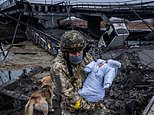
Ukraine: Photo of baby being carried to safety exposes the catastrophe of Russian invasion
The photo that exposes Putin’s madness: Baby is carried to safety by Ukrainian soldier amid catastrophic Russian invasion that has reduced cities to rubble – as deluded Vladimir continues to insist he is NOT hitting civilian areas
Heartbreaking image shows a Ukrainian soldier rescuing a baby from scene of devastation in Irpin, near KyivRussian defence ministry said that its units have stopped firing and opened humanitarian corridorsMoscow allowed evacuation routes for civilians to leave Mariupol in the south-east and Volnovakha in the eastVladimir Putin has again insisted that Russia is not shelling Ukrainian cities in a call with Germany’s ScholzThat is despite medics warning up to 100 people could be buried in apartment rubble in Boradyanka, near Kyiv, and that 49 people died in a cluster bomb attack on Chernihiv yesterday It comes after the Zaporizhzhia nuclear power plant was attacked by Russian troops in early hours on FridayMoscow’s ambassador to the UN has denied accusations that forces had shelled the atomic power plant Mariupol’s mayor has warned this evening that the city is being ‘simply destroyed’ by withering artillery fire Missile fragment even landed in the ground of Zelensky’s second residence, though it didn’t cause damage
<!–
<!–
<!–<!–
<!–
(function (src, d, tag){
var s = d.createElement(tag), prev = d.getElementsByTagName(tag)[0];
s.src = src;
prev.parentNode.insertBefore(s, prev);
}(“https://www.dailymail.co.uk/static/gunther/1.17.0/async_bundle–.js”, document, “script”));
<!–
DM.loadCSS(“https://www.dailymail.co.uk/static/gunther/gunther-2159/video_bundle–.css”);
<!–
Devastating photos have laid bare the horror of Vladimir Putin’s lawless invasion of Ukraine, as one image showed a baby being rescued from the scene of a brutal attack near Kyiv as the Russian tyrant continues denying bombing Ukrainian cities.
Heartbreaking images from Irpin, located on the outskirts of the besieged capital city, confirmed massive damage to heavily populated civilian areas, with piles of rubble, twisted metal and burned out cars stretching into the distance.
A Ukrainian soldier was pictured rescuing a tiny baby from a scene of total devastation, while other photos showed a terrified woman walking past a burning house after Irpin was pounded by Kremlin forces. Elsewhere, scenes of destruction were seen in the northwestern city of Zhytomyr on Friday, after it was hit by shelling that left a school building completely destroyed.
But an increasingly delusional Putin is insisting that Russia is not bombing Ukrainian cities, despite mounting fears that 100 people are buried under rubble after an apartment block near Kyiv was struck and after a cluster bomb attack on the city of Chernihiv killed 49.
Russia claims it has opened humanitarian corridors to allow civilians to leave the strategic port of Mariupol in the south-east and Volnovakha in the country’s east for five hours between 12pm and 5pm Moscow time. There was no immediate confirmation from Ukrainian forces.
The Ukrainian government claims Russia has now lost around 9,200 men in the fighting, along with hundreds of tanks, almost a thousand armoured vehicles, and dozens of helicopters and jets.
Preparations for the defence of the capital have been boosted by Ukrainian attacks on the column of Russian military vehicles which has ground to a halt 20 miles from Kyiv.
As Russian forces batter strategic locations, Ukraine’s president Volodymyr Zelensky has lashed out at NATO for refusing to impose a no-fly zone over his country, warning that ‘all the people who die from this day forward will also die because of you’.
NATO says a no-fly zone could provoke widespread war in Europe with nuclear-armed Russia. But as the United States and other NATO members send weapons for Kyiv and more than 1 million refugees spill through the continent, the conflict is already drawing in countries far beyond Ukraine’s borders.
Russia continues to crack down on independent media reporting on the war, also blocking Facebook and Twitter, and more outlets say they are pausing their work inside the country.
And in a warning of a hunger crisis yet to come, the UN World Food Program says millions of people inside Ukraine, a major global wheat supplier, will need food aid ‘immediately’.
Ukraine’s president was set to brief US senators on Saturday on a video conference call as Congress considers a request for $10billion in emergency funding for humanitarian aid and security needs.
In a bitter and emotional speech late Friday, Zelensky criticised NATO over the lack of a no-fly zone, saying it will fully untie Russia’s hands as it escalates its air attack. ‘The alliance has given the green light to the bombing of Ukrainian cities and villages,’ he said, warning that ‘the history of Europe will remember this forever’.
NATO Secretary-General Jens Stoltenberg earlier Friday ruled out the possibility of a no-fly zone, saying NATO planes would have to shoot down Russian aircraft.
In a separate video message to anti-war protesters in several European cities, Zelensky continued to appeal for help. ‘If we fall, you will fall,’ he said.
The UN Security Council will hold an open meeting Monday on the worsening humanitarian situation. The UN estimates that 12million people in Ukraine and 4million fleeing to neighbouring countries in the coming months will need humanitarian aid.
While the vast Russian armoured column threatening Kyiv remained stalled outside the capital, Putin’s military has launched hundreds of missiles and artillery attacks on cities and other sites across the country.
Russian forces did not make significant progress Friday in their offensive to sever Ukraine’s access to the Black Sea and the Sea of Azov, which would deal a severe blow to its economy. There were also no changes in the north and the east, where the Russian offensive has stalled, meeting fierce Ukrainian resistance.
In the early hours of Friday, the Zaporizhzhia nuclear power plant, which creates around 20 per cent of Ukraine’s electricity, was also attacked.
Zelensky slammed Putin’s troops for seizing the power plant as he urged Russian citizens to remember the ‘catastrophic’ Chernobyl disaster.
The Zaporizhzhia attack has been internationally condemned, with Emmanuel Macron expressing alarm about ‘the risks to nuclear safety’ while the US ambassador to the UN slammed the advance as a dangerous escalation that ‘represents a dire threat to all of Europe and the world’.
Moscow has attempted to deny responsibility for the attack, saying its forces had come under attack by Ukrainian ‘saboteurs’ while patrolling the plant, who then set fire to the building themselves.
In another denial, Putin, speaking on a call with German Chancellor Olaf Scholz, dismissed all reports of Russian attacks on apartment buildings, schools and hospitals as ‘fake’ – a day after going on TV to accuse Ukrainians of using civilians as ‘human shields’ while vowing not to back down from his attack.
As he spoke, emergency services in Ukraine warned that around 100 people could be buried in rubble after a rocket strike cleaved an apartment in the city of Boradyanka – 30 miles from Kyiv – in two. Officials in Chernihiv also raised the number killed in a cluster bomb attack to 49.
Invading Russian troops have blockaded the strategic Ukrainian port city Mariupol, its mayor announced Saturday, as Moscow and Kyiv aimed to hold new talks over the weekend.
While laying siege to Mariupol for days, Russian forces also cut its electricity, food, water, heating and transportation in the depths of winter, prompting comparisons to the Nazi blockade of Leningrad in World War II.
Ukraine’s foreign minister Dmytro Kuleba claimed that Russian troops have raped women in cities they have already captured. He did not give evidence to back his claim, but Ukrainian media reported that 11 cases of rape had been reported in Kherson, the only major city captured by Russia after more than a week of fighting.
Russia has been increasingly waging a war of terror against Ukrainian civilians after attempts to rapidly capture the country failed.
A Ukrainian soldier was pictured rescuing a tiny baby from a scene of total devastation in Irpin, including what appeared to be a bombed-out bridge, in a harrowing image that summed up the atrocity of the ongoing war
A woman reacts as she stands in front of a house burning after being shelled in the city of Irpin, outside Kyiv, on March 4
A woman walks amidst the debris of a school building destroyed by shelling, as Russia’s invasion of Ukraine continues, in Zhytomyr on March 4
A delusional Vladimir Putin has again insisted that Russia is not bombing Ukrainian cities, despite fears that 100 people are buried under rubble after an apartment block near Kyiv was struck and after an attack on the city of Chernihiv which killed 49
Other pictures showed a devastated woman appearing emotional as she walked past a house burning after the city of Irpin came under massive shelling
And the attack showed no sign of letting up today, as Mykolaiv, in the south of Ukraine, came under attack with Russian forces moved within striking distance of the city centre. The city is located just a few miles from Kherson, which fell to Putin’s men earlier in the week, along the road to Odessa – Ukraine’s third-largest city and main port.
However, reports emerged on Friday evening that an attack on an airport on the outskirts of the city had been repulsed, with Ukrainian forces digging in for fresh fighting overnight.
But Ukraine’s military did managed to pull off some successes. Two Russian jets were downed near Volnovakha, in the east near Donetsk, while Ukrainian special forces also ambushed two of the Kremlin’s tank columns at Hostomel and Brovary, leaving large numbers of troops dead and destroying vehicles.
Meanwhile, Ukrainian President Volodymyr Zelensky addressed Russian citizens after Putin’s troops seized the Zaporizhzhia nuclear power plant in the early hours.
Zelensky appeared on video as he urged Russian residents to tell authorities that they want to live on land ‘without radioactive contamination’, amid fears of a meltdown following the attack on Europe’s largest power station.
The Ukrainian leader, 44, appealed to people to remember the ‘catastrophic consequences’ of the 1986 Chernobyl disaster as he said ‘radiation does not know where Russia is’.
CCTV captured a fierce gun battle between Putin’s men and Ukrainian defenders that sparked a fire in a six-storey training building just outside the main complex. Moscow’s men then stopped firefighters getting to the building for several hours.
Boris Johnson spoke with Macron about the ‘appalling situation in Ukraine’ on Friday evening and described it as ‘the worst war on our continent for a long time’, while both leaders agreed ‘the reckless actions leading to damage to the Zaporizhzhia nuclear plant were despicable’, to a Downing Street spokesperson said.
The leaders were said to have agreed it is ‘imperative’ both countries continue to do all they can to help the Ukrainian people, ‘including via further humanitarian support – as well as economically and militarily’.
‘Both leaders reiterated the UK and France would work closely in the coming days in the face of Putin’s increasingly savage and evil actions,’ the spokesperson added.
In the early hours of Friday, the Zaporizhzhia nuclear power plant was attacked. A damaged Russian attack vehicle is seen outside the power plant (left) while firefighters work to extinguish a fire that broke out inside a training complex (right)
Fire-damaged buildings at the Zaporizhzhia nuclear complex are pictured on Friday morning after coming under attack by Russian forces overnight, leading to international condemnation
Russian armoured vehicles and troops attacked the nuclear power plant in the early hours of Friday, shooting and shelling guards holed up in administrative buildings near the nuclear reactors – setting one of them on fire
Nuclear experts warned the attacks were ‘frightening’ but that any disaster caused by fighting would be similar to Fukushima in 2011 rather than Chernobyl in 1986. Fukushima, in Japan, melted down after a tsunami cut electricity to the plant, disabling its cooling system. Chernobyl exploded after a training exercise gone-wrong caused an uncontrolled nuclear reaction.
Addressing Russian citizens, Zelensky said: ‘Russian people, I want to appeal to you: How is this possible?
‘After all we fought together in 1986 against the Chernobyl catastrophic consequences. You must remember smouldering graphite which was scattered across by an explosion.
‘The victims. You must remember irradiation over the destroyed power plant unit. You must remember evacuation from Pripyat and the 30km zone around it. How could you ever forget about it?
‘If you did not forget, then you must not keep silent. You must tell your authorities, go out on the streets and say that you want to live, that you want to live on the land without radioactive contamination.
‘Radiation does not know where Russia is.’
Zelensky also appealed to European nations to support his country’s fight against the invading Russian military, asking people not to be silent about what is happening in the Ukraine.
In a video, he addressed thousands of people protesting the war in several European cities, naming among them Paris, Prague, Lyon, Frankfurt and others.
‘Don’t turn a blind eye on this,’ he said. ‘Come out and support Ukraine as much as you can,’ he said though a translator. ‘If we fall, you will fall.’
‘And if we win, and I’m sure we’ll win, this will be the victory of the whole democratic world, this will be the victory of our freedom, this will be the victory of light over darkness, of freedom over slavery.
‘And if we win we will become as blossoming as Europe. And Europe will be flourishing more than ever. All of you are Ukrainians today, thank you for this.’
Sparks erupt from an administration building (bottom right) as a live steam video shot from a larger office block behind it films Russian tanks opening fire on the Zaporizhzhia nuclear power plant in the early hours of Friday morning
Rafael Mariano Grossi, head of the UN’s nuclear energy watchdog, outlines where the building that caught fire was in relation to the six reactors at Zaporizhzhia
There were frantic calls for a ceasefire during the early morning attack on the Zaporizhzhia plant, which reportedly saw Russian artillery shells rain down on the plant, preventing firefighters from battling the flames in a nearby administration building.
Ukrainian authorities said Russian military forces attacked the plant on all sides on Thursday night and by 2.30am, the assault had set an adjacent five-storey training building alight, causing widespread alarm over radiation levels.
Emergency crews were finally allowed to go in and douse the flames before Russian troops moved in an occupied the site, which provides a fifth of Ukraine’s electricity and is the ninth largest plant in the world.
The UN’s nuclear monitoring agency said that, fortunately, none of the site’s six reactors had been directly damaged and radiation levels remained normal. Three Ukrainian troops were killed defending the complex and two others were wounded, Kyiv said.
The Zaporizhzhia reactor components are housed inside a heavily reinforced steel and concrete containment building designed to withstand extreme events – both natural and man-made.
Russia’s defence ministry confirmed the plant was working normally and blamed the fire on a ‘monstrous attack’ by Ukrainian saboteurs, but admitted its forces were now in control.
The US embassy in Kyiv tweeted: ‘It is a war crime to attack a nuclear power plant. Putin’s shelling of Europe’s largest nuclear plant takes his reign of terror one step further.’
A projectile (the bright light, bottom left) lands in a car park at the Zaporizhzhia nuclear power plant, damaging cars in the area
As fears of a nuclear disaster continue, Russian planes also bombed a thermal power plant in Okhtyrka (pictured), 220 miles east of Kyiv, on Friday
While the vast Russian armoured column threatening Ukraine’s capital remained stalled outside Kyiv, Putin’s military has launched hundreds of missiles and artillery attacks on cities and other sites across the country.
Russian forces did not make significant progress on Friday in their offensive to sever Ukraine’s access to the Black Sea and the Sea of Azov, which would deal a severe blow to its economy. There were also no changes in the north and the east, where the Russian offensive has stalled, meeting fierce Ukrainian resistance.
Ukrainian presidential adviser Oleksiy Arestovich said battles involving airstrikes and artillery continued north-west of Kyiv, and the north-eastern cities of Kharkiv and Okhtyrka came under heavy fire. He said Ukrainian forces were still holding the northern city of Chernihiv and the southern city of Mykolaiv.
Ukrainian artillery also defended Ukraine’s biggest port city, Odesa, from repeated attempts by Russian ships, he said.
More than 840 children have been wounded in the war, and 28 have been killed, according to Ukraine’s government. A total of 331 civilians had been confirmed killed but the true number is probably much higher, the UN human rights office said.
The Reuters/IPSOS survey, conducted online and in English throughout the United States on Thursday and Friday, with 831 adults responding, ups the pressure on
Joe Biden has dismissed the notion of no-fly zones because of the risk of open conflict between NATO and Russian forces, despite opinion polling showing that a growing number of Americans want the US to take more aggressive action against the Kremlin.
The White House on Friday said it was weighing cuts to US imports of Russian oil, though it is proceeding cautiously, concerned about a spike in gasoline prices that would add to already high inflation.
On Friday, the United States flew B-52 Stratofortress bombers over NATO’s eastern flank above Romania, exercising with the German and Romanian militaries.
The largest strategic bombers in the US Air Force took off from RAF Fairford, a Royal Air Force station in England, and conducted ‘close air support and integration mission training’, according to a statement from US Air Forces in Europe. The B-52s then flew to Romania, where they conducted more close air support training as part of the Bomber Task Force (BTF) missions.
The White House announced that US Vice President Kamala Harris will travel to Poland and Romania next week to meet with officials to discuss the Russian invasion of Ukraine and impact the war is having on the region.
Harris’ agenda for the March 9-11 visit to Warsaw and Bucharest is expected to centre on economic, security and humanitarian assistance for Ukraine.
‘The Vice President’s meetings will also focus on how the United States can further support Ukraine’s neighbours as they welcome and care for refugees fleeing violence,’ Harris’ deputy press secretary Sabrina Singh said.
Biden spoke on Friday with Poland’s President Andrzej Duda. Poland is assisting about 700,000 Ukrainians and others who have fled the war so far. The United States has also more than doubled its military presence in Poland, which is a member of NATO, to 9,000 troops in recent weeks.
While the vast Russian armoured column threatening Kyiv remained stalled outside the capital, Putin’s military has launched hundreds of missiles and artillery attacks on cities and other sites across the country.
Russian forces did not make significant progress Friday in their offensive to sever Ukraine’s access to the Black Sea and the Sea of Azov, which would deal a severe blow to its economy. There were also no changes in the north and the east, where the Russian offensive has stalled, meeting fierce Ukrainian resistance.
Invading Russian troops have blockaded the strategic Ukrainian port city Mariupol, its mayor announced Saturday, as Moscow and Kyiv aimed to hold new talks over the weekend.
While laying siege to Mariupol for days, Russian forces also cut its electricity, food, water, heating and transportation in the depths of winter, prompting comparisons to the Nazi blockade of Leningrad in World War II.
Ukraine’s foreign minister Dmytro Kuleba claimed that Russian troops have raped women in cities they have already captured. He did not give evidence to back his claim, but Ukrainian media reported that 11 cases of rape had been reported in Kherson, the only major city captured by Russia after more than a week of fighting.
Earlier, it was revealed that no radiation was released from a Russian attack at Europe’s biggest nuclear power plant in Ukraine.
The International Atomic Energy Agency’s director-general, Rafael Mariano Grossi, said on Friday the building hit by a Russian ‘projectile’ at the Zaporizhzhia plant was ‘not part of the reactor’ but instead a training centre at the plant.
Nuclear officials from Sweden to China said no radiation spikes had been reported, as did Grossi.
Ukrainian officials have said Russian troops took control of the overall site, but the plant’s staff were continuing to ensure its operations. Grossi said the Ukrainians were in control of the reactor.
In the frenzied initial aftermath when the risk of a radiation release was not clear, the attack caused worldwide concern – and evoked memories of the world’s worst nuclear disaster, at Ukraine’s Chernobyl.
Facing worldwide indignation over the attack, Russia sought to deflect blame. Without producing evidence, defence ministry spokesman Igor Konashenkov blamed arson rather than artillery fire.
He claimed a Ukrainian ‘sabotage group’ had occupied the training building at the plant, fired on a Russian patrol and set fire to the building as they left.
There had been conflicting reports earlier over which part of the Zaporizhzhia facility had been affected in the attack, with an official saying at one point that shells fell directly on the facility and set fire to a reactor not in operation as well as a training building. Grossi later said that the fire was in the training centre.
A column of Russian tanks, armoured vehicles and support trucks is seen at the Zaporizhzhia plant after it was seized
An apartment building damaged following a shelling on the town of Irpin, 26 kilometres west of Kyiv
A school building damaged in yesterday’s shelling in the city of Chernihiv in northern Ukraine, which saw 47 people die, according to local authorities
A man stands in front of a residential building damaged in yesterday’s shelling in the city of Chernihiv on March 4 after 47 people died in the city on March 3, according to officials
Ukrainian troops take cover from Russian shelling in the city of Bucha, located to the west of Kyiv
People take cover from shelling in the city of Bucha, west of Kyiv, during a Russian assault to try and capture it
Macron is ‘extremely worried about the risks to nuclear safety, security and the implementation of international safeguards resulting from the Russian invasion of Ukraine,’ the French presidency said in a statement.
It added that France would in the next hours propose ‘concrete measures’ to ensure the safety and security of the five main nuclear sites in Ukraine.
His concerns were echoed by deputy PM Dominic Raab, who said the move was an ‘affront to the world at large’, while Defence Secretary Ben Wallace warned Putin that he was ‘playing with fire’.
While Norwegian PM Jonas Gahr Store branded the assault as ‘madness’, and Italian leader Mario Draghi condemned the ‘heinous attack’ as ‘an attack on everyone’s security’.
NATO secretary-general Jens Stoltenberg said it demonstrated the ‘recklessness of this war and the importance of ending it’, and the Nuclear Industry Association echoed these calls as it condemned the attack in the ‘strongest possible terms’.
Forty-seven people died on March 3 when Russian forces hit residential areas, including schools and a high-rise apartment building, in the northern Ukrainian city of Chernihiv (pictured on March 4), officials said
A Russian armoured vehicle sits on a street of wrecked troop transports after several attacks trying to seize the town of Bucha
Rescuers and locals search through rubble of residential buildings destroyed by Russian shelling in the village of Markhalivka, to the south west of capital city Kyiv
Russia has been increasingly waging a war of terror against Ukrainian civilians after attempts to rapidly capture the country failed. Shelling has targeted small villages and towns, such as Markhalivka (pictured)
A house is on fire following shelling on the town of Irpin, 26 kilometres west of Kyiv, on Friday
A man walks in front of a residential building damaged in yesterday’s shelling in the city of Chernihiv on March 4
A dog wanders through the wreckages of Russian armoured vehicles left littering the streets of Bucha, near Kyiv
A Russian tank in the city of Irpin, west of Kyiv, sits abandoned after being attacked by Ukrainian forces
Destroyed Russian armored vehicles in the city of Bucha, west of Kyiv, which has been under heavy attack in recent days
A fragment of a Russian shell sits in the garden of President Zelensky’s country home, despite Putin’s insistence that he is not targeting civilian properties
A local resident walks past the remains of a house of culture following a night air raid in the village of Byshiv, 40 kilometres west of Kyiv
In Kyiv itself, a suspected missile fragment landed in the courtyard of a ‘state dacha’ – an official residence of president Volodymyr Zelensky.
A spokesman for the president confirmed: ‘It missed’.
It remained unclear last night whether the projectile was directed at the home of Mr Zelensky, who has reportedly been targeted for assassination by Moscow.
Preparations for the defence of the capital have been boosted by Ukrainian attacks on the column of Russian military vehicles which has ground to a halt 20 miles from Kyiv.
Western officials confirmed last night that the ‘traffic jam’ is not a current threat to the city and the Russians face considerable difficulties to get the hundreds of vehicles in the 40-mile queue moving again.
One said: ‘Ukraine’s use of explosives to blow up bridges has been effective as it means that Russia’s engineering capabilities have fallen behind. They have huge problems passing logistics forward.’
As Russia fails to seize major cities, Russian commanders have been moved into frontline positions in an attempt to invigorate their soldiers, which has led to unexpected casualties among senior officers.
Usually generals and officers of similarly high rank are confined to headquarters, where they coordinate the actions of their subordinates further ahead.
But, as a Western official confirmed last night, many have been forced towards the frontline.
They said: ‘We are seeing multiple senior Russian officers being killed on the battlefield. They’re going closer to the fighting because battles are being lost, progress is stalling.
‘So far Ukrainian resistance has been remarkable. This has shocked Russian commanders and is having a psychological impact on Russian troops.’
It comes after former UK defence minister Tobias Ellwood claimed that the Russian invasion was going so badly for Putin that he will be forced from office.
The Tory MP, chairman the Commons Defence select committee, said: ‘President Putin has taken Russia to such a dark place the only way out of it is to remove him. That’s the realisation many of the country’s elites are coming to.
‘Putin may find himself in an increasingly solitary position, because they’ve realised to save Russia they must look beyond his time in office.’
The former Army officer added: ‘In a little over a week he’s cost a lot of very rich and very powerful people a lot of money. Then there’s Russia’s military commanders. They’re facing war crimes trials for atrocities carried out to save Putin’s campaign.
‘The Russians are good at recognising when their leader’s time is up. It is a ‘when’ and not an ‘if’ Putin is ousted.’
Sir Lawrence Freedman, Professor of war studies at Kings College London, said: ‘It is now as likely that there will be regime change in Moscow as in Kyiv.’
The fighting raged on as NATO diplomats met in Brussels today, with Secretary of State Antony Blinken saying that NATO is ‘ready’ for war and will defend ‘every inch’ of member states’ territory – though resisted calls for a no-fly zone over Ukraine, saying that would violate the defensive alliances’ principles.
Jens Stoltenberg, head of the alliance who spoke alongside Blinken, said after a meeting of foreign ministers that NATO’s responsibility is to protect its 30 member states – two of which, Poland and Romania, directly border Ukraine – and to stop the conflict from spilling over into a Europe-wide war.
The duo spoke amid concerns in Washington that a ‘cornered’ Vladimir Putin – who faces near-total condemnation of his invasion abroad, growing dissent at home, and stiffer Ukrainian resistance than he bargained for – may ‘lash out’ by invading another country or threatening the West with nukes, according to the New York Times.
‘NATO will defend all its allies and territory against a Russian attack,’ U.S. Secretary of State Antony Blinken said on arriving in Brussels, which hosts the alliance’s headquarters.
‘Ours is a defensive alliance. We seek no conflict. But if conflict comes to us, we are ready for it and we will defend every inch of NATO territory.’
NATO’s head echoed Blinken’s condemnation of Russian attacks on civilians in Ukraine, a former Soviet republic and Moscow satellite that wants to join the European Union as well as the Western military alliance.
Ukrainian authorities said on Friday Russian forces seized the largest nuclear power plant in Europe after a building at the Zaporizhzhia complex was set ablaze during intense fighting.
‘This just demonstrates the recklessness of this war and the importance of ending it and the importance of Russia withdrawing all its troops,’ Secretary General Jens Stoltenberg said.
While some countries indicated a willingness to discuss a no-fly zone, they made clear they did not consider it a viable option.
Canadian Foreign Minister Melanie Joly said that NATO’s red line was to avoid triggering a wider conflict. France’s presidential office described a no-fly zone as ‘a very legitimate request and very difficult to satisfy.’
Kharkiv, the country’s second-largest city, has come under renewed bombardment having already suffered heavy damage in increasingly indiscriminate Russian attacks (pictured)
Russia is continuing to advance in southern Ukraine, with Mariupol under bombardment and Odessa and Mykolaiv under threat. Chernihiv, in the north, and Kharkiv, in the east, continue to come under heavy bombardment. The capital Kyiv is also under threat, though Ukrainian counter-attacks took out some Russian forces early on Friday
A mother flees with her child from the town of Irpin, on March 4, as fighting continues in the Ukraine
Ukrainian army soldiers stand at a checkpoint in the town of Irpin, on March 4. According to information from the Ukrainian government and UNHCR, at least 2,000 civilians have died and around one million refugees have fled Ukraine
Jens Stoltenberg (left) and Antony Blinken (right) have today warned Putin that NATO is ready to defend ‘every inch’ of its territory in the event of a Russian attack, but is not seeking a war
Yevghen Zbormyrsky, 49, reacts in front of his burning house after being shelled in the city of Irpin, outside Kyiv
People remove personal belongings from a burning house after being shelled in the city of Irpin, outside Kyiv
A militiaman enters a vehicle on March 4 in Irpin. Ukraine has been embroiled in an armed conflict for nine days following the start of attacks by Russia
A woman cries after not being able to board an evacuation train that departed carrying women and children that fled fighting in Bucha and Irpin
A Ukrainian army soldier carries a box of supplies, March 4, 2022, in Irpin, after shelling hit the northern Ukrainian city
A man runs in front of a house burning after being shelled in the city of Irpin, outside Kyiv
People flee the town of Irpin, on March 4 as the Ukraine has been in the midst of an armed conflict for nine days
Ukrainian army soldiers ride in a vehicle on a road in Irpin on March 4
An office block in the centre of Kharkiv, Ukraine’s second largest city, is left in ruins after being hit by a Russian strike
Damaged cars sit abandoned in the streets amid rubble after an office block in central Kharkiv was hit by a Russian strike
A burned-out building sits next to a ruined office block and amid the rubble of destroyed buildings in downtown Kharkiv
Kharkiv has been under days of bombardment, with local officials saying there is no area of the city that has not been hit
Lithuanian Prime Minister Ingrida Simonyte said calls to get NATO involved into military conflict now were ‘irresponsible.’
Putin launched his ‘special military operation’ to get rid of what he said was Ukraine’s fascist government and demilitarize the country. Zelenskiy says Moscow is trying to prevent a liberal democracy flourishing on Russia’s border.
‘We are now witnessing a fully-fledged war at our borders, a war unleashed by president Putin against Ukraine,’ the EU’s top diplomat said ahead of the bloc’s separate talks on Friday.
‘We will consider everything. Everything remains on the table,’ Josep Borrell said of more sanctions on Russia.
On Thursday, Zelenskiy said that if allies wouldn’t meet his request to protect Ukrainian air space, they should instead provide Kyiv with more war planes.
‘We have 15 nuclear units so these units, two in the east are close to the front line of war. It’s not just a Ukrainian question,’ Energy Minister Herman Halushchenko told Reuters on Thursday. ‘We are fighting. We will fight to the end.’
Russia’s land assault on the capital Kyiv has moved slowly but Russian forces have shelled residential blocks and key civilian infrastructure, including in Ukraine’s second-largest city of Kharkiv in the northeast.
The Azov Sea port of Mariupol has been encircled and left without electricity or running water by heavy Russian bombing.
Spooked by the invasion, eastern members of the 30-nation NATO are ramping up defence spending and seeking more protection.
‘Russian troops are in Ukraine and in Belarus, so we need to rethink everything,’ said Romania’s Foreign Minister Bogdan, adding his country would increase its defence spending to 2.5% of GDP next year.
Russian President Vladimir Putin attends a flag-raising ceremony on the ferry Marshal Rokossovsky via a video link today
The remains of a Russian Su-25 fighter-bomber aircraft is seen in eastern Ukraine after being shot down by Kyiv’s forces
A second Russian aircraft was also destroyed by Ukrainian anti-air units in eastern Ukraine, as they inflicted losses on Russia
A destroyed Russian T-72 tank is seen in Brovary, on the eastern outskirts of Kyiv, after being hit with an anti-tank weapon
Ukrainian forces said they ambushed a Russian tank column outside Kyiv, destroying two tanks and five armoured vehicles
Ukraine has confirmed it scuttled the flagship of its own navy – the Hetman Sahaidachny – while it was at anchor in Odessa because the vessel was in the midst of repairs that could not be completed in time for it to join the fighting
Ukrainian artillery units are pictured operating in the Luhansk region of eastern Ukraine, where war has been ongoing with rebel factions since 2014 – though the region is now part of a much-larger war with Russia
Artillery vehicles of the Ukrainian armed forces take up firing positions in a field in Luhansk, in the east of the country
Ukrainian artillery units open fire on Russian positions in the Luhansk region, where they are in danger of being surrounded
Servicemen of Ukrainian Military Forces set a fire to get warm in the Luhansk region
Soldiers of a mobile artillery unit in eastern Ukraine observe as their guns open fire on Russian positions on Friday
A Ukrainian soldier throws a cocktail Molotovs during a self-defence civilian course on the outskirts of Lviv, western Ukraine, on March 4
A Ukrainian soldier throws a cocktail Molotovs during a self-defence civilian course on the outskirts of Lviv, western Ukraine, on March 4
A Ukrainian soldier throws a cocktail Molotovs during a self-defence civilian course on the outskirts of Lviv, western Ukraine, on March 4
A destroyed school building is seen in the Ukrainian city of Zhytomyr after being blown up by a Russian strike
Civilian and administrational infrastructure damaged in Russian shelling in Kharkiv
A destroyed Ukrainian army tank in the settlement of Gnutovo outside Mariupol, taken by Russian forces
A Russian armoured personnel carrier is seen after being attacked by Ukrainian special forces and destroyed
Armoured personnel carriers of Russian forces are seen after being attacked by Ukrainian special forces
Poland announced plans to go up to 3%. Last week Germany also responded to the war with a commitment to increase military spending. In a departure from its long-declared policy, Berlin also authorised arms supplies to Ukraine.
Meanwhile Russian lawmakers approved legislation Friday to impose fines and harsh jail terms for publishing ‘fake news’ about the army – the latest move to silence dissent one week after Moscow launched the invasion of Ukraine.
The bill sets out jail terms of varying lengths and fines against people who publish ‘knowingly false information’ about the military.
‘If the fakes led to serious consequences, (the legislation) threatens imprisonment of up to 15 years,’ Russia’s lower house of parliament said.
Amendments were also passed to fine or jail anybody calling for sanctions against Russia.
Opening the parliament’s session, chairman Vyacheslav Volodin railed against foreign social media, after Facebook was briefly inaccessible in Russia on Friday.
‘All these IT companies beginning with Instagram, and ending with the others, are based in the United States of America. It is clear they are used as weapons. They carry hatred and lies. We need to oppose this,’ he said.
A man stands next to a burnt car near a cultural and community centre, which locals said was destroyed by recent shelling, as Russia’s invasion of Ukraine continues, in the settlement of Byshiv in the Kyiv region
A man stands in front of a destroyed house by shelling in the town of Stoyanka, west of Kyiv, on March 4
Kyril Kolcheryn, 21, walks next to a destroyed house by shelling in the town of Stoyanka, west of Kyiv, on March 4
A doctor operates on a Ukrainian soldier who was wounded fighting Russian forces that have attacked the country
Doctors hook up a Ukrainian soldier to IV drips to help his wounds heal after he was hurt fighting Russian troops
The past year has seen an unprecedented crackdown on independent and critical voices in Russia that has intensified since the invasion.
Russia’s media watchdog said Friday it had restricted access to the BBC and other independent media websites, further tightening controls over the internet.
Access to the BBC, the independent news website Meduza, German broadcaster Deutsche Welle, and the Russian-language website of the US-funded Radio Free Europe/Radio Liberty, Svoboda, were ‘limited’ by Roskomnadzor following a request from prosecutors.
Roskomnadzor said in each case, the request was filed on February 24, the day Russian President Vladimir Putin launched his attack on Ukraine.
Valery Fadeyev, the head of the Kremlin’s human rights council accused Western media of being behind ‘a huge flow of false information that comes from Ukraine’ and said the council had set up a project to stop it.
In another attack on critical voices, Russian police on Friday were carrying out searches at the office of the country’s most prominent rights group, Memorial, which was ordered to close late last year, sparking international outcry.
Russia’s invasion has already claimed hundreds of lives, displaced more than a million people and spurred allegations of war crimes.
Western-led sanctions levelled against Russia in retaliation have sent the ruble into free-fall forcing the central bank to impose a 30-percent tax on sales of hard currency after a run on lenders.
Moscow has few economic tools with which to respond but the duma on Friday adopted a bill that would freeze any assets inside Russia of foreigners ‘violating rights of Russians’.
Russian media have been instructed to publish only information provided by official sources, which describe the invasion as a military operation.
State-controlled broadcasters have meanwhile reinforced government narratives about nationalism in Ukraine and Moscow’s claim that Ukrainian soldiers are using civilians as human shields.
For the moment, it appears the invasion has marked the beginning of the end for what remains of Russia’s independent media.
Ekho Mosvky – a liberal-leaning radio station majority-owned by Russia’s energy giant Gazprom – said Thursday it would shut down after being taken off air over its Ukraine war coverage.
Authorities had on Monday blocked the Ekho website and took the station off air as punishment for spreading ‘deliberately false information’ about the conflict.
Another independent outlet, Znak, said Friday it was ceasing work ‘due to the large number of restrictions that have recently appeared for the work of the media in Russia’.
The BBC said this week that the audience of its Russian language news website had ‘more than tripled…with a record reach of 10.7 million people in the last week’.
In a Friday response to the blocking, a BBC spokesperson said the company will ‘continue our efforts to make BBC News available in Russia, and across the rest of the world’ despite the restrictions.
Shelves in a supermarket stand empty, following Russia’s invasion of Ukraine, in Skvyra near Kyiv
A woman walks through an empty supermarket in Skvyra, near Kyiv, as food runs scarce with the Russian military advancing
Empty shelves are seen at a grocery store in Irpin, west of Kyiv, amid Russian attack on the city