

Covid can cause regions of the brain to SHRINK
‘Covid brain’ IS real: Illness can cause regions of the brain to SHRINK and lead to cognitive decline, new study finds
Scientists looked at MRI scans from people who have been infected with CovidRevealed tissue damage and shrinking in regions of the brain linked to smell Examined the brains of 785 participants aged 51-81 who had received scansThe findings from the latest study have been published in the journal Nature
<!–
<!–
<!–<!–
<!–
(function (src, d, tag){
var s = d.createElement(tag), prev = d.getElementsByTagName(tag)[0];
s.src = src;
prev.parentNode.insertBefore(s, prev);
}(“https://www.dailymail.co.uk/static/gunther/1.17.0/async_bundle–.js”, document, “script”));
<!–
DM.loadCSS(“https://www.dailymail.co.uk/static/gunther/gunther-2159/video_bundle–.css”);
<!–
A Covid infection can shrink parts of the brain and triple the rate of degeneration in middle-aged and older people, a world first study suggests.
University of Oxford researchers looked at brain scans of more than 400 people between the age of 51 and 81 before and after they had the disease.
Results showed that in olfactory-related regions, responsible for smell, their brain volume shrunk by an average of 0.7 per cent compared to a control group who did not get Covid.
A middle-aged person would normally expect to lose about 0.2 per cent volume in that area in a year, while an older person could expect to see a 0.3 per cent decrease.
On average, Covid patients involved in the study had four-and-a-half months between their two scans — suggesting the virus significantly speeds up the rate of degeneration.
Survivors also took longer to complete cognitive tests than their peers and had poorer scores.
To check that the declines in brain matter and cognition was not simply the result of a respiratory illness, the researchers carried out an analysis of the brains of pneumonia patients and found no similar changes.
The study may help explain why many people continue to suffer brain fog and other neurological issues months after clearing a Covid infection.
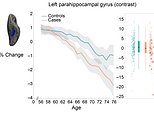
Brain’s gradually reduce in size as we age, with reductions beginning in the 30s and 40s. The above graph shows falls in size in the left parahippocampal gyrus, an area of the brain linked to smell. It reveals that it fell faster in people who tested positive for Covid (orange line) compared to those that did not get the disease (blue line)
The above graphs show changes in the size of the brain (left) and of the cerebellum — which is linked to movement — (right) between Covid patients (orange) and those who did not catch the virus (blue). It shows in both cases those who had Covid saw a faster decline while they aged
Scientists from the University of Oxford examined the brains of 785 participants aged 51-81 who had received MRI scans both before and during the pandemic. (Stock image)
Scientists said the reduction was more pronounced among older people and the 15 patients who were hospitalised with the disease.
But declines were still evident in patients who had mild to moderate Covid or were asymptomatic — did not experience any symptoms.
It was not clear why Covid patients saw a greater reduction in brain size, but scientists said the findings may explain why some virus survivors experience ‘long Covid’ symptoms such as brain fog that can persist for months after an infection.
Some scientists today described the results as ‘compelling’, but others suggested that it had uncovered only ‘very modest’ reductions in brain size.
The study — published in the journal Nature — is believed to be the first in the world to investigate large-scale changes in the brain after a Covid infection.
Human brains naturally shrink as people age, with the first reductions normally observed in the 30s and 40s.
But this study found people who caught Covid had a faster reduction in brain tissue than those that did not.
Professor Gewnaelle Douaud, a neuroscientist who led the study, said: ‘Despite the infection being mild in 96 per cent of our participants, we saw a greater loss of grey matter volume, and greater tissue damage in the infected participants.
‘All these negative effects were more marked at older ages.’
Reductions were observed in areas of the brain including the parahippocampal gyrus — which is linked to smell.
There was also an extra 0.7 per cent reduction in the cerebellum — which is at the back of the brain and helps to control muscle movements.
Scientists also compared the brain changes in pneumonia patients compared to those who had not had it.
They found some changes, but not as large as between Covid and non-Covid patients.
The study was based on participants in the UK Biobank, a database including the genetic and health information of half-a-million British nationals.
Reacting to the research Dr Rebecca Dewey, a neuroimaging expert at Nottingham University who was not involved in the study, said it was ‘compelling’.
‘If the findings were based on imaging data alone, I would say that we have much less reason to worry about this as the brain is so plastic that it is likely to compensate in the absence of any conditions preventing this.
‘However, I find the significant association between the imaging findings and the cognitive tests highly compelling.’
She added: ‘These sorts of changes are seen after many forms of disease onslaught, and even that of healthy ageing.
‘The key difference shown here is that they appear to be happening faster than with ageing alone.’
On the other hand, Professor Alan Carson, a neuropsychiatrist at Edinburgh University who was also not involved in the research, said the changes in brain size were ‘very modest’.
‘Such changes can be caused by a simple change in mental experience,’ he said.
‘I am very concerned by the alarming use of language in the report with terms such as “neurodegenerative”.’
He suggested the area of the brain linked to smell may have been reduced because of reduced signals from cells in the nose — which the virus infects.
Long Covid is defined as having lingering symptoms of the virus for more than a month after infection.
It is a poorly understood condition with sufferers normally reporting extreme tiredness, breathing difficulties, a loss of smell, and problems concentrating. But it has been linked to an array of other symptoms like joint pain, nausea, insomnia and depression.
An estimated 1.5million people in the UK — or 2.4 per cent of the population — are currently suffering from long Covid.
For those suffering the condition for more than 12 weeks, exhaustion was the most common condition, followed by shortness of breath, loss of smell and difficulty concentrating.
The latest research comes after scientists at the University of Edinburgh uncovered more than a dozen genetic quirks that may explain why some people are more vulnerable to severe Covid than others.
Up to 16 changes to DNA were found in patients critically ill with the virus, many of which are involved in blood clotting and inflammation.
One genetic variant was found to be slower at signalling to the immune system that cells were under attack from the virus.
Having just one of the genes could be the difference between getting a cough or being admitted to intensive care, according to the biggest study of its kind.
As part of the Government-funded research, experts at the University of Edinburgh studied the genes of more than 57,000 people across the UK, including 9,000 Covid patients.
The study, partly funded by the Department of Health, did not break down the risk of becoming severely ill per gene, or which Britons might be more at risk then others based on their heritage.
However, they said some genes were linked to a doubling of the risk of severe illness from Covid.
This is not the first time studies have found different genes could predispose certain people to becoming severely ill with Covid.
But the scientists hope the latest finding will help identify new drugs and treatments in the future.