

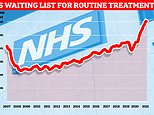
NHS waiting list hits ANOTHER record high: 6.1MILLION stuck in queues for routine ops
NHS waiting list hits ANOTHER record high: Now 6.1MILLION are stuck in queues for routine ops like hip and knee replacements… including 310,000 who’ve been on the books for over a year
Data shows 6.1million were waiting for routine treatment by the end of JanuaryThose waiting over 12 months rose to 311,528, an increase of of 2%year-on-year Nearly 24,000 were waiting more than 2 years, a 9-fold increase from April 2021
<!–
<!–
<!–<!–
<!–
(function (src, d, tag){
var s = d.createElement(tag), prev = d.getElementsByTagName(tag)[0];
s.src = src;
prev.parentNode.insertBefore(s, prev);
}(“https://www.dailymail.co.uk/static/gunther/1.17.0/async_bundle- -.js”, document, “script”));
<!–
DM.loadCSS(“https://www.dailymail.co.uk/static/gunther/gunther-2159/video_bundle- -.css”);
<!–
NHS waiting lists for routine operations have hit yet another record high of 6.1million in the first data released for 2022.
An additional 30,000 people were on the list for routine operations such as hip and knee replacements and cataract surgery compared to December.
The 6.1million figure is the largest since records began and 2million higher than when the pandemic hit in 2020 and effectively froze NHS elective treatments.
Ministers has come under increasing pressure to get a handle on the crisis with millions of Britons living in pain while waiting for their procedures.
The number of people waiting over a year to start treatment increased to 311,528 in January, up from 310,813 in December and 2 per cent higher than a year ago.
And almost 24,000 have been waiting at least two years for treatment, up from 20,065 in December, and over nine times the 2,608 who were waiting in April 2021.
It comes after the Government and NHS England vowed to eliminate all waits of more than a year by March 2025.
Record long waiting lists were joined by the lowest ever level of cancer referrals within two weeks and another poor month of A&E performance.
Data from NHS England shows one in nine people in the country were waiting for routine treatment — such as joint replacement and cataract surgery — or diagnostic tests as of the end of January
Responding to today’s waiting times data Labour’s Shadow Health and Social care Secretary said the situation patients faced was unacceptable.
‘Record numbers of patients are forced to wait unacceptable lengths of time, including 24,000 who have been waiting for treatment since before the pandemic began,’ he said.
Charity Versus Arthritis also slammed the data, saying it represented thousands of people living in agony while waiting in limbo for procedures.
‘Behind today’s waiting times statistics are people with arthritis living in agony and distress, slipping further away from a life free from pain, being able to work, and having some semblance of independence,’ the charity’s head of policy and public affairs Tracey Loftis said.
She added while some could afford to go private those being squeezed by rising cost of living pressures remained trapped.
‘Hip and knee replacements work brilliantly to give people with arthritis their quality of life back; they should not have to “choose” between the uncertainty of long waits or a huge financial hit to access them,’ she said.
Just this week Health Secretary Sajid Javid revealed patients waiting over two years for treatment will be offered offered appointments in places where queues aren’t as long or referred to private hospitals by the end of this month.
They with also have their transport and accommodation fees covered.
He also detailed how this offer will be extended to patients who have been waiting 18 months by the end of the year and eventually to all patients waiting for treatment.
Official NHS modelling estimates the backlog could peak at 10.7million in March 2024, with 200,000 people in England waiting more than a year by 2025.
NHS England itself defended it’s performance today saying it had delivered 280,000 more diagnostic tests and checks in January compared to the same month last year despite ongoing staffing pressures.
NHS national medical director, Professor Stephen Powis said staff were determined to address the Covid backlogs that had ‘inevitably built up’ during the pandemic.
But he added that it could not happen ‘overnight’.
Other NHS England data showed proportion of patients in England seeing a specialist within two weeks if their GP suspects they have cancer fell to its lowest level on record in January.
Some 202,816 urgent cancer referrals were made by GPs in England in January but only 75 per cent had their first consultant appointment within two weeks, the lowest percentage in records going back to October 2009.
The poor performance data comes with NHS England currently running a consolation on ditching the two week target for suspected cancer patients to see a specialist.
It will instead be replaced with a new ‘faster diagnostics standard’, where 75 per cent patients who have been urgently referred should be diagnosed in 28 days — or have the disease ruled out by March 2024.
Today’s data shows the NHS England, which already records this data, only managed to have 63.8 per cent of suspected cancer patients were diagnosed or had cancer ruled out within 28 days in January.
Data on this metric only goes back to April 2021 so there are no comparable figures for January 2021, but this is the lowest percentage so far.
A&E performance also hit a record low in February with only 73.3 per cent of patients seen within the four-hour target.
This is down from 74.3 per cent in January and 83.9 per cent in February last year, and equals the lowest percentage since records began in November 2010.
Queues for routine operations are expected to peak in 2024 at around 10.7million in the most pessimistic scenario, modelling from the NHS shows. It is because the health service expects many patients who missed operations to now come forward for care
Other estimates showed up to 200,000 people could still be on waiting lists for more than a year by 2025 under the most pessimistic scenario. This was despite Health Secretary Sajid Javid saying year-long waits would end by this date
The target, to get 95 per cent of patients admitted, treated or discharged within four hours has not been met since 2015.
Today’s data also showed 16,404 people had to wait more than 12 hours in A&E departments in England in February from a decision to admit to actually being admitted.
The figure is a slight improvement from 16,558 in January, which was the highest for any calendar month since records began in August 2010.
In total 114,910 people waited at least four hours from the decision to admit to admission in February, again a slight improvement from an all-time high of 122,427 in January.
It comes as experts have asked NHS England for proof that new A&E measures – set to replace the four-hour waiting times target – will improve patient care.
The Royal College of Emergency Medicine (RCEM), Nuffield Trust and King’s Fund have all expressed concern that data from pilot studies in 14 NHS trusts has not been made public.
A new target of average wait times for A&E patients is set to replace the four-hour target a change backed by several NHS groups.
Under the new measures, patients would be seen within 15 minutes of arriving at A&E for an initial assessment and hospitals would be monitored based on the average time people spend in the department.
As first reported by the Health Service Journal (HSJ), a spokesman for the RCEM said there was a need for public scrutiny of the pilot data.
‘We would like to see better transparency and proper scrutiny of all NHS data, particularly for the urgent and emergency care pathway,’ he said.
‘This would include any data around the [clinical review of standards]. Transparency and scrutiny of this data would allow for progress to be made on implementation.’
King’s Fund chief analyst Siva Anandaciva told the HSJ that publication of the data should happen before the new performance measures are implemented.
‘We need evidence from the pilot sites that we are improving outcomes – we’ve not got that yet.’
The NHS Confederation senior programme lead for acute care, Rory Deighton, said: ‘Having greater transparency on emergency performance is crucial, which is why we agree with RCEM’s call that the data from the pilot sites should be made available.
‘If NHS organisations do not have access to this information, it will be difficult to know whether the new standards will deliver the improvements envisaged.”
Nuffield Trust researcher Jessica Morris added: ‘There is a concern that they are replacing the four-hour target, which they have not been meeting for a long time. The question is why are they doing this now? Without more data it’s hard to know what the benefits are.’
The Department of Health has yet to sign off the changes to the performance targets following a consultation.
However, Mr Javid has said he believes the four-hour target is the ‘wrong target’, which leads to ‘perverse outcomes’.
An NHS spokesperson said performance data from pilot sites of the trial continues to be shared within the NHS and will continue until an agreement on future emergency care performance targets is reached.
In terms of ambulance performance the average time for people waiting for an ambulance for life threatening emergencies in February was eight minutes and 51 seconds.
This is up from eight minutes and 31 seconds in January but below record the nine minutes and 20 seconds recorded in October 2021, the longest average response time since current records began in August 2017.
Ambulance response times for less urgent emergency calls which cover incidents like burns, epilepsy and strokes rose to 42 minutes and seven seconds in February.
This is up from 38 minutes and four seconds in January.
The number of people admitted for routine treatment in England in January was 226,856 – up 63 per cent from a year earlier (139,378), although this reflects lower-than-usual figures for January 2021, due to Covid disruption.
In January 2020, the last data before before the pandemic hit, the figure was 303,466.
Another worrying statistic was the number people in England been waiting more than six weeks for a key diagnostic test in January.
Data shows 435,000 people were waiting for one of 15 standard tests – which include an MRI scan, non-obstetric ultrasound or gastroscopy.
The equivalent number waiting for more than six weeks in January 2021 was 377,651 while in January 2020 there were just 46,319.
The elective recovery plan sets the ambition that 95 per cent of patients needing a diagnostic test receive it within six weeks by March 2025.