

Shower of missiles brought death and destruction to Yavoriv where residents never saw it coming
Horror in town where mothers told children ‘war will never reach us’: Shower of missiles brought death and destruction to Yavoriv, just 12 miles from the Polish border, as residents say they never saw it coming
Yavoriv, in the far west of Ukraine, had largely escaped horrors seen elsewhereMothers, hoping for peace, had told children not to worry about the RussiansBut many of its 12,000 citizens sheltered refugees and observed 10pm curfew Then yesterday a shower of missiles brought death and destruction to the cityThe missiles rained down on the International Peacekeeping and Security CentreAs a result, a total of 35 people were killed and another 134 were injured
<!–
<!–
<!–<!–
<!–
(function (src, d, tag){
var s = d.createElement(tag), prev = d.getElementsByTagName(tag)[0];
s.src = src;
prev.parentNode.insertBefore(s, prev);
}(“https://www.dailymail.co.uk/static/gunther/1.17.0/async_bundle- -.js”, document, “script”));
<!–
DM.loadCSS(“https://www.dailymail.co.uk/static/gunther/gunther-2159/video_bundle- -.css”);
<!–
Until early yesterday morning, the people of Yavoriv in the far west of Ukraine considered themselves blessed.
Blessed that the fighting was hundreds of miles away, that living on the cusp of Western Europe, their peaceful existence would endure come what may.
Mothers told anxious children not to worry about the Russians.
‘I told mine that war would never reach us here,’ says Yana Volbyn, 29.
‘I said the fighting was so distant it might as well be in a foreign land.’
Still, this small, unremarkable town rolled up its sleeves and did its bit for the war effort nonetheless.
Just 12 miles from the Polish border, many of its 12,000 citizens sheltered refugees, some of its menfolk joined volunteer units and everyone observed the 10pm curfew, scrupulous about turning off lights lest they might aid Russia’s night bombers.
True, they shared their town with a military training base.
‘But that place was about peacekeeping, right?’ says Yaroslav Smuk, 21, shaking his head. Not to Vladimir Putin.
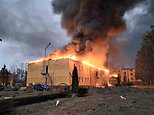
The barracks at the International Peace Keeping and Security Centre in Yavoriv burns after being hit by a Riussian missle strike in the early hours of Sunday morning – killing 35 people and injuring 134 more
A patient is assisted by medical staff as he arrives at Novoiavorivsk District Hospital on March 13, 2022 in Novoiavorivsk, Ukraine, following the missile attack
Dispatched as the town slept yesterday, a shower of missiles brought death and destruction, raining down on the International Peacekeeping and Security Centre, and sending flames shooting into the night sky.
So confident was one resident that Yavoriv was impervious to war, his first thought was that an earthquake had struck. Daybreak displayed the horrors in high relief.
Muffled cries leaked from collapsed buildings, one flattened as if by a giant boot.
Nearby a giant crater 30ft deep scarred the camp’s sports field. And then from the rubble came the bodies. At least 35 dead and 134 injured.
One witness said: ‘We heard an alarm and went to a bomb shelter, before returning when it seemed everything had stabilised.
Then, about 30-40 minutes later, sometime between 5am and 5.30am, we heard a sudden clap. Our positions were being bombed.
‘We got on the floor. I heard what sounded like rocket launches, and the sound of explosions on the ground. We are currently searching for people under the rubble. Maybe there is someone still alive.’
Father Michael Haniak, 32, who lives nearby recalls being shaken from slumber by a series of explosions. He peered out of his bedroom window just as the sky over acres of woods and pastures lit up ‘like the most terrible lightning’.
A succession of blasts rattled his windows – ‘How they are still intact, I do not know’ – and he instinctively sought cover behind his bed.
Later, he would console his flock at Sunday mass. The sentiments expressed were all the same: ‘We never saw this coming, Father. We assumed we were safe here.’
One woman outside his church, knelt down and laid a wreath of yellow flowers on a granite war memorial. The last time war claimed Yavoriv’s dead was in 1941.
Smoke rises amid damaged buildings following an attack on the Yavoriv military base, as Russia’s invasion of Ukraine continued
For a few hours after the missile strike, few in the town left their homes. Some residents frequently commute to Poland where they earn good money picking fruit.
Yaroslav recalls only the night before he had been looking forward to the strawberry season.
‘But then there was panic,’ he says. ‘People were asking each other whether there would be more bombs?’
Slowly yesterday, the town regained its nerve. Listless youths congregated on street corners as if in defiance. Above them a red billboard, which appeared the day after the invasion, issued Russian fighters with the now-hollow warning: ‘This is our land and you will be buried in it.’
All morning ambulances ferried the injured to hospital before returning time and again as the rubble yielded yet more bloodied survivors.
By lunchtime, when the sirens at last fell silent, Yavoriv became twitchy. Were Russian infiltrators stalking its streets? Reporters were eyed with suspicion.
Our press accreditation was scrutinised and photographed eight times in the space of an hour by police and volunteers.
At one of the several entrances to the Peacekeeping Centre, a soldier told us: ‘It is not safe around here. There is still a special operation going on.’
Across the road a middle-aged woman at a bus stop began suddenly wailing as if reacting to appalling news.
Refusing all entreaties, she was unable to speak and just wandered away, crying still.