

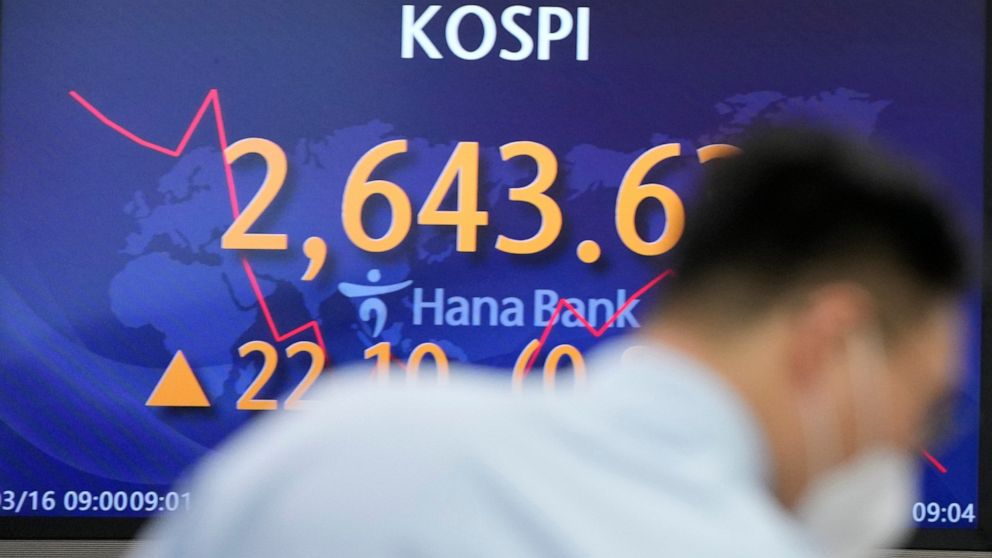
Hong Kong shares soar 9% on China pledge to support economy
U.S. stock indexes shed much of their gains in afternoon trading Wednesday afternoon after the Federal Reserve announced its first interest rate hike since 2018
NEW YORK — U.S. stock indexes shed much of their early gains Wednesday afternoon after the Federal Reserve announced its first interest rate hike since 2018.
As Wall Street largely anticipated, the central bank announced it was increasing its key short-term rate by 0.25 percentage points. The move marks a shift in policy by the Fed away from maintaining ultra-low interest rates as it seeks to tame persistently high inflation.
The S&P 500 fell less than 0.1% as of 2:31 p.m. Eastern. The benchmark index had been up about 2% in morning trading. The Dow Jones Industrial Average was down 141 points, or 0.4%, at 33,425, after having been up 531 points earlier in the day. The Nasdaq composite was up 0.5%, having shed about three-fourths of the gain it had shortly before the Fed’s statement.
Bond yields rose sharply after the Fed’s announcement. The yield on the 10-year Treasury rose to 2.24% from 2.15% late Tuesday, while the 2-year Treasury yield rose to 2% from 1.85% late Tuesday, a big move.
The Fed is trying to slow the economy enough to tamp down the high inflation sweeping the country, but not so much as to trigger a recession. It is part of a larger movement by central banks around the world to pull the plug on the support they poured into the global economy after the pandemic struck.
Inflation has hit its highest level in generations as the global economy recovers. Economists worry that could eventually curtail spending and hurt growth. The latest retail sales report from the Commerce Department shows that Americans slowed their spending in February on gadgets, home furnishings and other discretionary items as higher prices for food, gasoline, and shelter are eating up more of their wallet.
A list of concerns including inflation have made for volatile markets over the last few weeks. Stocks have been swaying sharply on a daily, sometimes hourly basis. That volatility will likely remain until investors get a better sense of where the economy is headed.
“The thing that is more controllable is increasing clarity around what the Fed’s path looks like for rates and the balance sheet,” said Scott Ladner, chief investment officer at Horizon Investments. “Probably one of most important things Chairman Powell can do is to provide a sense of stability and predictability around both those things.”
Oil prices have mostly surged since late February amid concerns that the conflict in Ukraine will squeeze energy markets. Benchmark U.S. crude fell 1.1%, a relatively subdued move considering the gigantic swings it has made recently. Prices are up nearly 30% for the year, and the recent surge has pushed gas prices in the U.S. to record highs. That has increased concerns that inflation could worsen.
Gains in banks and technology stocks helped lift the S&P 500 as investors shifted money into sectors that are considered riskier. Traditionally safe-play stocks, such as utilities and household goods makers, lagged the broader market.
Stocks overseas, meanwhile, notched solid gains. Chinese markets soared overnight after Beijing promised help for that country’s struggling real estate industry and its internet companies. Hong Kong’s benchmark Hang Seng surged 9.1%.
Stocks in Europe rose as Russia and Ukraine projected optimism for another round of scheduled talks Wednesday.
Elsewhere in the market, several stocks made some sharp moves on corporate news.
Starbucks rose 4.2% after President and CEO Kevin Johnson said he will retire next month. Former CEO and company founder Howard Schultz will replace him on an interim basis.
NortonLifeLock fell 14.7% after the security software maker said its buyout of Avast is undergoing additional review by U.K. regulators.