

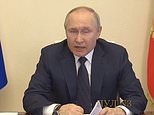
Putin says the West’s ‘attempt to have global dominance’ is coming to an end
Putin says the West’s ‘attempt to have global dominance’ is coming to an end and its ‘economic blitzkrieg’ of sanctions will only ‘strengthen Moscow’ in bombastic televised Kremlin address – as he insists the ‘military operation’ is going to plan
Vladimir Putin said West’s ‘attempt to have global dominance’ coming to end, that it’s trying to ‘cancel’ RussiaHe said that keeping Russia in check was a long-term policy of Western nations to prevent state being ‘strong’Russian president told citizens they are fighting for the country’s ‘sovereignty’ and ‘the future of our children’Latest in Moscow’s propaganda as it seeks to justify its Ukraine war, claiming it is a ‘de-nazification’ operation
<!–
<!–
<!–<!–
<!–
(function (src, d, tag){
var s = d.createElement(tag), prev = d.getElementsByTagName(tag)[0];
s.src = src;
prev.parentNode.insertBefore(s, prev);
}(“https://www.dailymail.co.uk/static/gunther/1.17.0/async_bundle- -.js”, document, “script”));
<!–
DM.loadCSS(“https://www.dailymail.co.uk/static/gunther/gunther-2159/video_bundle- -.css”);
<!–
Vladimir Putin said today that the West’s ‘attempt to have global dominance’ is coming to an end and its ‘economic blitzkrieg’ of sanctions will only ‘strengthen Moscow’ in bombastic televised Kremlin address.
The Russian President, speaking in a televised government meeting in Moscow, insisted the ‘military operation’ in Ukraine is going to plan despite his troops’ advance remaining largely stalled on the outskirts of Kyiv.
Putin claimed that the conflict was merely a pretext for the West to impose sanctions because ‘they just don’t want a strong and sovereign Russia’ and said that its economic measures were short-sighted as ‘most countries do not support sanctions’.
‘The West doesn’t even bother to hide the fact that its aim is to damage the entire Russian economy, every Russian,’ he said, adding that the West’s actions would ‘only strengthen’ Moscow.
But he also told Russians, in words ironically reminiscent of Ukrainian President Vlodymyr Zelensky’s speeches, that ‘we are fighting for our sovereignty and the future of our children’.
It is the latest in the propaganda pushed by Moscow in a bid to justify their invasion of Ukraine to Russian citizens – including claims the war is about ‘de-nazifying’ the country and preventing a genocide of minorities waged by Kyiv.
The speech comes as new allegations of war crimes were hurled at Putin on Wednesday after video emerged that purported to show at least 10 Ukrainian civilians gunned down while they were queueing for bread outside Chernihiv.
New drone footage appeared to show Russian soldiers executing a lone Ukrainian civilian as he held his hands up to surrender on a highway west of Kyiv last week.
Russian authorities have repeatedly insisted that their forces are only targeting strategic military locations and are not waging war on the civilian population of Ukraine but it comes after two residential apartment blocks in west Kyiv were hit in shelling overnight.
And Moscow’s men started pounding the southern Ukrainian city of Zaporizhzhia hours after around 20,000 refugees arrived through a humanitarian corridor from Mariupol.
Vladimir Putin said today that the West’s ‘attempt to have global dominance’ is coming to an end as he warned it is trying to ‘cancel Russia’ with an ‘economic blitzkreig’ of sanctions
If the West thought that Russia would step back, it did not understand Russia, Putin said on the 21st day of the war against Ukraine.
He claimed the the operation in Ukraine is unfolding ‘successfully, in strict accordance with pre-approved plans’ and warned the West is trying to stoke up civil conflict.
In his most explicit acknowledgment of the pain inflicted by Western sanctions, he said inflation and unemployment would rise, but promised support to families with children.
Structural changes to the economy would be needed, Putin said, as he accused the West of trying to ‘squeeze us, to put pressure on us, to turn us into a weak, dependent country.’
Meanwhile former senior officer in the Russian army laid out a battle plan on state TV which includes the Russian army invading the NATO Baltic states and parts of Sweden, a politically neutral country.
Speaking live on TV channel Rossiya 1, retired Russian military Colonel gestured to the map showing Gotland, Sweden’s largest island with a population of around 58,595, circled in red.
Pointing a the map, Colonel Igor Korotchenko, formerly of the Russian General Staff and air force and currently a reserve officer, said at the start of the invasion ‘a massive Russian radio-electronic strike is inflicted’ as ‘all Nato radars go blind and see nothing’, according to the Sun.
This was how the scenario for capturing the countries might look, he added.
‘At this time, on the Swedish island Gotland, Russian military planes land, delivering S-400 anti-aircraft missile systems, and Bastion coastal anti-ship systems,’ said Colonel Korotchenko.
In the video, a border area labelled the ‘Suwalki gap’ is shown – the gap between Belarus and Russia’s Kaliningrad exclave, a leftover territory annexed from Germany after the Second World War.
Colonel Korotchenko explained how Russia would push up from Kaliningrad towards the Suwalki corridor separating Poland and Lithuania, blocking NATO reinforcements from the West.
‘The astonished West and Nato will know that Russia declares a no-fly zone of 400km,’ added the enthused Colonel.
The entire Baltic Sea would then by open to Russian forces, he said on live TV.
The scenario ends with the new Baltic states governments pledging allegiance to Moscow while Sweden agrees to perpetual neutrality and a 99-year lease on Gotland. The program went out on Russian television as the end of last year but was posted by Ukrainian government advisor Anton Gerashchenko.
It came as reports emerged overnight that Russian forces in Mariupol had rounded up 400 people from houses neighbouring the city’s hospital number two, along with 100 doctors and patients who were already inside, and were refusing to let them leave in a bid to use civilians as human shields.
The number of people who have fled Ukraine since the start of the conflict topped three million this week, according to the UN whose human rights body said 691 civilians have been killed and 1,143 injured, thought it has acknowledged those numbers were likely an undercount.
Vladimir Putin was last night unanimously declared a war criminal in a vote late Tuesday night by the US Senate, which called for an investigation into the Russian president and his authoritarian regime amid the invasion of Ukraine.
There appeared to be movement in peace talks between Russia and Ukraine on Wednesday as Zelensky said that the negotiations with Russia were sounding ‘more realistic’, but the goodwill fell apart into the afternoon as questions of neutrality arose.
Colonel Igor Korotchenko, formerly of the Russian General Staff and air force and currently a reserve officer, outlined on TV channel Rossiya 1 how a Russain invasion of the Baltic states might look
Kyiv was rocked overnight by new explosions which wounded at least two people and damaged two residential buildings hours after the city was placed under curfew amid warnings to brace for a 36-hour bombardment at the hands of Russian forces
Aftermath of Russian shelling of a 12-storey residential building in Svyatoshyn district of Kyiv early on Wednesday, hours after the Ukrainian capital was placed under a 36-hour curfew
Moscow earlier Wednesday said that a neutral Ukraine along the lines of Sweden or Austria was being discussed at talks with Kyiv to end three weeks of fighting in Ukraine.
‘This is an option that is being discussed now and that can be considered as a compromise,’ Kremlin spokesman Dmitry Peskov told reporters.
His comments came after Foreign Minister Sergei Lavrov said neutrality was taking centre stage at the talks and that Moscow and Kyiv were ‘close to agreeing’ the wording of an agreement on neutrality.
But Kyiv rejected the proposal and instead called for legally binding guarantees that international forces signed by international partners, who would ‘not stand aside in the event of an attack on Ukraine, as they do today’, to ‘prevent attacks’ in the future.
‘Ukraine is now in a direct state of war with Russia. As a result, the model can only be ‘Ukrainian’ and only on legally verified security guarantees,’ its top negotiator Mikhailo Podolyak said in comments published by President Volodymyr Zelensky’s office.
Zelensky, speaking in his early morning address on Wednesday, had said that a deal could be struck with Vladimir Putin within one or two weeks because Moscow’s forces will run out of fresh troops and supplies by then.
The assessment echoes that of UK defence sources who say that Kyiv has Moscow ‘on the run’ and the Russian army could be just two weeks from ‘culmination point’ – after which ‘the strength of Ukraine’s resistance should become greater than Russia’s attacking force.’
Putin’s comments come after footage emerged of a man allegedly being executed on a road outside of Kyiv by Russian troops while attempting to surrender.
The slaughter of civilians, particularly those who do not pose a threat, is considered a war crime under international humanitarian law.
The video, obtained by German broadcaster ZDF and filmed on March 7, shows a silver car driving along the E40 European expressway west of Kyiv.
The car was heading towards Kyiv, but upon seeing a Russian tank and a group of soldiers parked by the side of the road, the driver made a rapid U-turn before braking and coming to a stop.
The man exited the car and immediately raised his hands above his head, turning to face the Russian soldiers in a clear show of surrender. But within seconds he was gunned down in cold blood.
Moments later, a gang of soldiers are seen grabbing the civilian’s lifeless body and dragging him away into the trees nearby.
The drone operator, a member of the Ukrainian territorial defence force in Kyiv, said a woman and child were also travelling in the car and were subsequently taken captive by the Russian forces.
The civilian’s execution took place mere yards from another car, which appears to have been abandoned on the road outside a petrol station on the E40 expressway west of Kyiv after sustaining damage.
The silver car was later towed away and burnt according to the Ukrainian drone operator, who gave his name only as ‘Zanoza’ and explained he was tasked with using the Mavic III drone to observe Russian tank positions.
The incident took place outside the petrol station located a mere 10 miles from the towns of Irpin and Bucha, both of which been decimated in recent days by brutal Russian bombing campaigns, resulting in many civilian deaths and mass evacuations.
Russian forces have started shelling the southern Ukrainian city of Zaporizhzhia where thousands of refugees (pictured) are sheltering after fleeing Mariupol – where 500 hostages are being held in a hospital as human shields
Zaporizhzhia is the first safe port of call for those fleeing Mariupol (pictured, a baby shelters in a circus building in Zaporizhzhia after fleeing Mariupol) but evacuees now face a new terror after Vladimir Putin’s troops launched rocket strikes on the city overnight on Tuesday, hitting a railway station
Three loud explosions were heard in western parts of Kyiv (pictured) just before dawn, partially destroying the top corner of one building, damaging and scorching the other as thick clouds of smoke billowed into the sky
Kyiv was rocked overnight by new explosions which wounded at least two people and damaged two residential buildings (pictured, a woman with a child evacuates from an apartment block which was hit by Russian shelling early Wednesday)
The Ukrainian capital remains firmly under the control of Ukraine’s military and territorial defence forces, and all Russian attempts to breach the city centre have been successfully repelled.
But Russia has in recent days begun a sustained bombing campaign of Kyiv, targeting civilian buildings as well as administrative centres to inflict considerable damage on the city’s infrastructure, as has been observed in other urban centres such as second city Kharkiv and southern port city Mariupol.
In Mariupol, there were harrowing scenes in the hospitals on Tuesday as premature children were abandoned by their parents who fled the city as medical centres continued to come under attack from Putin’s forces.
Kyrylenko said the main building of hospital two in the seaport has been heavily damaged by shelling, but medical staff are continuing to treat patients in makeshift wards set up in the basement.
He called on the world to respond to these ‘gross violations of the norms and customs of war, these egregious crimes against humanity.’
The Ukrainian army’s General Staff says Russian troops are trying to block off the city from the western and eastern outskirts of the city. ‘There are significant losses,’ it said in a Facebook post.
Russia has announced the establishment of safe corridors to allow civilians to leave Ukraine, but there have appeared to be few takers. Among those fleeing Mariupol on buses travelling to the Rostov region in Russia on Tuesday were mainly elderly people. It is unknown how many Ukrainians took this particular route instead.
Evacuation routes established by Moscow have led mostly to Russia and its ally Belarus, drawing withering criticism from Ukraine and the West. And Russia has continued to pound the cities with rockets even after the announcement of corridors.
A chief Ukrainian official said around 20,000 people have so far managed to flee Mariupol via the humanitarian corridor, and 570 of the 4,000 vehicles that left the city have reached Zaporizhzhia while others will spend the night in various towns along the way.
Mariupol has been besieged by Russian troops for more than 10 days, facing heavy shelling that has killed more than 2,300 people and left residents struggling for food, water, heat and medicine.
Kyiv was rocked overnight by new explosions which wounded at least two people and damaged two residential buildings hours after the city was placed under curfew amid warnings to brace for a 36-hour bombardment at the hands of Russian forces
Zaporizhzhia is the first safe port of call for those fleeing Mariupol (pictured, a baby shelters in a circus building in Zaporizhzhia after fleeing Mariupol) but evacuees now face a new terror after Vladimir Putin’s troops launched rocket strikes on the city overnight on Tuesday, hitting a railway station
In the city’s hospital number three, a heartbreaking picture showed tiny premature children who had been left behind by their parents who made the decision to flee the city, which aid agencies have warned faces a humanitarian disaster
In Mariupol’s hospital number two (pictured from above), also known as the intensive care hospital, Russian troops are using those inside as human shields, Kyryklenko said, adding: ‘It’s impossible to leave the hospital, they are shooting hard.’
Russia has in recent days begun a sustained bombing campaign of Kyiv, targeting civilian buildings as well as administrative centres to inflict considerable damage on the city’s infrastructure
Debris carpets the ground outside a ten-storey apartment block affected by a shelling that took place in the Podilskyi district, early in the morning on Tuesday, March 15, Kyiv, capital of Ukraine
Aftermath of shelling of a residential building by the Russian troops in Svyatoshyn district of Kyiv, capital of Ukraine
Ukraine REJECTS Russian peace talks proposal to become ‘neutral’ like Sweden – and demands guarantees that international forces will ‘prevent attacks’ in future
By Lauren Lewis and Chris Pleasance for MailOnline
Ukraine has today rejected a Russian plan to become ‘neutral’ like Sweden or Austria as the warring sides try to hash out a deal to end the bloodshed in eastern Europe.
Moscow is thought to be demanding that Ukraine refuse to join any military alliance or host foreign military bases on its soil in exchange for a ceasefire and withdrawal of Russian troops currently terrorising the country.
But Kyiv has said any deal will need to include security guarantees underwritten by ‘international partners’ who would agree to come to Ukraine’s defence in the event it is attacked again.
Mikhailo Podolyak, Ukraine’s top negotiator, said the international community cannot be allowed ‘to stand aside in the event of an attack on Ukraine, as they do today’ should fighting restart.
Russian Foreign Minister Sergei Lavrov today confirmed that neutrality is taking centre stage with Moscow and Kyiv ‘close to agreeing’ the wording of an agreement, as it was revealed a 15-point plan for peace is being discussed.
The plan includes ‘limits’ on Ukraine’s armed forces in return for Russia withdrawing from areas captured since the start of war on February 24, including along the Black Sea coast in the south, and Ukraine’s northern and eastern borders.
But it is unclear what would become of Crimea – which Russia insists must be recognised as part of its territory – and Donetsk and Luhansk – which the Kremlin says should be recognised as independent.
Putin insists that the whole of Donetsk and Luhansk – known as the Donbass – should split from Ukraine, and not just the parts occupied by pro-Moscow rebel forces before fighting broke out. It is unclear if Kyiv would agree to such terms.
Russian Foreign Minister Sergei Lavrov said on Wednesday that some parts of a possible peace deal with Ukraine were close to being agreed after Kyiv agreed to discuss neutrality
Ukraine (pictured, President Vlodymyr Zelensky) on Wednesday demanded guarantees that international forces will ‘prevent attacks’ in the future and rejected Russia’s proposal for Kyiv to become ‘neutral’ like Austria or Sweden
‘There is a small chance of a peaceful resolution,’ one high-ranking Russian official told Reuters today on condition of anonymity due to the sensitivity of the situation. ‘Something will be decided in the next three days to a week.’
Another senior Russian source said Putin is willing to consider a peaceful resolution on Russia’s terms and that there is a window of opportunity for some sort of deal.
But the officials spoke amid warnings from British and American intelligence that the Kremlin is also looking to move reinforcements to the frontlines in order to free up combat forces for fresh attacks.
It means that Putin, who went on state TV before the invasion to say that Ukraine has no right to exist as a country, could also be looking to press ahead with the war with the aim of uniting Ukraine and Russia under one banner.
News of a deal inching closer came a day after President Zelensky said his country must accept it will not become a member of NATO – a key Russian demand that was used to justify the Kremlin’s decision to attack.
The two sides have held several rounds of negotiations aimed at finding common ground and bringing the hostilities launched by Russian leader Vladimir Putin in late February to a halt.
The latest bout ended late Tuesday with Kyiv pointing to ‘fundamental contradictions’ in the delegations’ standpoints.
Both sides had earlier raised hopes of a breakthrough, referring to agreements that were close to being put to paper and signed.
Lavrov on Wednesday cautioned that the negotiations were not easy but that there was ‘some hope of reaching a compromise’.
Russia’s negotiator Medinsky echoed the line to reporters on Wednesday that talks were ‘slow and difficult’ but said the Kremlin wants peace, ‘as soon as possible’.
He reiterated that the core issue at the talks is a ‘neutral’ Ukraine, citing the status of Austria and Sweden as possible examples to follow.
It would mean Ukraine could retain its armed forces but that Kyiv would not be allowed to have any foreign bases, according to Kremlin spokesperson Dmitry Peskov.
‘A whole range of issues tied with the size of Ukraine’s army is being discussed’, Medinsky said, having earlier mentioned the sides are discussing an idea for a future Ukraine with a smaller, non-aligned military.
Sweden officially is militarily non-aligned in peacetime and neutral in times of war, having ended its policy of neutrality in 1992 at the end of the Cold War. It is not a member of NATO, but it has been a partner to the alliance for nearly 30 years.
At the end of the Cold War, Sweden slashed its military spending, but began reinvesting in its defence following Russia’s annexation of the Crimean peninsula in 2014.
Meanwhile, Medinsky said that other issues were being discussed, including the status of the Crimean peninsula, annexed by Russia in 2014, as well as territories held for years by pro-Moscow separatists.
Lavrov on Wednesday said the list of priorities included the security of people in eastern Ukraine, the demilitarisation of Ukraine and the rights of Russian-speaking people in Ukraine.
Ukrainian officials have also made cautious positive statements about the status of peace talks. Zelensky on Wednesday described the negotiations as ‘more realistic’ but warned that more time was needed for any deal to be in the interests of Ukraine.
Zelensky made the early morning statement after his team said a peace deal that will end Russia’s invasion of Ukraine will be struck with Vladimir Putin within one or two weeks because Russian forces will run out of fresh troops and supplies by then.
Moscow’s lead negotiator Vladimir Medinsky (left) said his delegation was pushing for Ukraine to assume a status comparable Sweden or Austria. But Ukraine’s chief negotiator Mikhailo Podolyak (right) has said he wants the country’s security to be guaranteed by international forces
The apparent breakthrough has come a day after Zelensky appeared to confirm that Ukraine will not join NATO.
Speaking on Tuesday, he said that ‘we have heard for years that the doors were open, but we also heard that we could not join. It’s a truth and it must be recognised.’
Ahead of the invasion, Putin had been demanding guarantees that Ukraine would never be admitted to NATO along with the removal of all the alliance’s troops and weapons from ex-Soviet countries.
After being rebuffed by Kyiv, Washington and NATO Putin said there was no option but to launch the military operation because Russian-speaking people in Ukraine had been subjected to genocide by ‘nationalists and neo-Nazis’ since Russia’s 2014 annexation of Crimea.
Russian negotiators have softened their stance a little since then, saying they want Ukraine to declare neutrality, disarm, recognise Crimea as part of Russia and recognise the whole of the Donbass as independent.
Ukraine has been demanding a ceasefire and the immediate withdrawal of all Russian forces.