

Bank of England set to raise interest rates TODAY amid inflation fears
Bank of England raises interest rates to 0.75% – the highest since Covid hit – inflicting more pain on struggling families despite fears it will not contain rampant inflation
Bank of England has announcing the latest decision on interest rates todayBase has been lifted to 0.75 per cent amid fears inflation spiralling out of controlConcerns that economy is already stalling as Ukraine standoff causes chaos
<!–
<!–
<!–<!–
<!–
(function (src, d, tag){
var s = d.createElement(tag), prev = d.getElementsByTagName(tag)[0];
s.src = src;
prev.parentNode.insertBefore(s, prev);
}(“https://www.dailymail.co.uk/static/gunther/1.17.0/async_bundle- -.js”, document, “script”));
<!–
DM.loadCSS(“https://www.dailymail.co.uk/static/gunther/gunther-2159/video_bundle- -.css”);
<!–
Families are facing more pain as the Bank of England raised interest rates again today despite fears it will not contain rampant inflation.
The Monetary Policy Committee has raised the base rate from 0.5 per cent to 0.75 per cent as it tries to deal with spiking inflation – which looks increasingly likely to sail past the Bank’s prediction of a 7.25 per cent peak.
The MPC voted by eight to one in favour of the increase, to the highest level since Covid hit. Just one member wanted to keep rates on hold.
Some believe inflation could even reach double-digits this Spring as the standoff with Russia sends fuel and energy costs rocketing.
However, while the Bank’s main remit is to control inflation, the global nature of the problems means the lever of interest rates might only have a marginal effect.
UK plc is already expected to suffer a severe slowdown with anxiety that it could even slip into recession amid soaring prices – the dreaded ‘stagflation’ scenario.
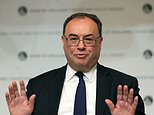
Bank of England governor Andrew Bailey faced a difficult balancing act in the latest interest rate decision today
Rates are at historically low levels but are widely expected to increase again today
Wages have been struggling to keep pace with soaring inflation over recent months
The Bank had already hiked rates twice in the past three months, with the latest quarter point rise in early February accompanied by warnings of more to come.
But Russia’s invasion of Ukraine has seen financial markets trim their expectations for rate rises this year, with central banks in the UK and worldwide predicted to tread more carefully.
Most economists expected a 0.25 per cent increase, with the case for action having been reinforced after official data on Tuesday showed a roaring UK jobs market.
But the MPC shied off voting for a larger rise as it faces the prospect of a slowing economy.
There are fears growth may come under pressure in the second quarter and beyond as the cost of living crisis and conflict in Ukraine weigh on confidence.
Susannah Streeter, senior investment and markets analyst, said: ‘The double whammy is that these super high prices affecting oil, metals and grains may be hard to bear for companies and consumers, leading to less spending and investment and could push the recovery into reverse.’
Bank governor Andrew Bailey has admitted there is little monetary policy can do to influence global commodity prices, but said on raising rates in February that cost pressures ‘would be even worse’ if it did not take action.
The EY Item Club believes the Bank will pause after rates reach 1 per cent this year.
Its chief economic adviser, Martin Beck, said: ‘The nature of the shock from soaring energy and commodity prices which has struck the UK economy following Russia’s invasion of Ukraine puts the MPC in a very difficult position.
‘As Governor Andrew Bailey has stressed, there is nothing UK monetary policy can do to increase the supply of gas and other commodities.
‘And changes in interest rates take 12-18 months to have their peak effect so hikes now may kick in at a point when base effects and falling energy prices mean inflation has fallen back sharply.’
There have been concerns that the Russia standoff could trigger a repeat of the Oil Shock in the 1970s, when inflation and interest rates spiked