

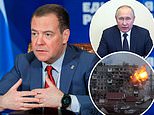
Russia says it will put the US ‘in their place’

Russia says it may need to ‘put the US in its place’ for stoking ‘disgusting’ Russophobia and trying to ‘bring Putin to his knees’ after Biden called him a war criminal

Former Russian President Dmitry Medvedev said Russia ‘has the might to put all of our brash enemies in their place’His comments come amid indications that Russia’s invasion has stalled in key areas President Joe Biden called Putin a war criminal on Wednesday President Vladimir Putin made chilling comments Wednesday where he said the West’s ‘attempt to have global dominance’ is coming to an end and went after ‘traitors’ inside Russia Medvedev, the former president and prime minister, now serves as deputy secretary of Russia’s National Security Council 

<!–

<!–

<!–<!–

<!–

(function (src, d, tag){
var s = d.createElement(tag), prev = d.getElementsByTagName(tag)[0];
s.src = src;
prev.parentNode.insertBefore(s, prev);
}(“https://www.dailymail.co.uk/static/gunther/1.17.0/async_bundle- -.js”, document, “script”));
<!–

DM.loadCSS(“https://www.dailymail.co.uk/static/gunther/gunther-2159/video_bundle- -.css”);

<!–

Former Russian President Dmitry Medvedev delivered the latest Kremlin threats against the U.S., accusing the U.S. of fueling anti-Russian feeling and saying Russia has the ability to put enemies ‘in their place.’

Medvedev, who now serves as deputy secretary of Russia‘s National Security Council, made the comment a day after President Joe Biden called Russian President Vladimir Putin a war criminal.

That assessment came on a day of new revelations of attacks on Ukrainians in Mariupol and other cities, as well as an AP report on children being buried in mass graves and residents unable to get food or medical attention.  

Medvedev warned that Moscow had the might to put the world’s pre-eminent superpower in its place, following U.S. and British assessments that the Ukrainian resistance has killed thousands of Russian troops, and indications that it has stalled Russia’s advance.   

Former Russian President Dmitry Medvedev said Russia will put ‘brash enemies in their place,’ and accused the U.S. of trying to bend Russia

Medvedev, who served as president from 2008 to 2012 and was once viewed as a potential reform element when he took over from Putin before the government revised its assessments, said the United States had stoked ‘disgusting’ Russophobia in an attempt to force Russia to its knees.

‘It will not work – Russia has the might to put all of our brash enemies in their place,’ Medvedev said.

Since Russia invaded Ukraine on Feb. 24, the United States and its European and Asian allies have slapped sanctions on Russian leaders, companies and businessmen, cutting off Russia from much of the world economy.

Medvedev at first tried to downplay the initial U.S. sanctions imposed immediately after the invasion, saying they showed ‘political impotence.’

The White House now says they are crippling Russia’s economy and have crashed the value of the Ruble. Russia’s stock market hasn’t opened since the invasion. 

President Vladimir Putin says that what he calls the special military operation in Ukraine was necessary because the United States was using Ukraine to threaten Russia and Russia had to defend against the ‘genocide’ of Russian-speaking people by Ukraine.

His comments came after President Vladimir Putin made chilling comments, where he said the West’s ‘attempt to have global dominance’ is coming to an end and went after ‘traitors’ inside Russia

U.S. officials continue to condemn Russian attacks on civilian targets. Here, an aftermath image of a theatre in the encircled Ukrainian port city of Mariupol where hundreds of civilians were sheltering on Wednesday March 16, 2022 after Russian forces dropped a powerful bomb on it, Ukraine’s foreign ministry said

An explosion is seen in an apartment building after Russian’s army tank fires in Mariupol, Ukraine, Friday, March 11, 2022

Medvedev’s comments come amid reports of Ukrainian success in targeting Russian armor

President Joe Biden called Putin a war criminal on Wednesday

Ukraine says it is fighting for its existence and that Putin’s claims of genocide are nonsense. The West says claims it wants to rip Russia apart are fiction.

Russia says that despite sanctions it can fare well without what it casts as a deceitful and decadent West led by the United States. It says its bid to forge ties with the West after the 1991 fall of the Soviet Union is now over and that it will develop ties with other powers such as China.

A U.S. diplomatic cable once called Medvedev ‘Robin to Putin’s Batman.’ A 2017 film by opposition leader Alexey Navalny alleged he had embezzled $1.2 billion. ‘Palaces, residences, and ancestral estates. Yachts and vineyards in Russia and abroad,’ Navalny said, calling Medvedev one of the country’s ‘most corrupted officials.’

Medvedev’s comments came after Putin made chilling comments about clearing out ‘traitors’ and ‘fifth columnists’ within Russia while warning oligarchs.

‘I do not judge those with villas in Miami or the French Riviera. Or who can’t get by without oysters or foie gras or so-called ‘gender freedoms.’ The problem is they mentally exist there, and not here, with our people, with Russia,’ Putin said. 

‘The West will try to bet on the so-called fifth column, on traitors… to divide our society.. to provoke civil confrontation… to strive to achieve its aim. And there is one aim – the destruction of Russia.’ 

He said Russians ‘spit them out like a midge that flew into their mouths.’

He said that the West’s ‘attempt to have global dominance’ is coming to end, that it’s trying to ‘cancel’ Russia. 

The five most-likely scenarios for what happens next in Ukraine – including peace deal, Putin military success and Russian elite revolt 

Russian forces in Ukraine continued to blast cities and kill civilians, but are no longer making progress on the ground, Western countries said on Thursday, as Moscow’s invasion Ukraine entered its fourth week.

With each passing day, it is beginning to look more likely that Vladimir Putin‘s war could drag on for months, while peace talks between Kyiv and Moscow stalling.

Meanwhile, the UN has said more than 3 million refugees have fled across Ukraine’s borders, not knowing when they will be able to see their homes again.

Despite the Kremlin insisting it is not targeting civilians, local officials said rescuers in the besieged southern port of Mariupol were combing the rubble of a theatre where women and children had been sheltering, bombed the previous day.

The Governor of the northern Chernihiv region said 53 civilians had been killed there in bombardment over the past 24 hours.

Meanwhile, Kyiv has resisted the Russian advance, but is also sustaining heavy bombardment in the outer-regions of the capital.

Here are five possible scenarios for the weeks and months ahead, according to Western government sources and think-tank experts.

1. Military quagmire: Russian forces get bogged down and Ukraine soldiers continue their fierce resistance

A view of burned tank is seen amid Russian-Ukrainian conflict in the city of Volnovakha, Donetsk Oblast, Ukraine on March 12, 2022

Ukrainian forces are still resisting Russia’s invasion, inflicting serious equipment and human losses.

Crucially they repelled an attempt by paratroopers to seize the capital in the opening days and have since withdrawn to defensive positions that have enabled them to keep control over all strategic cities.

Although Russia has long claimed it has air superiority, Ukraine’s air defences appear to be still working, while Western countries are pouring in portable anti-tank and anti-aircraft missiles.

‘The Russian invasion has largely stalled on all fronts,’ an update from the UK defence ministry said on Thursday.

US intelligence estimates that 7,000 Russian troops have died, The New York Times reported, while Ukraine’s military claims that figure to be much higher – although experts say that all such claims should be treated with caution.

US President Joe Biden announced a massive new package of military aid for Ukraine on Wednesday, including S-300 missile defence systems, 100 Switchblade ‘kamikaze’ drones and thousands more missiles.

Ukrainian military resistance comes at a high civilian cost, however, with thousands dead and towns devastated such as Mariupol and Kherson.

2) Peace deal: Ukraine and Russia reach an agreement with Putin withdrawing his forces when his demands are met

Pictured: The second round of talks between Russian and Ukrainian delegations at the Belovezhskaya Pushcha on the Belarus-Poland border on March 3

Negotiators from both sides began talking just days after the war started, first on the Belarus-Ukraine border, then in Turkey and latterly in the capital Kyiv.

Mounting battlefield losses and crippling Western sanctions on the Russian economy could be pushing Putin to seek a face-saving way to end the conflict.

‘Ukraine may be able to compel the Russians to make a choice: to persist and suffer irreparable losses, or desist and achieve some compensatory peace,’ wrote Rob Johnson, a warfare expert at the University of Oxford, this week.

Russian Foreign Minister Sergei Lavrov said Wednesday that the two sides were ‘close to agreeing’ a deal that would see Ukraine accept neutrality modelled on the status of Sweden and Austria.

Ukrainian President Volodymyr Zelensky has already publicly acknowledged that his country will not join the Western NATO military alliance – a key demand from the Kremlin.

But though the chances of a deal have grown significantly in recent days, there is no sign of a ceasefire and Ukraine wants a full Russian withdrawal and security guarantees about its future.

Some Putin critics suspect that the diplomacy is a smokescreen.

‘Reminder that to Putin ‘ceasefire’ just means ‘reload’,’ dissident politician and former chess champion Garry Kasparov wrote on Twitter.

3) Domestic Russian change: Anti-war movement grows in Russia and oligarchs turn on their leader

Police officers detain a man during a protest against Russia’s invasion of Ukraine, in Manezhnaya square in central Moscow on March 13, 2022

Putin is tightening his grip over Russian society.

A crackdown on independent media and foreign news providers has cemented the dominance of the ultra-loyal Russian state media.

Thousands of anti-war demonstrators have been arrested, while a new law threatens up to 15 years in jail for spreading ‘fake news’ about the army.

There are signs of cracks in the ruling elite, with some oligarchs, MPs, and even private oil group Lukoil calling openly for a ceasefire or an end to fighting.

A Russian editor held up a sign saying ‘No War’ during a prime-time news broadcast on state TV this week.

Though not seen as likely at this stage, the possibility of Putin being brought down in a popular backlash or even a palace coup cannot be ruled out.

‘His personal security is very good and it will be very good until the moment it isn’t,’ said Eliot A. Cohen from the Center for Strategic and International Studies, a Washington-based think-tank.

‘That’s happened numerous times in Soviet and Russian history.’ 

Huge sanctions have been placed on Russia and also its oligarchs – Russia’s elite who are also hugely influential, and close allies of Vladimir Putin.

However, it is often the case that an oligarch is powerful because Putin allows them to be, not the other way around.

4) Russian military success: Putin’s generals crush resistance with superior weapons and devastating artillery

Russian President Vladimir Putin attends a meeting with the head of the Russian Union of Industrialists and Entrepreneurs Alexander Shokhin in Moscow, Russia March 2

Given Russian troops’ superior weapons, air power and indiscriminate use of artillery, Western defence analysts say they are capable of grinding forward.

A senior European military official cautioned Wednesday against underestimating their ability to replenish and adapt their tactics.

They appear to have logistical and morale problems, with diesel and even engine lubricants in short supply, the official said.

‘But you need to keep it in perspective. All of that does not change the superiority of the Russian military,’ he said.

Moscow is openly recruiting mercenaries from Syria to supplement its forces, while also using the Wagner Group, a shadowy Russian private security company.

But even if they captured strategic cities such as Kyiv or the southern port of Odessa, Putin would then face the challenge of occupying them.

5) Conflict spreads: Russia attacks NATO country bringing the alliance into the war

Members of Pro-Russian separatists walk near a tank in front of a heavily damaged apartment in the pro-Russian separatists-controlled Donetsk, Ukraine on March 11, 2022

Ukraine has a border with four former Soviet states that are now members of the US-led NATO military alliance, which considers an attack on one member to be an attack against all.

Putin’s nostalgia for the Soviet Union and his pledge to protect Russian minorities – which are found in the Baltic States – has left an open question about his territorial ambitions.

Few expect Putin to openly attack a NATO member, which would run the risk of a nuclear attack, but analysts have warned about provocations that stop short of sparking a war.

Putin has ordered Russia’s nuclear deterrent forces onto high alert and Foreign Minister Lavrov has also warned that ‘World War Three can only be a nuclear war’.

Western analysts say such warnings should be taken as posturing to deter the United States and Europe from considering ideas such as a ‘no-fly zone’ over Ukraine.


Advertisement

Advertisement

Loading

Follow by Email
Pinterest
LinkedIn
Share