

UK’s daily Covid cases jump by another THIRD in a week
UK’s daily Covid cases jump by another THIRD in a week as hospital admissions breach 2,000 for first time since JANUARY – but Sajid Javid insists he is NOT concerned by inevitable rise because majority of ‘patients’ aren’t actually ill
Another 226,524 Covid cases were reported in the UK, including positive swabs from the last three daysDaily virus admissions exceeded 2,000 for the first time since January but majority in England are incidentalSajid Javid said the data provides ‘a lot of confidence that we are learning to live with Covid’And he said it was ‘possible’ there would be an autumn booster ‘probably for those that are 50 and over’The most vulnerable in society will be able to request their spring booster jab against Covid from todayA total of around five million people are expected to take up the offer including over-75s and the vulnerable
<!–
<!–
<!–<!–
<!–
(function (src, d, tag){
var s = d.createElement(tag), prev = d.getElementsByTagName(tag)[0];
s.src = src;
prev.parentNode.insertBefore(s, prev);
}(“https://www.dailymail.co.uk/static/gunther/1.17.0/async_bundle- -.js”, document, “script”));
<!–
DM.loadCSS(“https://www.dailymail.co.uk/static/gunther/gunther-2159/video_bundle- -.css”);
<!–
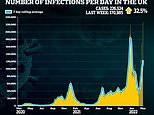
Covid cases in the UK have soared by a third in a week, as daily hospital admissions exceed 2,000 for the first time since January.
Another 226,524 cases were logged on the virus dashboard today, which includes positive swabs logged over the last three days. The figure is 33 per cent higher than that recorded last Monday.
And the number of daily admissions among people infected with the virus exceeded 2,000 for the first time in nine weeks.
On Tuesday, 2,054 infected people were hospitalised. For comparison, 2,608 hospitalisations were logged at the peak of the Omicron wave in December.
But just 44 per cent of those in hospitals in England were admitted because they were unwell with the virus, while the majority were primarily under NHS care for other illnesses.
Health Secretary Sajid Javid said the data provides ‘a lot of confidence that we are learning to live with Covid’, as nearly six in 10 so-called virus admissions just ‘happen to be Covid-positive’ while receiving treatment for something else, such as a hip or knee operation.
Meanwhile, 169 fatalities within 28 days of a positive test were logged, an increase of a quarter in a week.
And more than two-thirds of over-12s across the UK have now had a third dose.
It comes as millions of vulnerable Britons were today invited forward for a fourth or fifth dose as part of the spring booster campaign. Over-75s, care home residents and patients with weak immune systems are receiving another top-up dose to bolster their immunity levels.
Vaccine numbers are going up but a shocking 50 per cent of 35-39’s are still not boosted with their third dose of the vaccine
The UK’s Covid outbreak is rising on all fronts, with England detected 188,925 cases, while 29,678 were registered in Scotland, 2,566 in Wales and 5,355 in Northern Ireland.
The UK has stopped counting infections over the weekend, so the figures include all positive swabs logged with the UK Health Security Agency over the last three days.
It is the highest ever three-day figure since the recording change was brought in and is 32.5 per cent higher than the 170,985 UK-wide cases logged last Monday.
It comes after the UK’s biggest surveillance study — one of the most reliable ways of measuring the outbreak — suggested 2.6million, or one in 20 people, in England were infected on any given day in the week to 12 March.
And rates reached their highest ever level in Scotland, where one in 14 people were estimated to be carrying the virus, according to the Office for National Statistics.
Health Secretary Sajid Javid gave his strongest hint yet that fifth doses would be offered this autumn
The uptick coincides with surging cases of an even more transmissible version of Omicron, named BA.2. It quickly became the dominant strain.
Ministers in England, however, say the increases were to be ‘expected’ following the country’s ‘Freedom Day’ on February 24 — when the final Covid measures were dumped.
Meanwhile, 196 deaths within 28 days of a positive test were reported today, up 25.2 per cent week-on-week.
Some 2,054 infected people were admitted to hospitals across the UK on Tuesday, the highest figure since January 13.
And 14,948 people with Covid were in hospitals across the four nations on Friday, the largest number since February 3.
But data from England — which recorded 1,813 admissions on Saturday and 12,753 patients in hospitals today — shows just 44 per cent of those included in the tally are primarily in hospital because of the virus, while the remaining 56 per cent are mainly being treated for other conditions.
The Health Secretary today confirmed to Times Radio that the majority have not been admitted because of the disease.
Mr Javid said: ‘At the moment, in English hospitals we have around 11,500 people that are Covid-positive, but of those people the NHS estimates almost 60 per cent are not there because of Covid – they are there for something else.
‘That might be a hip operation or something, but they happen to be Covid-positive.
‘So those that are actually there for Covid is a much smaller number and so that does give us a lot of confidence that we are learning to live with Covid.
On rising infections, he added: ‘We are seeing an increase in the number of cases at the moment and indeed hospitalisations, that said the numbers are significantly below the Omicron peak.’
Most vulnerable in society will be able to request their booster from today, government says
Mr Javid also revealed today that fifth Covid jabs could be rolled out this autumn, in the strongest hint yet that the vaccination programme will be expanded again.
Grilled this morning about whether another booster campaign was in the works, Sajid Javid claimed it was ‘possible… probably for those that are 50 and over’. But he added a ‘final’ decision was yet to be made.
Five million over-75s, care home residents and patients with weak immune systems will begin receiving invitations for a spring Covid top-up from today, with 600,000 expected to be invited this week, in order to bolster immunity.
The move comes after the Joint Committee on Vaccination and Immunisation (JCVI) recommended the spring top-up as a precautionary measure.
It has now been six months since England’s rollout of third shots was launched. Scotland embarked on its top-up campaign more than a week ago.
Experts expressed concern that the current uptick in cases and hospitalisations could be an early sign of waning immunity from boosters, prompting calls for ‘more oomph’ in the programme.
Mr Javid claimed the spring roll-out will ‘top up their protection against this virus and allow them to go about their daily lives with more confidence’.
When the plans were first announced, officials claimed that it would mean some severely immunocompromised people who already had four jabs would get a fifth. The group can include blood cancer patients and transplant recipients.
It also raises the prospect that hundreds of thousands could even be offered a sixth dose this autumn, if a third round of boosters are approved.
Ministers have made no secret of plans for an annual Covid jabbing programme, which could cost in the region of £600million. It is expected that Covid vaccines could eventually be rolled out every year in a similar way to the flu jabs. These are already offered to over-50s for free every winter.
SAGE scientists have also backed the strategy, saying it will likely be part of the coronavirus’ gradual transition to becoming endemic.
But other scientists have claimed a never-ending cycle of boosters might not be needed, if the virus continues to become milder over time.
Britain’s Covid cases have been rising for the last two weeks, with the country now recording about 87,000 new infections a day, on average.
Asked about Britain’s rising Covid cases on BBC Breakfast, Mr Javid said: ‘Our level of concern hasn’t changed and that’s because although case numbers are rising, infections are rising and indeed hospital numbers are rising, they are still way below their peak.
‘And it’s also important for us when we review this, understand why they are rising and that is primarily due to the increased social mixing we’re seeing after the country’s opened up.
‘But also the BA.2 sub-variant of Omicron which we know is on the one hand more infectious but, on the other hand, we know that our vaccines work just as well against this sub-variant.
‘And so taking all that into account, of course we keep the data under review, but there’s no particular cause for concern at this point.’
As part of the strategy from next Friday England will no longer offer free lateral flow or PCR tests to most people.
In Scotland, the swabbing regime will end in May, while in Wales they will no longer be available at the end of July. Northern Ireland is yet to set a date.
Mr Javid urged people to take a ‘common sense’ approach following the end of testing.
He said: ‘If you’re not feeling well, if you’ve got the symptoms of Covid, then it’s not a good idea to mix with other people — the right idea is to try to spend some time trying to stay away from others.
‘(Tests) are still free, but from April 1, they won’t be in terms of a universal offer — from that point we will focus our tests on those that are most vulnerable or in vulnerable settings.
‘And I think that’s the right way forward, post-April 1 if people have Covid symptoms, then they should just behave sensibly — like you would expect someone to really behave if they had flu symptoms in the past — and that is to socialise a bit less, stay indoors and and wait till you feel better.’
Asked if people should still get tested, even if they have to pay for it, Mr Javid added: ‘I think that will be a decision for that individual. If you are someone who is vulnerable then the test will still be available for free.
He said some high street retailers were selling tests for ‘something like £2 each’, adding: ‘So people who want to have one — even if they’re not in a vulnerable group — that’s an option that’s still available for them.’
Mr Javid also urged Britons to start living with Covid like any other infectious disease during an interview on Good Morning Britain, saying: ‘When it comes to someone that may be having to take time off work or socialising less because they believe they might be positive, that is handled in the same way that all other infectious diseases are handled.’
Vulnerable people in England will begin receiving invitations for the spring Covid booster from today. People aged 75 and over and those who are immunosuppressed have been able to book from 7am.
Local NHS teams will be contacting care homes to arrange the jab for people who are eligible and have been invited.
The NHS said it will invite people to arrange a jab through the national booking service, which can be accessed online at nhs.uk/covidvaccine or by calling 119, when it is their turn.
Nikki Kanani, GP and deputy SRO for the NHS Covid Vaccination Programme, said: ‘Sadly, we are still seeing large numbers of people seriously unwell in hospital with Covid so it remains vital that those most at risk come forward when they are invited to do so.
‘The response so far from the public to the largest and most successful vaccination programme in NHS history has been incredible, with more than nine in 10 people aged 75 and over getting their initial booster.
‘The NHS Covid vaccination programme is once again ready to get people protected, so when you are invited please do come forward for your spring dose.’
Health chiefs are expecting high uptake of spring boosters among people aged 75 and over after 4.5 million of them had their top-up jab over autumn and winter.
The NHS said it has recruited additional call handlers for the 119 service to help people book their vaccine appointments, while hundreds of sites including community pharmacies, vaccination centres and hospital hubs will administering the booster.