

Baroness Howe dies aged 90: ‘Tory feminist’ loses ‘brave battle’ with cancer
Baroness Howe dies aged 90: Camilla leads tributes to her half-aunt who was married to Thatcher nemesis Sir Geoffrey after she loses ‘brave battle’ with cancer
Baroness Elspeth Howe of Idlicote died late on Tuesday at home in WarwickshireShe was the widow of Lord Geoffrey Howe of Aberavon, a deputy prime ministerLord Howe was both fundamental in making, and downfall, of Margaret ThatcherThe Duchess of Cornwall said it was ‘a sad time for all the family’ after the death
<!–
<!–
<!–<!–
<!–
(function (src, d, tag){
var s = d.createElement(tag), prev = d.getElementsByTagName(tag)[0];
s.src = src;
prev.parentNode.insertBefore(s, prev);
}(“https://www.dailymail.co.uk/static/gunther/1.17.0/async_bundle- -.js”, document, “script”));
<!–
DM.loadCSS(“https://www.dailymail.co.uk/static/gunther/gunther-2159/video_bundle- -.css”);
<!–
The Duchess of Cornwall has paid tribute to her half-aunt after she died aged 90 following a battle with cancer.
Camilla said it was ‘a sad time for all the family’ following the death of Baroness Elspeth Howe of Idlicote at her home in Warwickshire late on Tuesday.
The family also released a statement remembering a ‘remarkable lifetime’, adding ‘she will be missed intensely’.
Lady Howe was the widow of Lord Geoffrey Howe of Aberavon, a former deputy prime minister and chancellor, who helped bring down Margaret Thatcher.
She is well-documented to have clashed with Baroness Thatcher, with Tory grandee John Biffen once describing the two women as being like ‘wasps in a jam jar’.
A baroness once described as a ‘ Tory feminist’ who was married to one of the architects of Thatcherism whose speech sealed her downfall, has died aged 90. She is pictured with her husband in 2005
Lord Howe (pictured with his wife in 1983 as Chancellor) was both fundamental in the making of Margaret Thatcher but also credited as being key in her downfall
Camilla, Duchess of Cornwall (left) talks with Elspeth Howe (right) as she attends a Service of Thanksgiving for the life of Geoffrey Howe at St Margaret’s Church, Westminster Abbey on May 3, 2016
The Duchess of Cornwall said today it was ‘a sad time for all the family’. Lady Howe was Camilla’s half-aunt as the half sister of the duchess’ father Major Bruce Shand.
The Duchess is understood to have thought Lady Howe a remarkable woman who did so much for her country.
Lady Howe’s family said in a statement: ‘She will be missed intensely by her whole family and many friends.
‘We are immensely proud of her many achievements, especially her championing of the causes close to her heart which she supported so effectively during her remarkable lifetime.’
Former colleagues also paid tribute to her, with Elaine Mitchell, a PhD student at Birmingham University, saying: ‘Sad to hear news of Lady Howe.
‘Worked for her for short while at newly-established Equal Opportunities Commission. Strong, capable and good company.’
Broadcaster Alastair Stewart said: ‘So sad. Elspeth was a loyal wife to one of the quiet giants of the Thatcher era whose resignation speech was a key factor in her downfall.’
He added: ‘But Baroness Howe was also a clever, committed public servant in her own right.’
Lady Howe was once described as becoming ‘once, twice, three times a lady’ as she had become a Lady through her marriage to Lord Howe, then simply Sir Geoffrey (pictured in 2006)
Left: Lady Howe is pictured walking her dog in 1990. Right: Lady Howe is pictured in a portrait in 2009
Sir Geoffrey Howe and Lady Howe are pictured enjoying a drink while their dog Budget looks on outside The Dog & Duck near Outwood, Surrey, in 1983
Lady Howe was once described as becoming ‘once, twice, three times a lady’ as she had become a Lady through her marriage to Lord Howe, then simply Sir Geoffrey.
She retained her title when he was elevated to the Lords, and was then made a crossbench peer in her own right.
Lady Howe, who retired from politics in June 2020, entered the Lords as a life peer in 2001.
She was deputy chairman of the Equal Opportunities Commission from 1975 to 1979 and then chair of the Broadcasting Standards Commission.
When her position at the latter was announced, she took over from William Rees-Mogg, a former editor of The Times and the father of current Cabinet minister Jacob Rees-Mogg.
In a profile of Lady Howe in The Independent in 1993, she was dubbed a ‘Tory feminist’.
Antiques dealer and friend Alistair Sampson said: ‘She isn’t easily shockable but she does insist on standards.
‘She’s not a Mary Whitehouse figure. And she’s a feminist – but not a tiresome feminist.’
One of the baroness’s causes was to tackle homelessness, and in 1990 she took part in a sleepout where she spent the night on the street in a cardboard box.
The gesture was reported to have widened the rift between the Howes and Baroness Thatcher.
Lady Howe, known as ‘Heppy’ to her friends, was rumoured to have helped her husband write the resignation speech credited with destroying the former prime minister’s career in 1990.
It was later suggested that while she did not write it, she did inspire it.
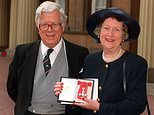
Lady Howe was the widow of the late Lord Geoffrey Howe of Aberavon (pictured together at Buckingham Palace when she was made a CBE in 1999), a former deputy prime minister and chancellor
Lady Howe is pictured with former PM David Cameron at her husband’s thanksgiving service at Westminster Abbey in London in 2015
Lord Howe (pictured with Baroness Thatcher in 1989) was credited in part with the Iron Lady’s downfall
In the book Margaret Thatcher: Power And Personality, Lady Howe was described as ‘forthright in her opinions, feminist in her sympathies, sharp-tongued in her humour, and fiercely supportive of her husband in his battles’.
Lady Howe married her husband in 1953 and the pair had three children: Caroline, known as Cary, and twins Amanda and Alec.
In her latter career, Lady Howe questioned the Government on the protection of children from issues such as internet pornography, gambling, and inappropriate content on the television and radio.
Her family said funeral details would follow in due course.
Baroness Howe and how she irritated Baroness Thatcher during her government
Margaret was renowned for being bad with cabinet wives.
She forgot their names, talked past them with bored dismissiveness and walked past them in reception lines with a yanking handshake that pulled women she did not want to converse with past her at high speed.
She gave the impression that none of her colleagues had such a thing as a ‘better half ‘.
She was more respectful towards the spouses of grandees, such as Celia Whitelaw or Iona Carrington.
But if there was one wife who irritated her more than any other it was Elspeth Howe.
For a start, Thatcher simply couldn’t stand her husband, Geoffrey.
She handbagged him constantly in front of others. ‘Just twaddle’ was her put-down to his face about his views on Europe.
If there was one wife who irritated her more than any other it was Elspeth Howe (pictured sleeping rough with her dog in Westminster in 1990). For a start, Thatcher simply couldn’t stand her husband, Geoffrey
There was something about him that never failed to drive her up the wall — it was as though proximity to his presence had the effect of itching powder on her skin.
She suspected he was disloyal and hated his ambition to succeed her, something she vowed would never happen.
‘He’s past it,’ she told a confidant. ‘He will never, never, never succeed me! It’s out of the question.’
But Lady Howe disagreed. She took very seriously the prospect of one day being in Downing Street, and was fiercely supportive of her husband in his battles.
She was a formidable character in her own right. Forthright in her opinions, feminist in her sympathies and sharp-tongued in her humour, she had an inner strength that grated against Margaret Thatcher’s ‘Iron Lady’ persona.
Lady Howe is pictured at the Colour for Kosovo auction, part of the Art 2000 exhibition, held at the Business Design Centre, London, in 2000
There were no overt clashes between the two of them, though their antagonism was clear. The Senior Tory John Biffen memorably likened them to ‘two wasps in a jam jar’.
Personally and politically, they were poles apart. But where Elspeth kept her opinion to herself, Margaret did not, scornfully deprecating the ‘feminist views’, ‘the progressive attitude’ and the ‘equal opportunities mindset’ of the Foreign Secretary’s wife.
Lady Howe had been a leading light in the Equal Opportunities Commission, a Labour-created quango which elicited much scorn from Mrs Thatcher.
She liked to say that her own career demonstrated that women did not need a government commission to help them achieve equal opportunity.
A third area of issue was the Howes had a reputation for being wonderful hosts at Chevening, the Foreign Secretary’s official grand country residence in Kent.
It was said to be much more fun than going to Chequers.
Margaret was jealous and suspicious. She believed they were using the house ‘to hold court’ and build up support for a future leadership bid against her.