

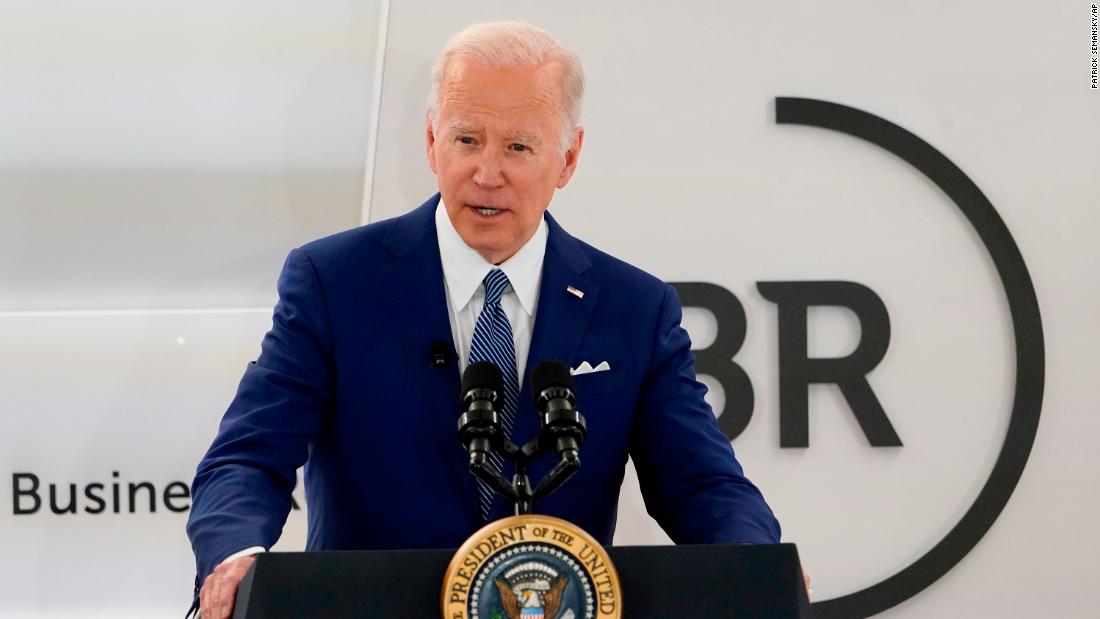
Brussels: Western leaders begin critical day of summits
Leaders, including US President Joe Biden, arrived to NATO headquarters Thursday morning intent on demonstrating unity amid Russia’s aggression. They posed for a brief family photo before entering a lengthy closed-door session, where talks were expected to focus partly on what to do if Russia deploys a chemical, biological or even nuclear weapon.
“We gather at a critical time for our security,” NATO Secretary General Jens Stoltenberg said as the meeting convened. “We are determined to continue to impose costs on Russia to bring about an end to this brutal war.”
“We are all doing more on land, at sea and in the air,” he went on. “This is necessary to respond to the new security reality in Europe.”
He said leaders would discuss ways to “strengthen our defenses now and for the years to come.”
Whether Putin views it that way — or whether cracks are exposed among the allies on sanctions and use of military force — remains to be seen.
It’s a critical moment for Biden, Europe and the world. Harsh coordinated sanctions already imposed by the West have not stopped Putin’s invasion, which is entering its second month. Biden warned as he was departing the White House for Brussels that chemical warfare posed a “real threat” in Ukraine. And massive refugee flows are quickly turning into a humanitarian crisis for Ukraine’s neighbors.
Leaders were expected to address all those issues Thursday, hoping above all to signal to the world their unity and collective commitment to stopping Russia’s aggression. They will hear from Zelensky, who will speak virtually and undoubtedly call for more help from the West in sustaining his nation’s fight against Russia.
Biden’s aides said ahead of the talks that he wanted to strike agreements on new military assistance to Ukraine, new steps to tighten the economic noose on Russia and new measures bolstering NATO’s force posture along the alliance’s eastern edge as part of his meetings.
“How we make sure that we are continuing to support Ukraine and its effort to defend itself will be a topic of conversation among the leaders,” national security adviser Jake Sullivan told reporters aboard Air Force One as Biden was flying to Brussels.
‘We must be intelligent” with sanctions against Russia, European allies warn
Still, Biden has made clear his options to stop bloodshed in Ukraine are limited. He has drawn the line at sending US troops into direct conflict with Russians and indicated that Ukrainian requests for a NATO-enforced no-fly zone are a nonstarter.
“We do not have exactly the same situation in Europe and in the United States,” Charles Michel, the European Council president, acknowledged in an interview with CNN’s Christiane Amanpour on Wednesday. “The oil or the gas sector, for instance. We are much more dependent in Europe in comparison with the situation in the United States.”
“It’s why we must be intelligent,” Michel said. “The goal is to target Russia; the goal is to be painful against Russia. The goal is not to be painful for ourselves.”
Still, leaders who began arriving in Brussels late Wednesday hoped to focus on what they are willing to do rather than what they have ruled out. Biden was expected to announce more American help in weaning Europe from its dependence on Russian natural gas as part of his meetings this week, US officials said.
Sullivan said Biden would reveal details of the assistance on Friday. He added that US and European officials have held an “intense back-and-forth” about reducing dependence on Russian energy in the lead-up to the emergency summits.
Other sanctions options for leaders include expanding the list of Russian banks barred from the SWIFT international banking system or adding more Russian individuals to the roster of those being punished. Biden planned to impose sanctions on hundreds of members of Russia’s Duma, the lower legislative chamber, according to US officials. Sullivan also said Biden would add to the names of oligarchs sanctioned by the US.
Biden also plans to unveil new steps plugging holes in sanctions already imposed, limiting the ability of targeted individuals to evade punishment.
More troops headed to eastern NATO countries
A day ahead of the extraordinary NATO summit, the alliance’s secretary general said he expected members to ramp up forces in countries closest to Russia.
“I expect leaders will agree to strengthen NATO’s posture in all domains, with major increases of forces in the eastern part of the alliance, on land, in the air and at sea. The first step is the deployment of four new NATO battle groups in Bulgaria, Hungary, Romania and Slovakia,” Jens Stoltenberg told reporters ahead of the summit.
Before Biden’s departure for Brussels, the Pentagon provided the White House with a series of options for potential additional US troops in Eastern Europe, according to a US official. The US already added troops in Poland and Romania as tensions between Russia and Ukraine escalated.
Sullivan said leaders on Thursday would ratify certain decisions on increasing NATO’s troop posture and would task their military and political officials with setting out a “longer-term game plan for what forces and capabilities are going to be required in those eastern flank countries.”
That plan will be agreed to at this summer’s NATO summit in Madrid, which had been previously announced. The new force posture will ensure that “we’ve got a long-term footprint that is matched to the new security reality that’s been created both by Russia’s full-scale invasion of Ukraine and by what’s happening in Belarus,” Sullivan said.
Officials said possibilities for changes include more forward-deployed US troops, either permanently or on a rotating basis, which could lead to more and potentially larger field exercises; a more structured rotational presence within the NATO force structure; or the construction of a new traditional US military base.