

Wall Street is off to another mixed start, oil prices fall
Stocks are off to a mixed start on Wall Street Friday, wrapping up a bumpy week with more uncertainty about where to go next
NEW YORK — Stocks are off to a mixed start on Wall Street Friday, wrapping up a bumpy week with more uncertainty about where to go next. Major indexes have been alternating between gains and losses all this week as markets try to suss out what’s next for inflation and the global economy as the repercussions of Russia’s invasion of Ukraine continue to play out. The U.S. and Europe announced a partnership Friday to reduce the continent’s reliance on Russian energy in hopes of further isolating Moscow for its aggression. Major U.S. stock indexes were split between gains and losses, Treasury yields rose and oil prices eased lower.
THIS IS A BREAKING NEWS UPDATE. AP’s earlier story follows below.
NEW YORK (AP) — Wall Street pointed toward some slight gains when markets open Friday after Western governments promised new sanctions on Russia, which threatened to make Europe pay for natural gas exports in rubles to prop up the crumbling currency.
Futures for the benchmark Dow Jones Industrial Average rose 0.3% while the same for the S&P 500 index gained 0.4%. Shares in Asia mostly finished down while European markets were up at midday.
Western leaders meeting Thursday in Brussels promised more sanctions that President Joe Biden said were meant to “increase the pain” on Russian President Vladimir Putin, but no details of possible new penalties were released.
Putin threatened to require European customers that rely on Russia gas supplies to pay in rubles. That would increase demand for the Russian currency, pushing up an exchange rate that has slumped under sanctions.
European leaders on Thursday rejected that possibility, potentially setting up a clash over energy supplies.
Putin’s demand is a “cunning gambit” to frustrate sanctions while “elevating uncertainty for the West,” said Tan Boon Heng of Mizuho Bank in a report.
London and Shanghai declined while Tokyo gained and Frankfurt was little-changed. Oil fell but stayed above $110 per barrel.
In midday trading, the FTSE 100 in London rose 0.3%, the DAX in Frankfurt climbed 1% and the CAC in Paris jumped 0.9%.
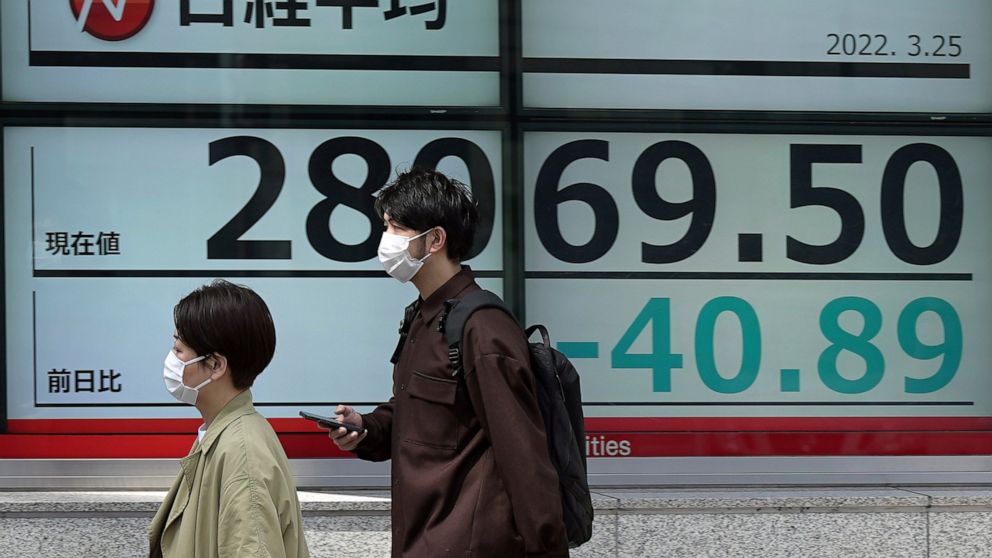
In Asia, the Shanghai Composite Index lost 1.2% to 3,212.24 while the Nikkei 225 in Tokyo gained 0.1% to 28,149.84. The Hang Seng in Hong Kong fell 2.5% to 21,404.88.
The Kospi in Seoul was little-changed at 2,729.98 while Sydney’s S&P-ASX 200 gained 0.3% to 7,406.20.
India’s Sensex lost 0.8% to 57,152.53. New Zealand, Singapore and Bangkok advanced while Jakarta declined.
Russia’s Feb. 24 invasion of Ukraine sparked investor unease about the impact on prices of oil, gas, wheat and other commodities. Russia is the second-biggest crude exporter and both Moscow and Ukraine are major wheat suppliers.
Markets already were on edge about plans by the Federal Reserve and other central banks to fight surging inflation by rolling back ultra-low interest rates and other stimulus that is pushing up stock prices.
Oil prices are up more than 50% in 2022 due to worries about inflation and possible supply disruptions.
Benchmark U.S. crude lost $2.12 to $110.22 per barrel in electronic trading on the New York Mercantile Exchange. The contract fell $2.59 on Thursday to $112.34. Brent crude, the price basis for international oils, sank $1.79 to $113.51 per barrel in London. It lost $2.57 the previous session to $119.03 a barrel.
The dollar declined to 121.67 yen from Thursday’s 122.26 yen. The euro gained to $1.1012 from $1.0997.